What makes this neglected war cemetery unique?
It is not clear who is responsible for the upkeep of these local history sites.
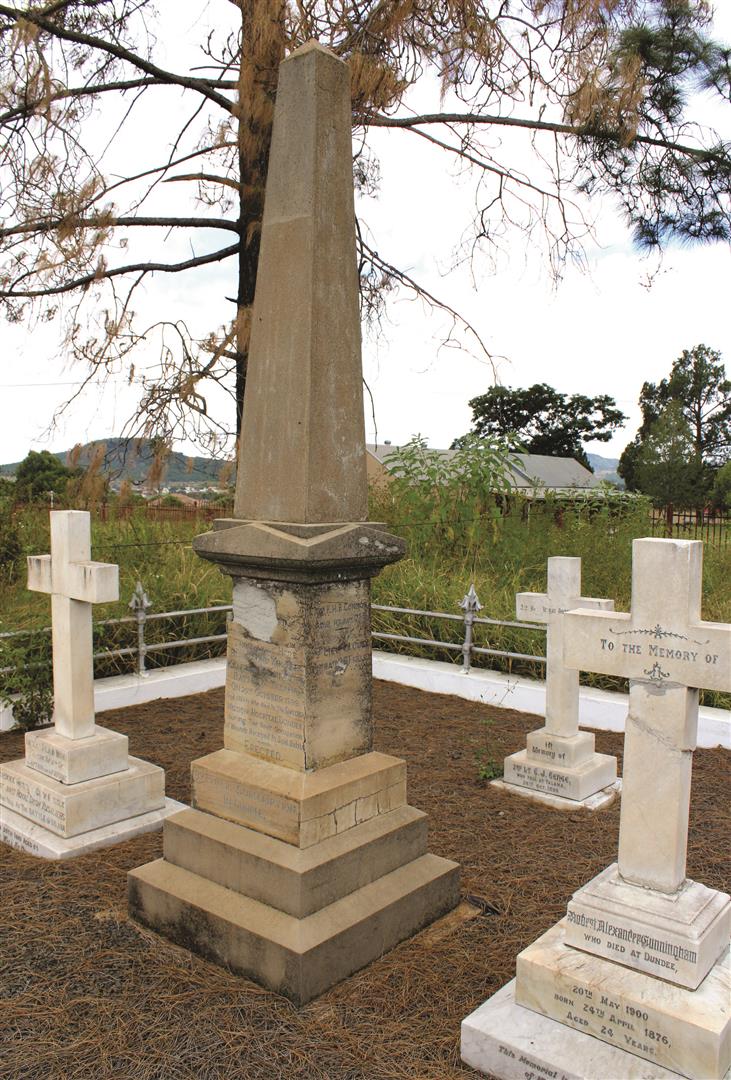
The small, forgotten military cemetery at the Wesleyan Church, which occupies an overgrown site on McKenzie Street, is unique in South Africa.
It is the only graveyard in the country where both British soldiers and Boers who died in the Anglo-Boer War are buried in the same plot, and the names of the dead are inscribed on the same memorial.
Attempts have been made to renovate the little graveyard through the Commonwealth War Graves Commission, but a shortage of funds means only a patchwork job can be done.
“The stonework is crumbling. This is sad. Few people visit the site even though it is a rather unique place, with four Boers and 15 ‘khaki’ soldiers lying side by side,” said local tour guide and historian, Johann Hamman.
Those wounded or who fell sick during and after the battle of Talana, on October 20, 1899, were treated at the Betania Mission Hospital (now Melusi Mission).
The Ebenzer Church and Mission complex was established by the Church of Sweden under Reverends Lars Norenius, Witt and Walberg between 1889 and 1890. In 1891, two acres of land and a small, simple house were bought at Dundee Coalfields.
The grass has not been cut for sometime around what historians have dubbed a unique cemetery.

A small chapel was built and consecrated, and Rev Norenius moved in the new parsonage with his family. In 1893, a schoolhouse and small house for an evangelist were built. Rev Norenius also started missionary work in Dundee proper.
As this mission work grew, it was decided to buy a plot of land to build a chapel, and later to move the mission into Dundee itself. Over time, more sections were added along with a school, a parsonage in 1897 and Ebenezer Church in 1898.
On January 12 that year, Betania Hospital and nurse’s home (Imbewana) were opened. The first matron of the hospital was Baroness Posse (1899-1901). She had previously taught at the mission school at Rorke’s Drift, and personally paid for the construction of the hospital and nurses home. Until 1903, the Baroness paid all the running expenses of the hospital and the salaries of the nurses.
The hospital literally had a baptism by fire, when on January 18, 1899, it had to deal with a number of European and Zulu casualties from a mine disaster – many were badly burned.
Then in October 1899, it was sheltering from the shells landing just in front of the buildings during the Battle of Talana. During the conflict, Rev Norenius offered the use of the hospital for wounded soldiers and the church was used as a hospital ward.
The sheer numbers of wounded coming in to the hospital necessitated many of the buildings being, and the church itself became another ward for the wounded. Members of the Dundee town guard came to offer their services, but could not carry weapons so the rifles of seven of the men were hid in the bell tower.

Today the site is once again a mission. The original hospital – with its 1930s additions and enlargement, the original ‘Imbewana’ and church are all still there. Many of the buildings which grew over the years still exist and others, like the school building, have been altered and reconstructed for modern use.
Elements of the original buildings were retained and can still be seen in the buildings today. It has since been declared a provincial heritage site.
Those buried in the cemetery include two British officers: Captain F. H. B. Connor (of the Royal Irish Fusiliers) and 2nd Lieutenant C. J. Genge (of the Royal Dublin Fusiliers). Also buried there is Trooper R. A. Cunningham (of Bethune’s Mounted Infantry), who died in May 1900 during the British advance through northern Natal.
The names on the ‘other side’ of the plinth reflect the Boer casualties and include the surnames Prinsloo, Meyer, Recemann (unclear inscription) and Breytenbach.
If you want to know more about the rich history of our area, visit the DundeeStory hall at the Talana Museum (after the lockdown is lifted) and indulge in a historical journey.
ALSO READ: Remembering the fallen by restoring grave legacy

HAVE YOUR SAY:
Like our Facebook page, follow us on Twitter and Instagram or email us at dundee.courier@caxton.co.za. Add us on WhatsApp 071 277 1394