
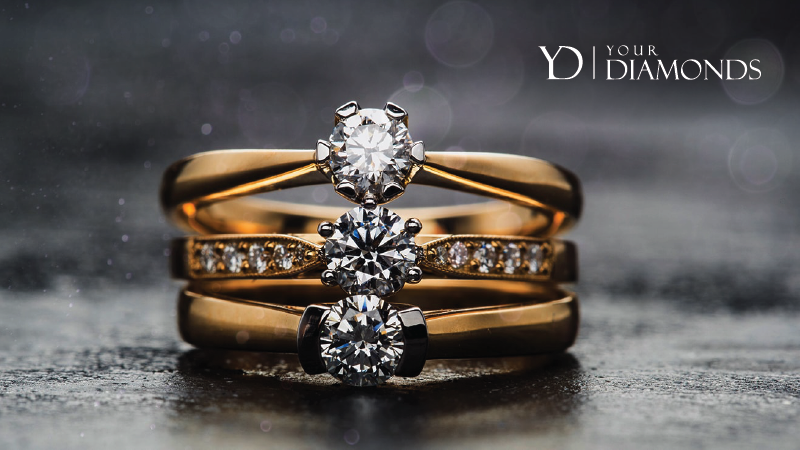
Learning about the differences between yellow gold, rose gold and white gold rings is a great way to narrow down your options when deciding which metal to choose for the jewellery that ultimately represents the love in your life. Here, we take a closer look at different types of gold with the goal of helping you to make a well-informed decision.
Yellow Gold

While we often think of yellow gold as being pure, the yellow gold used for rings is an alloy made by combining pure gold with metals such as zinc and copper. As with other gold colours, the higher the carat grade, the higher the actual gold content, but the less durable the piece of jewellery is. Therefore, 18ct or 9ct gold is used for wedding and engagement rings. This gives them a golden hue while helping them to stand up against the demands of everyday wear.
Yellow gold looks particularly beautiful when contrasted with darker or olive skin tones. It looks less impressive on rose or peach skin tones, meaning white or rose gold might be a better choice for someone with fair skin.
Some other considerations to keep in mind when comparing yellow gold with rose gold and white gold is that yellow gold, particularly high-carat yellow gold, can be easily scratched and dented. It needs to be cleaned and polished regularly.
Yellow gold ring settings look classical for all kinds of wedding and engagement rings, and make a lovely choice for vintage-inspired and modern styles. It is historically the most popular metal for wedding and engagement rings, and as it is the most malleable, or easiest for jewellers to manipulate, it is also a good choice for rings that may have to be altered or resized at a later date.
White Gold

The main difference between white gold and yellow gold is that white gold is an alloy of gold and a white metal such as palladium, manganese,silver or nickel. Like rose gold and yellow gold, white gold’s purity is defined in carats. When comparing white gold to yellow gold, white gold is stronger in the 18ct range because it contains less silver than its 9ct counterpart. Like all precious metals, white gold requires some maintenance. Cleaning and polishing is a must, and this metal needs to be rhodium plated every few years in order to retain lustre and colour. This service is not expensive.
On the downside, white gold that contains nickel can cause allergic reactions in some people with sensitive skin. If you have a nickel allergy and want to wear white gold, you will need to choose jewellery made with a nickel-free alloy.
White gold has a cool, sophisticated gleam. When you look at white gold vs rose gold and yellow gold, you’ll find that it looks nice with all skin tones, but is particularly complementary to fair and rosy skin tones and really beautiful on African skin.
Rose Gold

Next, let’s take a look at rose gold vs yellow gold and white gold. Rose gold is a gold and copper and silver alloy that is sometimes referred to as red gold or pink gold. As it was popular in Russia at the turn of the nineteenth century, it was once commonly referred to as Russian Gold, although the term is rarely heard these days.
Like yellow gold and white gold, rose gold is a very popular choice for jewellery. It is gaining popularity, particularly among people who want their engagement and wedding rings to have a unique, romantic look. Rose gold works particularly well in vintage-inspired engagement rings and wedding rings. It can be combined with white or yellow gold to create a unique multi-coloured setting that appeals to the wearer’s artistic side.
Durability is another consideration to keep in mind when comparing rose gold to yellow gold and white gold. Incredibly, this softly romantic coloured gold is the strongest of the three, as copper is very sturdy and the resulting alloy is tougher than yellow or white gold. On the downside, copper can cause allergic reactions in some individuals, and is not considered to be a hypo-allergenic metal. If you have very sensitive skin, yellow gold may be your best choice.
Rose gold is a wonderful choice for people with cooler and warm skin tones. The rose colour stands out beautifully against pale skin; however it might not look as lovely as yellow gold does against darker skin tones. If your skin tans easily in summer, rose gold might be a great choice.
Visit Your Diamonds’ website for great specials and promotions – https://www.yourdiamonds.co.za/