
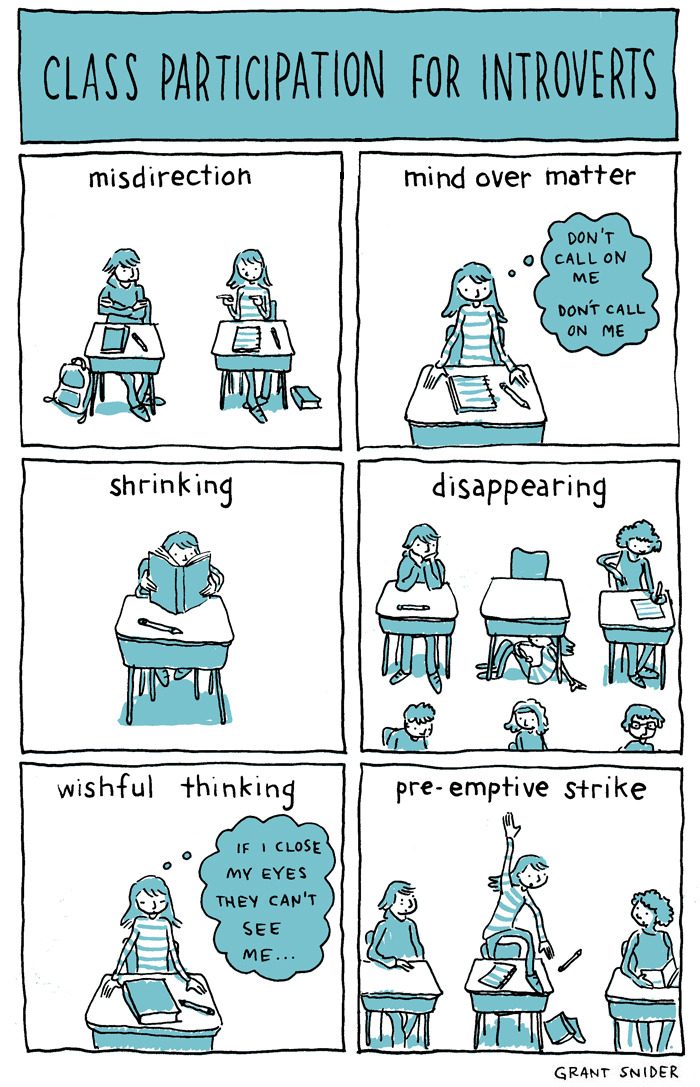
Sixteen-year-old me sitting on the far side of the classroom, with an empty desk between myself and a fellow student, being addressed about the requirements to be voted in for the school beauty pageant. She must have ‘personality’. These words have confused me to this very day.
I have heard of one having multiple personalities, whether psychologically diagnosed as such or simply ‘two-faced’, but never before have I come across someone devoid of personality – even the most uninteresting of people. The connotation in her words was obvious, someone with outward confidence, someone who loves the spotlight – the extrovert ideal.
This ideal personality type is praised everywhere, and the ‘birthplace’ is the breeding ground more commonly known as a school. When describing the perfect student, teachers account ‘class participation’ as one of the most important aspects. There appears to be a linear association between the loudness of one’s voice and the quality of ideas, which leaves introverts at a bit of a disadvantage. This association stems from a deeply ingrained myth that needs to be demystified.
Extensive research has been done on the subject and it appears that there is actually a direct link between creativity and introversion.
And that the greatest ideas have stemmed from solitude. Why then do children have to face the bluntness of a report card that reads “hard working, but if only she would participate more in class.”
Perhaps the biggest myth of all is one that mistakes an introverted personality for someone who is socially disadvantaged or inadequate when in reality the only distinguishing quality between introverted and extroverted students is the level of external stimulation they can take before feeling overwhelmed.
If we look at the setup of most modern classrooms we find desks arranged in groups and an increasing requirement for students to partake in group discussions and assignments. This setup is the perfect model for perpetuating the extrovert ideal, as well as the lack of accommodation for introverts in the classroom.
This dire situation calls for someone to speak up, a somewhat challenging solution for those directly affected. There have been various solutions proposed but those that stand out include introducing ‘quiet time’ (this mainly applies to younger grades) to allow introverted children to recharge with alone time to prevent them from becoming overwhelmed from external stimuli. Other practical solutions include making the classroom setup more flexible by including both areas for group discussions as well as quiet corners for solo work.
One major change that needs to take place is the attitude of teachers and parents towards the socialising tendencies of introverted children. If a child is happy sitting alone during lunch breaks they shouldn’t be forced to socialise on the playground. Teachers and parents should not be standardising a ‘normal’ social behaviour, they should instead be nurturing their child’s personality so that they may bloom into the people they were born to be.
The issue of ‘introversion exclusion’ in school environments is one that needs to be addressed urgently. Introverts make up a third of the global population, that means a third of the population are essentially not being equipped to reach their full potential. Think of all the young Einstein’s and Van Gogh’s not succeeding because of the oppression of the system. The world needs to quieten down and listen, listen to the soft-spoken geniuses who sit in the back of the classroom never raising their hand. And to all you introverts out there, keep them guessing as to what your voice actually sounds like, as Mahatma Gandhi said, “In a gentle way, you can shake the world”.