
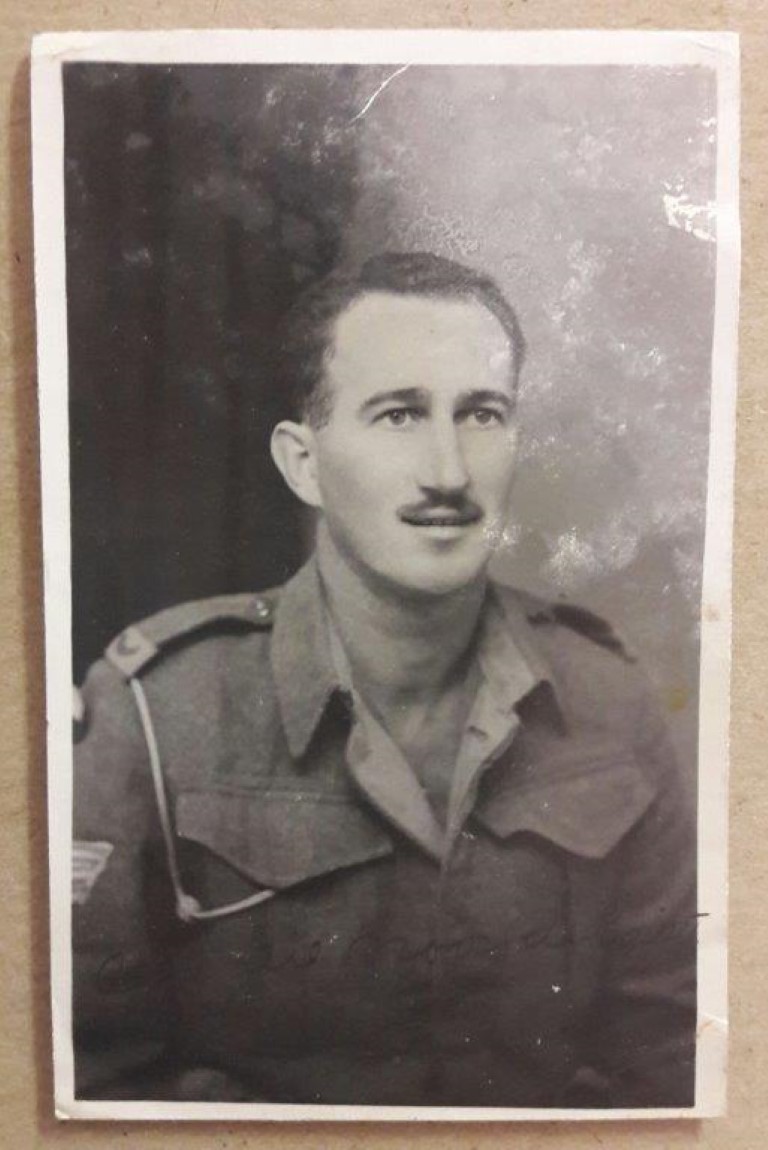
Reseached and submitted by André van Ellinckhuyzen
On an Internet group named ‘WW2talk’, a man wrote about his grandfather, who was one of many prisoners of war marched by the Germans in a column from Fallingbostel to Lübeck, and how they were mistaken for a German troop movement and attacked from the sky by a squadron of aircraft.
He wrote that his grandfather jumped into a ditch for cover, and hid there until the column had again moved on.
He and others then made a run for it, and after a couple of days met up with the advancing Allied forces.
He went on to describe how the men in the column of POWs had observed terrible things, especially when the column marched close by the Bergen-Belsen concentration camp earlier on during that march, and the story of Dixie Deans who had, after the attack on the POW column, cycled to the British lines with a German guard in tow, to warn them of the presence of the POW columns, and who cycled back to the POW column again followed by the same German guard.
The Allies wanted to arrest or shoot the Germans, but Dixie had bluntly refused.
Bergen-Belsen was a Nazi concentration camp near the town of Bergen in Northern Germany.
When British forces liberated the camp in April 1945, they found thousands of unburied bodies around the camp, and some 60 000 starving and mortally ill ‘skeletons’.
It is in this same ‘death camp’ where, in February 1945, Anne Frank and her sister Margot Betti Frank died of typhus.
Jacobus Stephanus Johannes ‘Fanie’ Breytenbach was born in Louwsburg on December 22, 1910.
His father was Jan Andries Breytenbach, born in Newcastle in 1868 and who farmed on Vaalhoek and Goedehoop in the Louwsburg district.
His mother was Jacoba Maria Susanna ‘Koba’ van Reenen (ex Breytenbach, neé Vermaak), born in Winterberg in the Cape.
A descendant of the Louwsburg Breytenbachs, Jan Andries, who resides in Randburg remembered his grandfather and grandmother were both buried on the farm at Louwsburg.
Jan’s Andries’ parents both died in a boating accident on the Mozambique coast on June 26, 1964 and he had them both buried at Melmoth, where he was a school teacher at that time.
Fanie Breytenbach never married, and was a motor mechanic in Vryheid before the war broke out.
He was killed on April 19, 1945, during the infamous marching column of POWs to from Fallingbostel to Lübeck, where they would have been a potential ‘bargaining chip’ with the Allies at the end of the war.
A patrol of Royal Air Force Typhoons mistook the column for German troops and attacked with rockets and cannon fire.
Close to 60 men were wounded and 30 were killed, as well as a few German guards.
The Typhoons came back over for a second run, but brave POWs ran in the open field, waving their arms to stop a second attack, which the pilots did when realising their terrible mistake.
The men reported as killed in action on that fatal day, with the exception of one who could not be identified, were: L/Sergeant Leonard Herbert John Goodfellow, W/O Kenneth Mortimer, W/O Eric Bardsley, Sgt JSJ Breytenbach, L/Cpl William Downie, L/Cpl George Moir, W/O John Gage, Pvt Rex Woodgate, Cpl Allen G. Hunt, F/Sgt William Ellemor Llawton, F/Sgt John Arthur Gibbs, F/Sgt Sydney John Wheadon, W/O John Gow Shierlaw, W/O Frank Baker Duffield, W/O Ellwood MacKenzie, W/O William Phillip Jeffrey Watson, W/O Charles Walter Heathman, W/O Robert Gordon Douglas, L/Cpl C. A. Joyce, Sgt V. A. Fox, W/O Lawrence Beresford Hamilton Hope, W/O Gordon Cyril George Todd Hawkins, F/Sgt Dandy Bauldie, W/O Douglas Jobson Clayden, W/O George Albert Losh, W/O William Andrew Irving Bone, W/O Arthur Haydn Porter, W/O Hugh Percival Lowman and Cpl Peter M. Paton.
In the Vryheid Cemetery is an empty grave for Fanie Breytenbach, while his body lies buried in the Berlin 1939-1945 Commonwealth War Graves Commission Cemetery.
Wir dürfen niemals vergessen.


ALSO READ: The Lord gives and He takes away; RIP Brigadier Andreas Roelof van Ellinckhuyzen
Make sure you follow us on our social media platforms for regular updates