
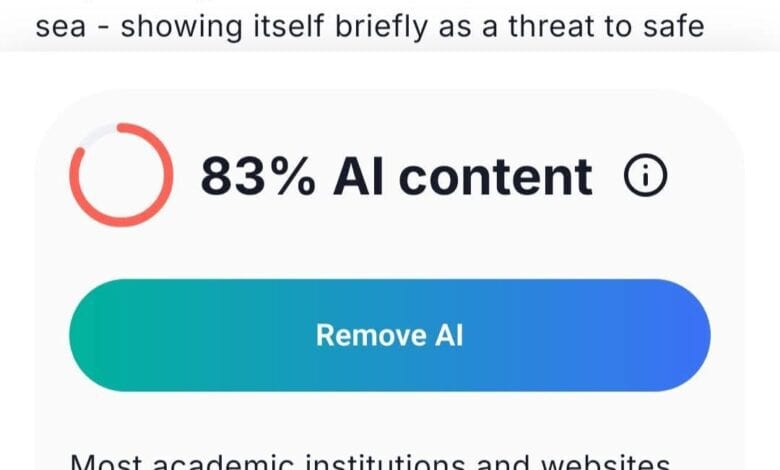
GptZero and other so-called AI checkers are usually incompetent. I wrote a post today, avoiding the temptation to bounce ideas off AI.
I didn’t ask AI to proofread, either. Often that’s a quick way to get the job done.
When I ran the text through GptZero – as a deliberate test of its skill – and it reported an 83% hit rate: I am an AI criminal.
Nonsense. Not a word of AI. Three conclusions.
- Don’t waste time asking for checks.
- My writing style is too conventional: it resembles AI (actually AI writing copies us)
- The machines are very far from thinking independently.
These tools also suffer from a deep flaw: they cannot prove origin. They do not know where text came from. They merely estimate resemblance to text that is statistically associated with large language models. That is a radically weak claim.
It has already caused serious problems in education and publishing. Students, journalists and academics have been falsely accused on the basis of software that often produces wildly inconsistent results from one paragraph to the next. Even the companies behind some of these systems admit they are unreliable as evidence.
Originality – especially metaphorical originality, moral intuition, lived historical feeling, and the strange emergence of unexpected associations – still comes overwhelmingly from human consciousness and experience.
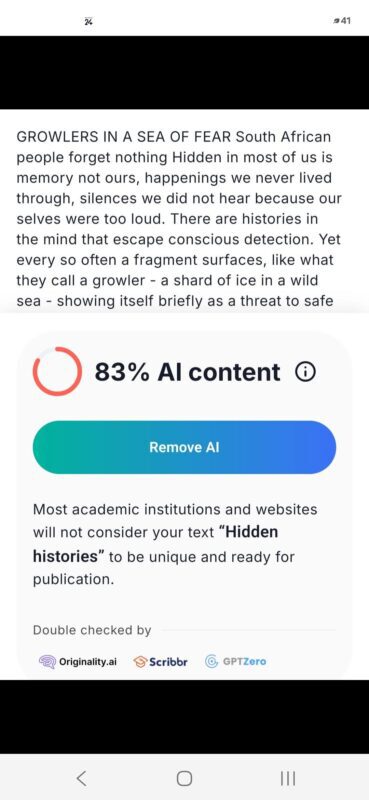
AI detectors confuse polish with plagiarism.
AI is sometimes a useful tool for a writer wanting a scan of the topic or needing standardised House Style. One can also bounce ideas off an AI assistant to see what others may have said about the same.
But originality isn’t its game.