The Potchefstroom Concentration Camp was the largest in the Transvaal (area north of the Vaal River).
By August 1901 there were 3651 people in the camp and between 3500 and 3650 people in town. Not all the women and children were accommodated in the camp itself, but some were lodged in empty houses in town.
Camp life
The fundamental reason for the hard life in camp was the unsympathetic way in which people were gathered and brought to the camps. Sometimes, without prior warning, everyone, young and old, the healthy and the ill, those who were pro- British and those who were anti-British, were taken from their homes. They had to watch the destruction of their farms, possessions and livestock. Initially, families were allowed to load a few pieces of furniture and precious objects on the wagons to take with them to the camp.
Later, when the Scorched Earth Policy was implemented, houses have literally been burnt down with all its contents. Those who were displaced and uprooted reached the camps with only the clothes they were wearing. In the case of Potchefstroom, people reached the camp battered, dirty, bewildered and showing all the signs of immense hardship.
Right from the start conditions in the camp left much to be desired. Due to a shortage of tents shacks of reeds were erected with buck sails for roofs. Sometimes new arrivals were left without shelter for a day or two even in the midst of winter.
In the camp there was a never-ending shortage of warm clothes, shoes and linen. Initially, the situation was slightly alleviated by organisations all over the world collect-ing food, money and other necessities. This aid, however, quickly decreased. Later on a tannery was erected in the camp to manufacture “velskoene” (home-made leather shoes).
Conditions in the camp were aggravated by various factors. Although people were granted a fair degree of freedom of movement, a single battered tent often had to house a family of up to nine people. A curfew was imposed prohibiting all lights and fires after sundown. This made camp life dull, boring and miserable.
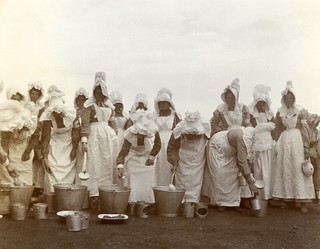
For some of the residents boredom was alleviated because they were allowed to perform small duties for which they also received a small remuneration. Boys could help to keep the camp clean and look after the tents. Some women scrubbed floors and did the washing in exchange for food. Chopping and fetching firewood were regular tasks. Older boys and men were used for these tasks, which they performed under the watchful eyes of soldiers. In October and again in December 1901, some of these groups were surprised by the Boer commando.
For the younger boys, playing marbles and flying kites provided a pastime. When the camp was moved, they swam in the Mooi River. From time to time a church picnic was organized for the children. Church services were regularly conducted on Sunday afternoons by Rev. Andrew Murray of the Reformed Church in Ventersdorp. The services took place either in the camp or in one of the church buildings. Women from town taught catechism.
Food provision
Insufficient food provision was a serious problem in the concentration camp. Right from the start there were two scales of allowance, the so-called A-scale for refugees who subjected themselves to British authority and the B-scale, or half scale, for the “undesirables”.
The B-scale provided 250g tinned meat, 250g maize flour, rice or pounded corn, 25g coffee, 50g sugar, 25g salt, and a twelfth of a tin of condensed milk per person per day. Even this allowance wasn’t always avail-able.
The family’s weekly food supply, with a ration of firewood, had to be fetched from the commissariat’s warehouse. Each family had to prepare its own food on fire in the open air. There was always a supply of “kakieklinkers”, or hard rusks, available.
Due to the efforts of Swart (the superintendant of the camp), a vegetable garden was planted. This was situated next to the water furrow at the far northern side of town. The disruption for the railway line to Johannesburg by Boer commandos in the vicinity often placed severe pressure on the food supplies in the camp. A camp mother described the food as “too little to live on but too much to die from.”
* Research by Prof Gert van den Berg on the history of the concentration camp in Potchefstroom was published in 1999 in commemoration of the Anglo-Boer War (1899-1902). This brochure – “The Potchefstroom concentration camp” – uncovers the facts on the biggest concentration camp in the Transvaal (area north of the Vaal River). Prof. Van den Berg was a lecturer at the Department of History at the North-West University until 1992, when he retired. He was particularly interested in the history of the Anglo-Boer War in the former Western Transvaal.