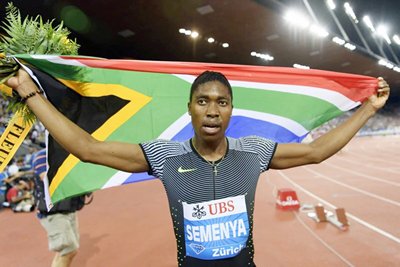
Following Caster Mokgadi Semenya’s loss on her appeal at the Switzerland’s Federal Supreme Court against the restriction of testosterone levels in female runners, the Commission for Gender Equality (CGE) and the South African Human Rights Commission (SAHRC) have joined hands in pursuing injustice meted against Caster Semenya.
CGE has said that the matter for these two Chapter Nine Institutions is more than an individual fight for Semenya but one that affects Black women in developing countries.
“It is about restoring her human dignity and rights to participate and have income from sport, as well as rights of other athletes, who have also been discriminated and prejudiced by the new International Association of Athletics Federations (IAAF) discriminatory regulations that came to effect in 2019.”
The CGE and SAHRC are still opposed to the IAAF’s modification of its regulation to require female athletes to maintain testosterone levels below 5 nanomoles per litre for a continuous period of at least six months, particularly with Differences of Sex Development (DSD).
The two institutions’ opposition is based on their strong conviction that the effects and impact of this new regulation will be detrimental and therefore amount to a severe violation of the rights of female athletes like Caster Semenya whose body produces what is considered by the IAAF ‘unnaturally high’ levels of testosterone.
Both institutions believe the outcome at Switzerland’s Federal Supreme Court amounts to a severe violation of the right to bodily integrity, human dignity and privacy of athletes like Caster Semenya whose bodies, through no fault of their own, produce what is considered high levels of testosterone.
The CGE and SAHRC are strongly determined to mount a global and national advocacy and support for women athletes like Caster Semenya and anyone else who falls foul of the new IAAF’s regulation.
The Commission’s Javu Baloyi said: “The CGE and SAHRC will jointly engage the President of the Republic of South Africa, Honourable Cyril Matamela Ramaphosa in his capacity as the Chairperson of the African Union, the Ministries of Women, Youth and persons with Disabilities and Sports, Arts and Culture; the National Assembly through Portfolio Committees of Women, Youth and Persons with Disabilities and Sports, Arts, and Culture; the Department of International Relations and Cooperation. This petition will not be limited to South Africa and Africa but also United Nations.”