
Local newsNewsNews
Flanders gov delegation visits HEINEKEN SA’s Sedibeng Brewery water reclamation plant
SEDIBENG.- HEINEKEN South Africa recently hosted a government delegation from the Flanders region of Belgium for a tour of a newly constructed water reclamation plant at Sedibeng Brewery in Midvaal.

The water treatment plant was constructed in 2020 by the Flemish company Waterleau, a global water technology Company specialising in design and construction of water and wastewater treatment infrastructure.
The visit by the Flemish- Belgian government led by His Excellency Minister-President Jan Jambon, was part of a showcase by Waterleau of its successful water projects in South Africa, which the water treatment plant in Sedibeng is one of them.
Amongst the key stakeholders in attendance were the Midvaal Executive Mayor, Peter Teixeira; the Diplomatic Representative of the Government of Flanders in South Africa, Dr. Geraldine Reymenants; City of Johannesburg Councillor, Michael Sun; as well as the representatives from Rand Water and Johannesburg Water. The Sedibeng Brewery water reclamation plant is one aspect of HEINEKEN’s global Brew a Better World strategy for 2030. It aims to ‘drive progress towards a net zero, fairer and more balanced world’. This strategy is of immense benefit to local communities around its breweries, such as the Midvaal communities who were represented at the occasion, because of its critical goal of conserving local water supplies and wetlands.
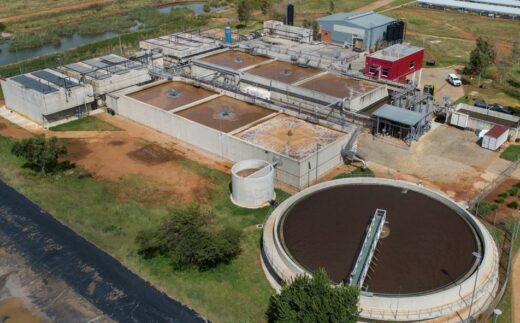

“Central to this strategy is reducing HEINEKEN’s reliance on local water supplies, by rather reclaiming used water. With this plant, up to 30% of the brewery water intake is saved, producing up to 45 000m³ per month of potable water, equivalent of 18 Olympic-size swimming pools of water each month. Heineken, one of the major brewers in Africa and the world, has done over 30 such projects across Africa with Waterleau Group,” said Vinicius Genio De Almeida, HEINEKEN South Africa’s Supply Chain Director.
Jambon described the involvement of his government as being one of its initiatives to combat the impact of climate change on the environment. “This is best achieved, as with this project, in implementing effective technology and innovations. We see our contribution as developing such technologies locally in Flanders, and then taking these to the rest of the world in this manner.” Water recovery has become ever more accessible in recent years in the food and beverage industry as the technology has evolved to be able to provide the extremely high-quality standard required in a brewery.
Bart Goedseels, CEO of Waterleau, described the technology of the effluent treatment plant.
“It consists of anaerobic and aerobic technology, not only purifying the effluent up to river discharge limits, but also converting this pollution into biogas. The water discharge limits are strict, with chemical oxygen demand below 75ppm (parts per million) and suspended solids below 15ppm. Furthermore, all nitrogen and phosphorus is removed.”
Mayor Teixeira acknowledged HEINEKEN and the Flanders government, saying his municipality had considerable interest in such technologies to improve access to water.
At Caxton, every story is written by humans. We use AI only to perform quality checks - never to generate the news. Happy reading!