Deneysville has its day at Indaba 2023
Why spend your hard-earned cash on toll gates and petrol when you can save it for a Vaal visit just down the drag, one hour from Joburg, at the Free State’s 'land-locked sea'
At the heart of the Lion Route lies Deneysville, the largest village at the Vaal Dam, which represents the hub of the Vaal Triangle, servicing key centers in the Free State, Gauteng and Mpumalanga provinces.
Deneysville was recently the recipient of Fezile Dabi District Municipality and DESTEA’s grant for the 2023 Town Turn-around program. This includes the 7km-long island, Groot Eiland, (or UJ Island, which belongs to the University of Johannesburg and boasts a fully functional tourism facility welcoming visitors for day trips and overnight stays, full board, including safari drives and cruises)!
Holding the fort, sole exhibitor at the Deneysville stand during the Tourism Indaba hosted in Durban this year, was Rnew, a waterfront Gin Distillery and functions venue situated more-or-less in-between Deneysville and its smaller, sister town of Oranjeville.
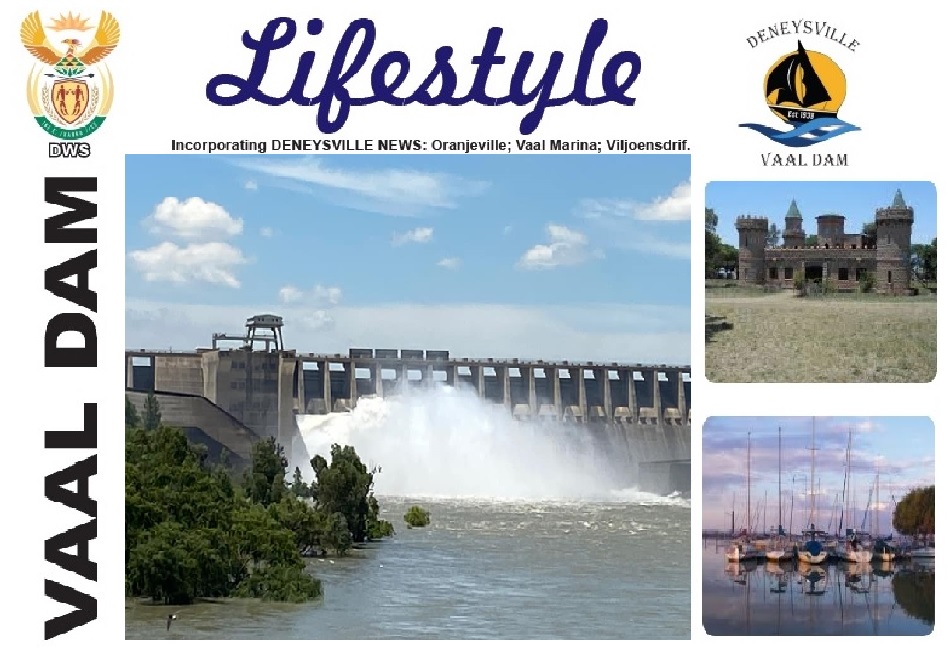
Although ‘bungled’ communications threatened to scupper the presence of the town of Deneysville at the Indaba, Rnew was joined by the Deneysville Tourism and Business Association (DTBA) virtually, through a visual introduction via the Vaal Dam Lifestyle, tourism supplement, fed from the Vaal Ster and Vaalweekblad, published by Caxton Publishers
The Vaal Dam is SA’s third biggest dam and is at the core of the Vaal Triangle; strategically (it is the source of Gauteng’s drinking water and is a natural conservancy) and in terms of location, (with hubs like Heilbron and Heidelberg and bordering Gauteng towns of Vereeniging and VDBP all well within one-hour’s drive through the countryside).
And the dam is also situated more-or-less in the middle of the 1200 running, Km-long, Vaal River, which originates near Swaziland and flows from East to West ending at the Orange River and Gariep Dam, before exiting into the Atlantic Ocean at the Southern Namibia border.
So it’s sometimes a challenge to get one’s head around both the river and the dam (especially since the dam itself has a circumference matching the length of the Vaal River of over 1000-running kilometres when the dam is 126% full)!
So, 126% full, you may ask? Well, that’s because the dam wall was raised (twice) since its construction in 1938, in order to ‘feed’ the then Transvaal (now Gauteng) province with fresh drinking water.
Walking inside this impressive wall (which can be arranged beforehand ‘on demand’), you can catch a glimpse of its history. The wall was first raised from 54.2m (in the early 1950s) to 60.3m and then again, in 1984, to 63.4m. At its current height, it secures the water masses, positioning it as SA’s third-largest dam.
The relevance of this? Well, even TV crews, regular visitors here, get it wrong. They assume that the pollution that infests the lower Vaal River and the barrage reservoir (a 64km stretch which links Vereeniging and VDBP), is running into the Vaal Dam.
Not true! The Dam, which lies high above the barrage, Loch Vaal and Vanderbijlpark, (which was the original ‘dam’ constructed for the Vaal and Johannesburg areas in 1923), regularly ‘flushes’ the polluted lower river when the waters there become too pungent to enjoy.
In fact, the opposite is true: while the Vaal Barrage suffers from putrid water quality (which is threatening the viability of a large number of resorts, businesses and households along the lower river, sometimes even incorporating Parys), until recently the Vaal Dam has boasted largely pristine water, which we are immensely proud of. Any threat to this record is fought “to the death”, as indicated by our current challenge to the municipality.
The Vaal Dam is no ‘puddle’, it’s a fully-fledged conservancy, 20-times bigger than “Harties”, with working harbours and waters boasting waves up to 2m in height when our winds gust at times above 85 knots! Much the same as those which often swoop through the Western Cape.
And our guests get to experience that ‘wild’ yet largely approachable waterway right on their doorstep with minimal, financial output; minimal time delay in reaching destination and no hassles associated with big cities. … Enjoy!