The greatest gift a leader can give to his country
We must demand good leadership that is not cruel, good and democratic structures that are not oppressive.
There is something particularly distressing about one of the architects of the current post-1994 South Africa pointing to the state’s decline and failure.
This writer is none other than Jay Naidoo, a veteran of the struggle for a “free” South Africa and founder of Cosatu.
As a minister in Nelson Mandela’s cabinet, he was part of the team of new South Africa’s builders.
It is not merely a moral obligation that compels Naidoo to criticise the decline of public institutions, but also the fact that the liberation movement that won political freedom for South Africans has failed to fulfil its promise to uphold the dignity of all, ensure justice for all, and create opportunities for all.
His letter unmasks the tragic failure of a generation of leaders who, as a liberation movement, built South Africa’s public institutions, only to see them consumed by corruption, patronage and incompetence.
The painful irony of Naidoo’s writings is not that he writes – he must.
The deeper irony is that this same generation of leaders must now call on their own government to listen to the people, redeem the South African state from the distrust that has been heaped upon it, and remind government of the covenant it entered into with the South African people.
Good governance is more than just waving flags, campaigning, putting up posters and large photos of a leader.
Good governance is when citizens trust their government to deliver basic services such as clean water, well-maintained roads, reliable electricity, quality healthcare and education, effective policing, and the responsible use of public funds.
It also requires free and fair elections, and more than that, ensuring that the poor are not exploited while the rich grow richer.
The greatest gift any leader can give a country is to build trust in institutions by upholding the law, ensuring the proper use of public funds, safeguarding free and fair elections and treating all citizens equally.
South Africa will be put to the test during the upcoming local government elections, set to take place on November 4.
Will citizens of South Africa continue to be fooled by leaders’ empty promises, or will they demand honest service from honest leaders?
Egypt’s President Abdel Fattah el-Sisi is another useful case study
Sisi rose to power in 2013, when Egypt’s military removed then-president Mohammed Morsi from office following his failure to govern effectively and large-scale protests supported by several opposition leaders, including former general Sisi.
Soon after taking power, Sisi enjoyed support from most Egyptians, as they were eager to end a period of unrest and give their leader time to implement policies to create stability and spur economic development.
In the years since his assumption of power, Sisi and his government have undertaken an impressive array of new and upgraded infrastructure development projects, including the extension of the Suez Canal through a newly reclaimed piece of land in the Mediterranean, as well as the new administrative capital that is currently under construction on the east bank of the Nile, approximately 45km east of Cairo.
He has also launched a campaign to rid Egypt of terrorists, primarily concentrated in the Sinai Peninsula.
He portrays himself to the Egyptian public as the strong leader who can bring his highly divided nation out of volatility and establish stability and security.
READ MORE: Youth shine in Siyaqobangamandla Talent Show
South Africa can learn a great deal from the negatives of Sisi’s strong-arm tactics to retain power and govern only through speeches and promises that are never fulfilled.
The country needs positive planning, discipline, infrastructure, safety and security, and a government that can deliver on its election manifestos.
A weak government may deliver beautiful speeches, but it cannot build roads, maintain a sewerage system, safeguard its citizens, or fight corruption.
What a country needs is leaders who follow through on their commitments.
This means that budgets must translate into roads, plans into pipes and other water infrastructure, effective solid waste management, and clean, well-functioning municipal services.
Building capacity, ensuring good governance, and creating order and a sense of safety for all citizens are what leadership is all about.
In this respect, South African leaders have much to learn from Sisi’s efforts to modernise.
While religious institutions need to be reformed, he publicly supported reform across all faiths.
While it is up to individual places of worship to decide what happens during services, he attended a Coptic Christmas service to publicly celebrate Muslim-Christian unity.
A leader who publicly recognises the importance of religious freedom and understands that a country belongs to all its citizens, not just the loudest or most vocal, is a leader to be emulated.
Of much greater value, however, are the lessons derived from the negative aspects of Sisi’s leadership.
Indeed, stability, in and of itself, is bad when it amounts to the silencing of all opposition and the suffocation of all life and freedoms.
The ideal of control and of order of affairs in the country, of which Sisi continues to boast, very quickly turns into oppression and into an authoritarian regime if there is no accountability.
The worst aspect of it is that, under Sisi, Egypt has developed into an entirely authoritarian state in which there is no political opposition of any kind and in which civil and political rights are being severely restricted.
The security services are acting with absolute impunity and are reportedly involved in serious human rights abuses.
Freedom House does not list Egypt among the ‘free’ countries and rates it as ‘partly free’.
According to Human Rights Watch’s World Report 2026, Egypt remains under the iron grip of the authoritarian Sisi regime.
Peaceful critics of the regime, as well as human rights activists and defenders, are being subjected to persecution.
A leader is not necessarily a strong leader. What democracy needs is leaders who function as ‘servant leaders’ who encourage input and manage to handle their criticism well, whereas ‘strongman’ leaders fear the questions that they do not even get to ask.
Democracy isn’t lost just because elections have stopped being held. Instead, it is being slowly but irreversibly destroyed even as elections are being held. In such a case, the opposite of democracy is being implemented and extended step by step, i.e., such events reduce democracy rather than extend it.
In the meantime, the opposition is silenced or even worse – journalists and other citizens are intimidated by them, whereas the judiciary is captured/brainwashed as well and thus functions as a mere compliant rubber-stamper for the decisions of the leader and the cabinet of ministers.
The second warning that we need to take from Egypt is with regard to the mega-projects of Sisi’s Egypt, those highway systems of bridges, of new military installations, of impressive buildings and monuments of art, culture, science and even a new capital in the desert that will be home to seven million Egyptians by the year 2050.
The list of these mega-projects is very impressive, and most are funded by the Egyptian public purse at enormous cost.
At the same time that basic foodstuffs and services are becoming more expensive for the Egyptian citizen, leading to more debt and poverty for them, there is a growing critique that these projects only serve to enrich select individuals and their military patrons while they fuel the hyper presidential rule and military guardianship of the new ‘republic’ of state capitalism and of intense, even austerity-driven, social contraction with nothing ‘free’.
The prognosis in Carnegie’s 2025 analysis is that financing these external projects supports a regime that keeps the country ‘stable’ but, in the long run, leads to worse economic problems.
Over a cup of coffee, Reverend Maans van Zyl looks at what is the purpose of leadership?
— WitbankNews (@WitbankN) July 6, 2026
https://t.co/Ao0fg6ED6B #reverendmaans #opinion #witbanknews pic.twitter.com/E3NCiwkeSa
READ MORE: eMalahleni boys among safely returned initiates
This is so relevant in South Africa today, where local government needs to be wary of mixing massive projects with the basic services that municipalities are supposed to provide
There is nothing wrong with municipalities building massive projects to celebrate special occasions or events, but they need to also ensure that the basic services, such as the provision of water and sanitation, decent roads, safe and healthy environments, proper and adequate housing management, libraries, clinics and other health facilities, as well as proper local economic development, are being delivered.
If not, then such projects as fancy branding, vehicles for workers, as well as massive projects, will be of no use if the services of the municipality are not being delivered to the residents in the shambles in which they are being maintained.
The poor do not eat pretense and promises – they need services delivered.
In addition to concentrating power, a third path that Egypt and other countries have pursued is the militarisation or securitisation of politics.
Here, the military and security institutions of the state are the dominant set of political institutions and structures, often complemented by structures of presidential government, military or other forms of guardianship, and structures of state control and economic ownership.
In Egypt, for example, the Carnegie Centre noted that the way the military and security structures of the state are combined to impose discipline at the very top of the system of government creates huge problems for the rest of society.
In the worst case, subjects are created instead of citizens, businesses must obtain permission from politicians to operate, and therefore, a large part of the private sector is affected by politics.
Civil society is viewed with suspicion, and local government structures have such a stranglehold on local communities’ voices that they are effectively muzzled.
In South Africa, it is equally important that the strong arms of the state are used to serve the public and to create space for, and enable, public participation and ward accountability in municipalities.
This means that the strong arms of the state are needed to combat crime and to root out corruption in the municipalities.
But in fighting crime and corruption, the strong arms of the state must be used to serve the public.
This means that there must be open council meetings, a free media, and an environment in which churches, community organisations, and other structures and bodies, as well as whistle-blowers, can function safely and effectively.
A leader who fails to keep his or her promises to followers, the media, and foreign countries tends to place the blame for such failures on followers, the media, foreign countries, history, and ‘saboteurs’ in the country.
The leader who wants a title must accept full responsibility for all that happens during his or her term of office
Would you vote for a candidate for leadership who blames others for his or her failures, or would you rather vote for a candidate for leadership who accepts responsibility for the failures of his or her team and/or followers?
The leader who accepts responsibility for the failures of his or her team and/or followers holds others responsible for the failures that happen despite his or her best efforts.
The question is, does the candidate you want to vote for for leadership understand public office as a stewardship, or does he or she understand public office as a job to earn a salary, to acquire status, to get tenders and to amass power?
You can learn a lot from countries with impressive structures, wonderful hotels, and other achievements, but that lack a fundamental pillar: freedom, trust, accountability, and respect for the human rights of all citizens.
At one end of the spectrum, you have countries like Egypt, where structures, hotels, and other wonders are built, but at the cost of freedom, trust, accountability, and respect for the human rights of ordinary citizens.
From the other end of the spectrum, you have countries like South Africa with a fantastic Constitution, but with mostly incompetent, corrupt, lazy and captured by factional interests local leaders.
The lesson we must draw from these two extreme examples is a balanced one: we must demand good leadership that is not cruel, good and democratic structures that are not oppressive, good infrastructure that is not built for vain and selfish purposes, good security that does not breed fear and worship of a God-like leader.
What is expected of good Christian leaders in South Africa in 2026?
Contrary to how the world views power and leadership, Christian leadership is of a completely different nature.
Jesus, in Mark 10:42-45, spoke of the way the rulers of this world’s systems ‘lord it over’ men and said it shall not be so; and said whoever wishes to become great will serve and said even the Son of Man did not come to be served but to serve.
So, for 2026, the Christian leader must first be a servant and then a strategist.
He or she must have the moral strength under God to speak the truth, to fight for justice and to serve the poor against the interests of the elite to do good.
This is how the Christian leader is characterised in Micah 6:8, which says, “to do justice, and to love kindness, and to walk humbly with your God.” Jeremiah 22:3 says, “Do justice and righteousness, and deliver from the hand of the oppressor him who has been robbed.”
As Christian leaders, they are stewards of the public office they hold
This governing authority is that of a servant of God for the good of society.
The public office is not private property.
The councillor’s office is not their family business. Tenders are not to be awarded to their friends and family in return for their loyalty.
The municipal budget is not the councillor’s or the mayor’s party’s money to spend as they wish.
They are accountable to God and to the people for the proper use of the public resources placed in their care.
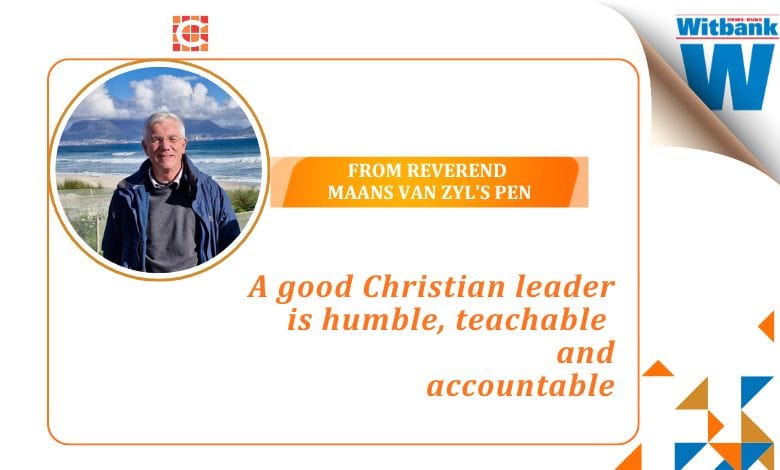
A good Christian leader is humble, teachable and accountable.
“Do nothing out of selfish ambition or self-pride; instead, humbly estimate others better than themselves; not looking to their own interests, but the interests of others; all for the good of each other in order to advance each other’s welfare” (Philippians 2:3–4). “Not lording it over those of them which belong to them, but they will watch out for your welfare, and will gently and patiently put up with them in case they are doubled up with disease or any terrible illness” (1 Peter 5:2–3).
A Christian leader is someone who serves as a steward, serving his master, managing the estate as his master would, and he must give an account for his actions.
That is why a good leader would be above reproach.
It is also why there are so many examples of good leaders today who operate transparently by revealing the facts, answering all questions, and giving auditors the freedom to do their jobs.
They support the whistle-blower and resign when necessary.
Finally, Christian leadership must give hope without deception.
Matthew 5:13-16 calls believers salt and light. Salt prevents decay; light exposes darkness.
Before the 2026 local elections, churches and Christian citizens should not ask only, “Which party do I like?”
They should ask, “Who tells the truth?” Who serves the poor? Who protects public money? Who has character? Who can be trusted with power? The greatest gift leaders can give South Africa is not a speech, a promise, or a poster.
It is a trustworthy service before God and before the people.
The greatest gift a leader can give a nation is not power, promises, or monuments, but trust.
A country does not need leaders who build monuments to themselves; it needs leaders who build trust among the people.
This column is the opinion of the writer and does not represent the views of Witbank News.
Your city, your story, as it happens. Stay in the loop with WITBANK NEWS.
Find us on our website, Facebook, X, Instagram or TikTok