
With 53% allocated to loss-of-income claims
Picture: Nigel Sibanda / The Citizen


Less than a tenth of Road Accident Fund (RAF) payouts goes towards medical care. Yet spending more on early medical treatment could reduce the amount needed for loss-of-income claims and lower the overall cost of compensation.
This is according to a detailed study examining the most sustainable ways of compensating people injured in road accidents, presented at the recent Actuarial Society of South Africa (Assa) Convention in Cape Town.
The study was funded by the society.
Only 6% of payments to injured people over the five years to March 2024 went towards medical costs, while 53% was allocated to loss of income, said Dr Gregory Whittaker of Algorithm Consultants & Actuaries, one of the study’s authors.
The RAF has come under increasing scrutiny because of its severe financial difficulties.
Its total net liabilities stand at R439.5 billion, while it is funded through a R2.25-per-litre fuel levy, adding to the cost of petrol.
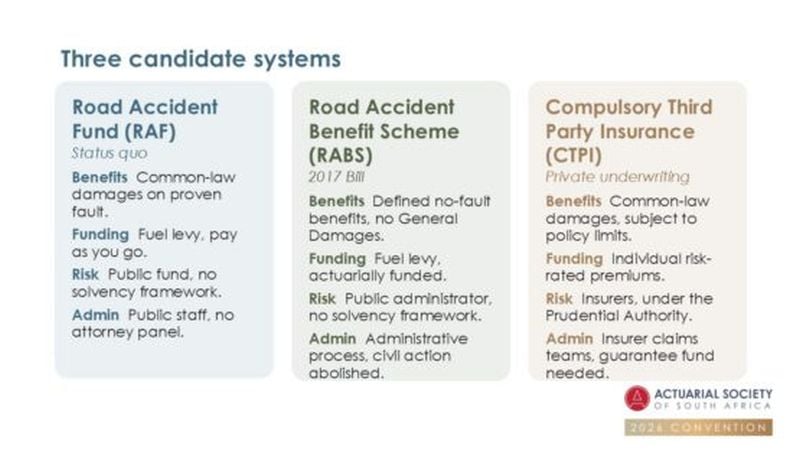
The study examined three systems: the RAF, compulsory third-party insurance and the Road Accident Benefit Scheme (Rabs). The latter was tabled in parliament in 2017 as a possible replacement for the RAF but was rejected by the portfolio committee on transport in 2020.
The study’s other authors are Dr David Rodda of the University of the Witwatersrand and Colourfield, and George Schwalb of GRS Actuarial Consulting.
Among its key findings were:
- In 2020, the RAF finalised just over 100 000 claims. By 2024, this had fallen to just over 18 000 – a decline of about 82%.
- Trucks pay roughly twice as much in levies as their share of vehicles involved in fatal crashes would suggest, while taxis and motorcycles pay considerably less.
- Assets as a proportion of outstanding claims fell from 44% in 1985, under the RAF’s predecessor, to 3% in 2020.
- From 2017 to 2020, the most recent years for which estimates are available, fuel levy income was insufficient to cover the cost of accidents occurring in each year.
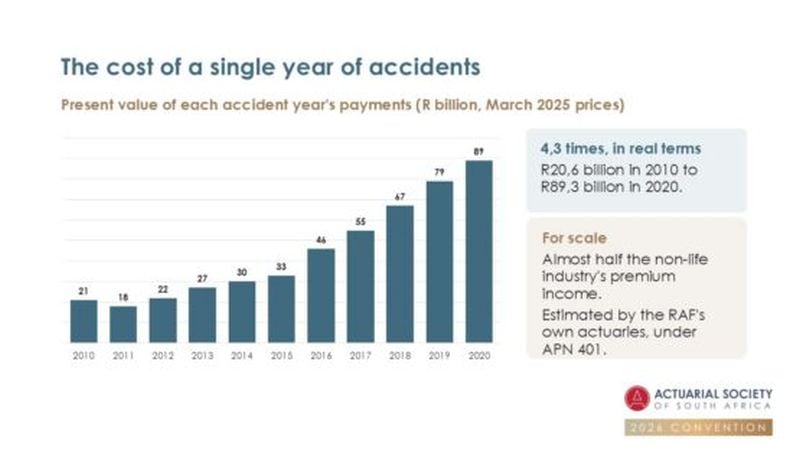
- The estimated cost of accidents occurring in a single year increased 4.3 times in real terms, from R20.6 billion in 2010 to R89.3 billion in 2020.
Speaking at the Assa convention, Whittaker said the rising costs were not the result of an increase in accidents.
Instead, he said, “road deaths fell and claim numbers were stable at about 48 000 a year in the early 2010s, with no change in benefits”.
Whittaker attributed the higher costs to factors within the RAF’s control, including an increase in loss-of-income claims, awards based on potential rather than likely future earnings, and weaker defence of claims, including default judgments.
The latter refers to cases in which courts award compensation without the RAF adequately scrutinising or defending the claims through its attorneys.
Whittaker pointed out that of claims paid between 2019 and 2023, loss of income accounted for 53%, general damages 28%, legal fees associated with proving claims 13%, and medical care just 6%.
“Yet medical care is the one benefit that can make all the other bits of damage smaller. Treat someone early, and they lose less income. They suffer less, and they need less care later on,” Whittaker said.
He added that about 80% of road accident victims are treated in public hospitals, for which the RAF seldom reimburses the costs.
This means the public healthcare budget and medical aid schemes, rather than the fuel levy, effectively bear much of the expense.
The study looked at the three systems against criteria developed by the RAF Commission in 2002: whether they are reasonable, affordable, equitable and sustainable. The commission had recommended reforms to the RAF more than two decades ago.
“Without prescribing a specific model, the paper concludes that a hybrid approach should be adopted for future accident compensation, combining the strengths and mitigating the weaknesses of the RAF, RABS, and compulsory third party insurance systems, supported by sound governance reform and actuarial oversight to ensure long-term sustainability.”
Even if third-party insurance were to be made compulsory, as Deputy Transport Minister Mkhuleko Hlengwa has suggested, some form of state-backed insurance system would still be necessary.
Not all motorists would comply with the requirement to obtain and pay for insurance, the study notes.
Regardless of which system is adopted, the study emphasises that good governance and efficient claims handling are essential to controlling costs and ensuring that a public compensation scheme remains affordable.
With the RAF’s liabilities continuing to grow, Transport Minister Barbara Creecy has ruled out increasing the fuel levy, citing the financial pressure already facing motorists.
Additionally, as the number of electric vehicles on South African roads increases, the fuel levy could generate less revenue to fund the RAF.
Whittaker said there is a precedent for private insurers managing claims on behalf of the state. Between 1965 and 1986, insurers handled claims for the state fund, which retained the financial risk.
This article was republished from Moneyweb. Read the original here.