Applications for leave to appeal earlier judgments have 'no reasonable prospect of success'.
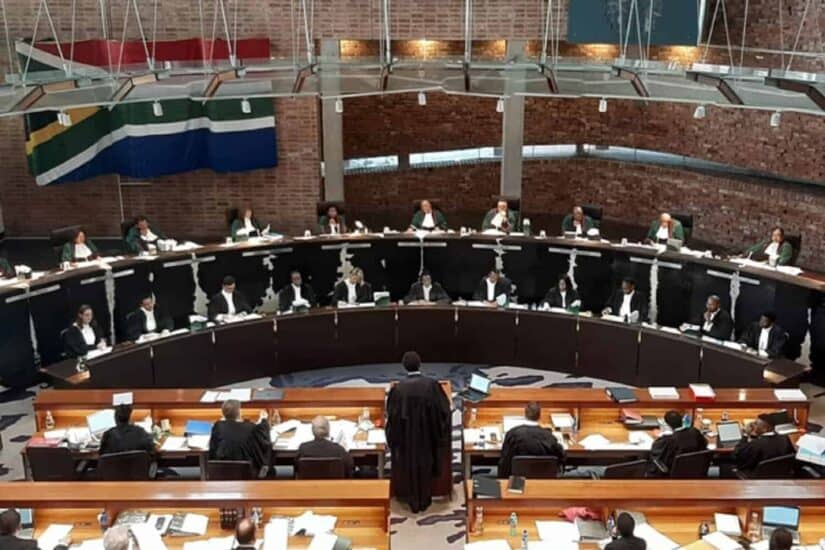
The Constitutional Court. For illustrative purposes. Picture: The Citizen/ Nigel Sibanda


The door has been finally slammed shut on attempts by the Road Accident Fund (RAF) to exclude illegal foreigners from submitting claims against the fund.
This follows the Constitutional Court on Tuesday dismissing with costs applications by the RAF to appeal earlier court rulings on this issue.
The High Court in Pretoria in July 2024 dismissed with costs an application by the RAF for leave to appeal a judgment that declared invalid a Department of Transport regulation and RAF management directive that excluded illegal foreigners from submitting claims against the RAF.
The Constitutional Court order said a quorum – comprising Chief Justice Mandisa Maya, judges Nonkosi Mhlantla, Nambitha Dambuza, Rammaka Mathopo and Katherine Savage, and acting Constitutional Court judges Annali Basson, Lister Nuku and Tembeka Ngcukaitobi – considered the RAF’s application for leave to appeal and concluded that the application must be dismissed with costs “as it bears no reasonable prospect of success”.
An order was issued by the Constitutional Court to the two RAF applications for leave to appeal:
- The first related to a judgment obtained by Adam Mudawo, Wenile Simon Ndlovu, Bruce Mthokozi Sibanda and Oyetunde Oneniyi Areo; and
- The second to a judgment obtained by A Lyton and 14 other respondents.
They are all foreign nationals and all were involved in motor vehicle accidents at various places in South Africa in which they sustained multiple injuries.
They claimed compensation from the RAF in terms of the RAF Act for the losses and damages they suffered because of their injuries.
Exclusion measures repeatedly rejected
The various judgments followed the Minister of Transport and the RAF in June and July 2022 seeking to put measures in place whereby illegal foreigners would be excluded from the operation of the RAF Act through the promulgation of a “new RAF 1 claim form”.
A full court of the High Court in Pretoria on 26 March 2024 reviewed and set aside these measures in a case brought by Mudawo, Ndlovu, Sibanda and Areo – and the RAF lodged an application with the Supreme Court of Appeal (SCA) for leave to appeal this judgment and order.
In a judgment handed down in April this year in the SCA, Judge Ashton Schippers – with judges Yvonne Mbatha, Wendy Hughes, Annali Basson and Acting SCA Judge Maake Kganyago concurring – also dismissed the RAF’s applications for leave to appeal these two cases with costs.
Schippers said the central issue on these two appeals concerns the meaning and effect of a section of the RAF Act, and more specifically, whether “any person” entitled to claim compensation for loss or damage as contemplated in that provision excludes illegal foreigners.
He said the second RAF appeal is against an order by the High Court in Pretoria, which dismissed an application by the RAF to interdict the respondents in that case from proceeding with a warrant of execution against the fund’s assets, pending a decision by the SCA on the first appeal.
Former CEO’s arguments
Former RAF CEO Collins Letsoalo said in an answering affidavit to the applications brought by the illegal foreigner road accident victims that the purpose of the decisions was not to deny qualifying legal foreign claimants access to the social benefit scheme in the RAF Act.
He said the purpose of the decisions was rather to satisfy the RAF that the loss or damage, which is the subject of the claim, is caused by the driving of a motor vehicle within South Africa, and to ensure the fund does not contravene the Immigration Act when processing claims submitted by foreign claimants.
Letsoalo further said the RAF had established that there were several claimants who are citizens of other countries that do not have a social benefit scheme such as that created by the RAF Act.
Letsoalo added that a number of these claims are fraudulent because the loss or damage was sustained in accidents outside the borders of South Africa.
He said unless claimants are asked to state where the loss or damage was caused, the RAF has no way of knowing whether it was caused by the driving of a motor vehicle within South Africa.
Letsoalo also claimed the social benefit scheme in the RAF Act was neither designed nor intended “to benefit people who are in South Africa illegally”.
He said the law distinguishes between foreigners and citizens of the Republic of South Africa, and foreigners do not have the same rights as citizens and permanent residents of South Africa.
Letsoalo added that the phrase “any person” in a section of the RAF Act is a reference to “a South African citizen, a permanent resident and a legal foreigner” and does not include illegal foreigners.
Judges disagree
However, Judge Schippers concluded that on a proper construction of a section of the RAF Act, the obligation of the fund to compensate “any person” (the third party) for loss or damage suffered because of bodily injury to the third party, or the death of or bodily injury to any other person caused by the driving of a motor vehicle, “does not exclude illegal foreigners”.
He said the RAF’s contention that they are excluded because the Immigration Act prohibits foreign nationals from being in South Africa illegally, and that investigating claims lodged by illegal foreigners amounts to aiding and abetting them in contravention of that RAF Act, is incorrect.
Schippers said in the second appeal, the RAF failed to make out a case for suspension of the orders and the stay of the warrants of execution in favour of the respondents.
This article was republished from Moneyweb. Read the original here.