US Secretary of State Marco Rubio announced new visa restrictions.
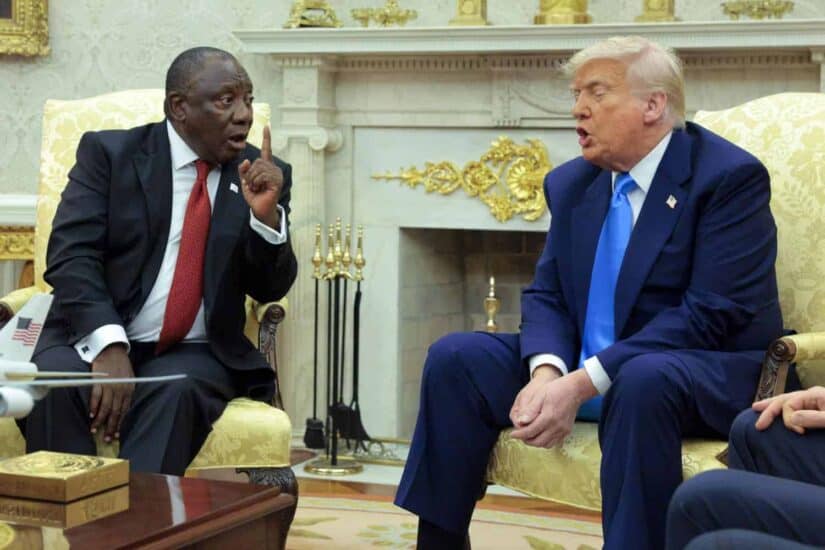
President of South Africa Cyril Ramaphosa and US President Donald Trump exchange words during a meeting in the Oval Office of the White House on May 21, 2025 in Washington, DC. Picture: Getty Images


North West University Professor and political analyst Andre Duvenhage says the US’ decision to impose visa restrictions on South African officials should not surprise anyone, but is a red flag for the ANC and a historic low in bilateral relations.
US Secretary of State Marco Rubio on Tuesday announced new visa restrictions against those accused of involvement in race‑based discrimination and uncompensated land seizures in South Africa.
Warning to SA
The policy, unveiled by Rubio, marks Washington’s sharpest rebuke yet of Pretoria’s handling of minority rights.
US ambassador to South Africa, Leo Brent Bozell III, warned Pretoria that the new restrictions are just the beginning and show “America’s firm resolve in this matter.”
The policy, unveiled by Rubio, marks Washington’s sharpest rebuke yet of Pretoria’s handling of minority rights.
It is also the latest action by the Trump administration to target the South African government for allegations that it is mistreating White South Africans- a claim the South African government has denied.
‘No surprise’
Duvenhage told The Citizen that the visa restriction was not a surprise and that “stronger action was expected.”
“South Africa has not responded to issues raised by the United States – from discriminatory legislation and rural safety to its international alignment with China, Iran and Russia. This is probably the lowest point in relations between the US and South Africa since 1994,” Duvenhage said.
He warned that the restrictions are a red flag for the ANC on multiple levels.
“Internationally, South Africa is under growing pressure from countries like the United States. In a world that has become far more polarised – with conflicts in the Middle East and the Russia‑Ukraine war – this process will intensify,” he explained.
‘Roelf Meyer was not able to turn this process around’
Duvenhage added that domestic dynamics compound the crisis.
“Internally, racial discrimination is being emphasised by organisations like Solidarity, AfriForum, and political parties such as the DA and Freedom Front Plus and other groupings.
“Resistance is building at a time when the ANC is losing support, with indications they may only secure around 30% nationally in the local elections on 4 November,” he said.
According to Duvenhage, the visa restrictions are a direct result of Pretoria’s failure to respond to Washington’s concerns.
“This is a negative signal internationally, but it has a lot to do with South Africa’s failure to act. It also shows that Roelf Meyer was not able to turn this process around,” he said.
Red lights
He said the move underscores both the fragility of South Africa’s global standing and the ANC’s weakening domestic position.
“The red lights are flashing. Internationally, South Africa is isolated, and internally, the ANC is losing ground. This is a moment of reckoning.”
US confusion
International relations expert Brooks Spector has cautioned that the United States’ new visa restrictions on South African officials raise more confusion than clarity, warning that the measures risk undermining dialogue between the two nations.
Spector said that while any country has the right to set visa conditions, the US move lacks clear criteria.
“You issue regulations that are clear and consistent and are rooted in reality. I read the statement from Marco Rubio and the ambassador’s note, and I don’t find in either of them any clear definition of how one would judge a visa applicant,” he told broadcaster eNCA.
Restrictions
He questioned how the restrictions would be applied in practice.
“Take a government official applying for a visa. Obviously, they support government policy. Would they now be disqualified on that basis? On what grounds would that happen?”
Spector argued that the US framing of its demands has shifted from negotiation to unilateral action.
“Some months ago, the US president announced what were effectively his five demands. Ambassador Brent Bozell referred to them as ‘asks.’
“There’s a huge difference between a demand and an ask. An ask means you negotiate questions of mutual concern. A demand means you dictate terms,” he said.
Cooperation
On rural safety, Spector stressed that the issue should be addressed through cooperation rather than punitive measures.
“This is about the capabilities of police and security, not a deliberate effort by government to encourage attacks against white farmers,” he noted.
He also questioned the timing and substance of US concerns over land expropriation.
“I’m not sure there are any cases of land expropriation without compensation currently ongoing. Much of this remains theoretical,” he said.
Unease
Ultimately, Spector expressed unease with the trajectory of US-South Africa relations.
“I’m perplexed by what I see happening. These are serious disagreements, but they should be resolved through discussion, not visa restrictions by fear,” he concluded.
No harm, AfriForum says
AfriForum CEO Kallie Kriel has welcomed Washington’s new visa restrictions on South African officials, saying the measures target politicians accused of human rights violations rather than ordinary citizens.
“This action will not harm ordinary South Africans, but is directed at politicians guilty of gross violations against minorities and Afrikaners,” Kriel said.
He cited incitement to ethnic violence – including the slogan “Kill the Boer” – as well as expropriation without compensation and racially discriminatory policies as reasons for the US move.
Responsibility
Kriel argued that Pretoria must accept responsibility.
“Proposals by AfriForum and the Solidarity Movement to resolve the dispute have fallen on deaf ears. The government must accept responsibility for the latest turn of events,” he said.
AfriForum has already launched a High Court challenge against the Expropriation Act and vowed to intensify its campaign against EFF leader Julius Malema’s use of “Kill the Boer.”
“We are grateful the US has imposed punitive measures against those who incite ethnic violence,” Kriel added.
Dialogue
Despite backing the restrictions, AfriForum insists it remains committed to dialogue.
“It is in the interest of everyone to prevent South Africa from being punished due to the reckless policies of a group of politicians,” Kriel said.
Trump on SA
Trump has singled out South Africa for harsh treatment on several issues since he returned to the White House in January, notably making debunked claims of white Afrikaners being systematically “killed and slaughtered” in the country.
He ambushed Ramaphosa in the Oval Office earlier last year, playing a video in which he alleged a campaign against white farmers by the post-apartheid government.
During the bilateral talks, which played out before the media, Trump showed videos of EFF leader Julius Malema to support his false belief in genocide against whites in the country, asking why Malema has not been arrested.
The videos also showed MK party leader Jacob Zuma singing similar, apparently anti-white, songs from the struggle years.
Crime in SA
International Relations and Cooperation Minister Ronald Lamola firmly rejected claims that white Afrikaners face systematic persecution or “white genocide” in South Africa.
“We must encourage the South African citizens who participated in this matter, particularly regarding the execution order, to find their place here,” Lamola said during a G20 media briefing.
Lamola’s remarks came after the Trump administration granted controversial refugee status to a group of 49 Afrikaners who departed for the United States on a chartered flight from OR Tambo International Airport.
In response, Lamola asserted that the “white genocide” narrative is entirely non-existent and unsubstantiated