



Transnet's financial recovery masks deeper structural problems. Its debt, which has topped R150bn, remains one of its biggest burdens.
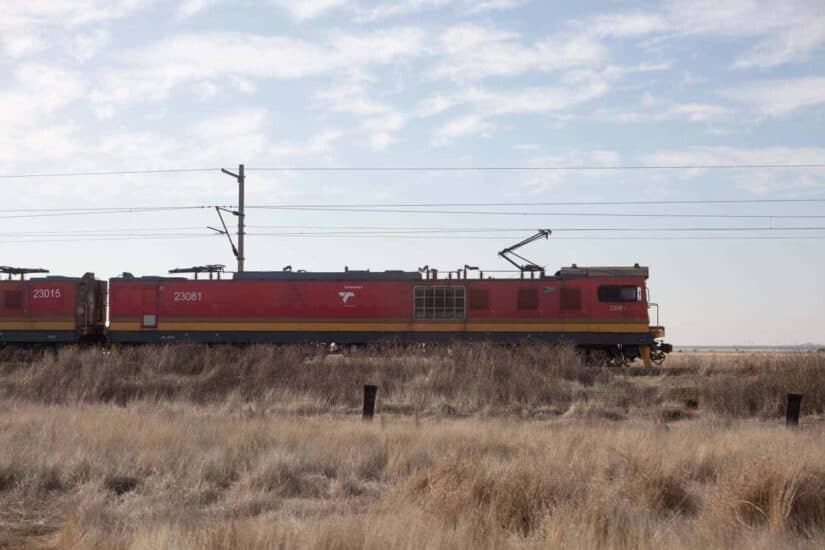
A Transnet train on 23 August 2022 in Hopetown, South Africa. Picture: Gallo Images/Misha Jordaan


By all accounts, Transnet is on the mend. Rail freight volumes are improving, private rail operators will soon commence services on the national rail network, and its financial performance appears to be regaining some dignity.
The state-owned logistics provider posted a R4.6 billion profit for the year to March 2026, its first in four years, reversing the R1.9 billion loss for the prior year.
But a closer look at the figures shows that the profit came from a once-off R12.5 billion accounting gain arising from the concession of Durban Container Terminal Pier 2 to International Container Terminal Services Incorporated (ICTSI), which has taken over the port’s management and operations.
Without that windfall, the figures would have been doused in red.
The noose around Transnet’s neck is its R150.7 billion debt, up from R144.8 billion the previous year. About half of this is a legacy of the Gupta-era state capture, saddling Transnet with a crippling interest burden that will persist for years.
Biggest burden
To put this into perspective, Transnet paid R17 billion in interest in the latest financial year (2025: R15.8 billion).
That’s about R1.42 billion a month, or R47 million a day, equivalent to about 11.5% of average borrowings.
After capitalising some borrowing costs, R16.4 billion was charged against earnings – more than 3.5 times the reported R4.6 billion profit. And the situation is not getting any better.
The annual financial statements show that approved government guarantee facilities have reached R196.3 billion, with R74.3 billion of Transnet’s debt covered by guarantees at year-end.
Transnet raised R36.2 billion in new funding during the year, while lenders granted waivers after it breached interest-cover covenants affecting R30.8 billion of loans. The guarantees have become central to Transnet’s ability to refinance maturing debt and remain a going concern.
These interest costs are strangling Transnet’s ability to reform and fix its dilapidated infrastructure.
But there is a far bigger cost to the SA economy: roughly R500 million a day in lost export sales and higher logistics costs, according to some estimates. That is an improvement on the previously reported estimate of R1 billion a day by the GAIN Group, reflecting higher volumes of coal and iron ore being moved by rail.
Freight rail volumes improved from 160.1 million tonnes (Mt) to 167.9Mt in the latest financial year, but remained well below the group’s 180Mt target.
Transnet CEO Michelle Phillips said reaching that volume was necessary for the underlying business to break even, confirming that the operational turnaround remains incomplete.
Slow train
The growing interest costs have slowed Transnet’s reform agenda.
While a new operator, in the form of ICTSI, has been appointed to run Durban Container Terminal Pier 2, and 11 private operators have been allocated routes on the rail network, the benefits may take years to appear on the financial statements.
The difficulty facing the new private rail operators is that they will enter a network weakened by years of underinvestment, theft and deferred maintenance.
Transnet has previously estimated that restoring and upgrading the freight network, including signalling, will require about R50 billion over five years.
Transnet Rail Infrastructure Manager (Trim) spent R8 billion on capital projects in 2026, while Transnet’s wider five-year investment programme has since increased to R129.1 billion. Of this, R115.9 billion is earmarked for maintaining and rehabilitating rail, port and pipeline infrastructure.
The reform will bring private trains onto the network, but it does not remove the much larger problem of financing and executing the track repairs needed to run them reliably.
There is a stark divide between Transnet’s profitable ports and pipelines and its loss-making rail businesses.
The National Ports Authority, Port Terminals and Pipelines generated a combined R16.6 billion in pre-tax profit, while Freight Rail and the Rail Infrastructure Manager together recorded a R13.25 billion loss. Transnet Engineering added a further R4 billion loss.
Pier 2 handles about 46% of South Africa’s container volumes and has long been a major source of congestion and delays for importers and exporters. ICTSI will operate the terminal and is expected to bring international expertise and significant private capital to its modernisation.
The partners plan to increase capacity from two million to 2.8 million twenty-foot equivalent units and improve crane productivity.
While this arrangement should improve performance at the port, the once-off accounting gain of R12.5 billion will not repeat and cannot be relied on to support Transnet’s future debt repayments or capital programme.
Entering a damaged network
Transnet plans to invest R129.1 billion over the next five years, of which R115.9 billion will be spent maintaining and rehabilitating existing infrastructure.
That programme remains heavily dependent on state support. Government guarantees have helped Transnet refinance maturing debt and avoid a liquidity crisis, but they ultimately transfer part of the financial risk to taxpayers.
This leaves a question that the current reforms have yet to answer: can a debt-laden Transnet generate enough cash to rehabilitate the network while charging access tariffs that private operators can afford?
Many transport specialists argue that the reforms envisaged in the 2022 National Rail Policy must ultimately go further by placing the rail network in a properly capitalised and operationally independent infrastructure entity.
Train operators would then compete for access, much as road users access infrastructure administered by Sanral.
Without a solution to the network’s debt burden and rehabilitation backlog, introducing private trains may simply add more operators to a railway that remains unable to perform reliably.
This article was republished from Moneyweb. Read the original here.



