The group 'aspires to serve' 95% of the population in South Africa, and the 'very greatest of opportunities lies in backing South Africa's entrepreneurs'.

Capitec. Picture: Gallo Images/Jacques Stander


You may be forgiven for thinking that Capitec CEO Graham Lee misspoke when he characterised the bank’s market share in South Africa as being “excitingly low”.
After all, this is a group with 26 million active clients – easily bigger than the next two largest retail banks combined.
Of that base, as at 30 June, a full 10 million are now fully banked.
For context, that’s roughly the same:
- As FNB’s total customer base in South Africa (including Commercial but excluding eWallets, at 10.18 million);
- Absa’s total Personal and Private Banking segment (9.7 million at 31 December); and
- Standard Bank’s core clients who hold at least one banking product (9.3 million at the end of 2025).
But Lee has a valid point. Speaking at Capitec’s AGM on Friday, he said the numbers are “excitingly low” precisely because it shows there’s “runway” for growth.
Personal banking
If you look at personal banking from certain angles, he contended, “we have small market share”.
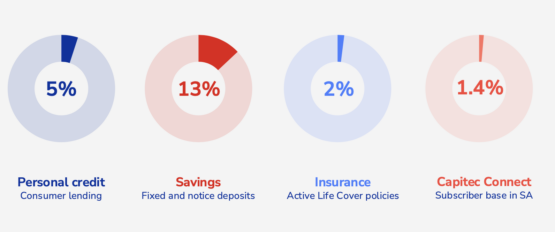
According to data presented at the meeting, Capitec holds 5% of personal consumer credit, 13% of savings and notice deposits, and just 2% of active life cover policies in the country.
And even after a strong start, its Capitec Connect MVNO (mobile virtual network operator), with 1.5 million active clients, holds just 1.4% market share of subscribers (active SIMs) in South Africa.
“We have not yet properly touched home loans and vehicle finance and all types of insurance, [or] stokvels. We’ve still got so far to go,” said Lee.
These are all ‘profit pools’, to use First Rand’s description, that the incumbents have built – and been allowed to build – over decades.
Capitec has but dipped its proverbial toes into home loans (in partnership with SA Home Loans) and vehicle finance through so-called purpose lending, which it underwrites, in partnership with WeBuyCars.
Expect there to be a lot more movement, and soon, across all of these product sets.
Lee says Capitec will launch its stokvel account soon, and while it’s “certainly not the first”, he maintains it “will be the best”.
On top of this foundation, the bank plans to “lay out future opportunities like group insurance”.
Business banking
In business banking, Lee says its market share is “even lower”.
“If you take all of the relevant headline earnings in South Africa [for business banking], and we’re excluding the very large corporate stuff here, we have only 5% market share of that R26 billion.”
Capitec, which has built out a business bank following its acquisition of Mercantile Bank in 2019, holds only 3% of the business credit market (across secured and unsecured lending) and 2% of deposits (across call, current, notice and other savings accounts).
“There is so much for us to do.”
Lee describes the examples shared as illustrative of the “the breadth of those opportunities”. He says Capitec “aspires to serve” 95% of the population in South Africa.
Backing SA’s entrepreneurs
“The very greatest of those opportunities lies in backing South Africa’s entrepreneurs, both formal and emerging.”
Since it launched its Entrepreneur Account in December 2025, he says Capitec’s business banking segment has grown “significantly”.
In the last four months (from its February year-end to the end of June), business clients are up from 456 000 to 593 000, or 30%.
That is roughly three-and-a-half times the base in February 2024 when it rebranded the unit to Capitec Business, and more than double the size from February 2025 when it simplified its fees for business clients.
“They are the future engine of our economy. They are the future engine of our employment. And the better we can serve them, the better off South Africa will be.”
“And that’s before we look beyond banking,” says Lee.
New name
These aspirations are among the reasons why its board recommended that it drop ‘Bank’ from its name.
According to the bank, “the proposed new name is strategically better aligned with the group’s evolution into a diversified financial services provider”. This special resolution was approved practically unopposed at the AGM.
‘Strategise, invest, plan, execute’
Going forward, Lee says Capitec needs “to strategise and invest and plan and execute in multiple time frames”.
“We prioritise protecting and growing what has made us strong. And we do that through stability, security, and excellent client experience.
“But we think beyond that … In the next one to three years, we are accelerating those businesses which will have the significant impact on our bottom line in that time frame.”
These include its business banking, Capitec Connect, and insure units, as well as consumer lending subsidiary’s Avafin’s push into new emerging markets.
Lee says the group is “already incubating, funding, [and] actually working on those businesses in the three-to-five-year time horizon”, which includes “embedded finance, [and] an enterprise payments business that can take South Africa forward”.
“And beyond that, we’re capacitating, investing, and strategising, and acting today for those businesses which will take us further beyond banking, and even beyond South Africa’s borders.”
This article was republished from Moneyweb. Read the original here.