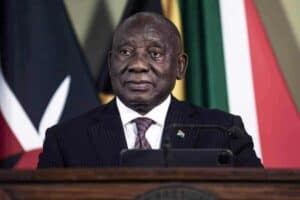
Advocate Maenetje argued that the opposing parties have interpreted section 25 of the constitution incorrectly.

A view of the Western Cape High Court in Cape Town. Picture: iStock


Advocate Ngwako Maenetje, for President Cyril Ramaphosa, has told legal representatives challenging aspects of the Expropriation Act not to use the dictionary to interpret aspects of the constitution.
On Wednesday, AfriForum, along with the DA and the Institute of Race Relations (IRR), returned to the Western Cape High Court on the third day of arguments against sections of the Expropriation Act.
The Association for Rural Advancement, the Rule of Law Project, and the Society for the Protection of Our Constitution were admitted as Amicus Curiae [friend of the court].
On Wednesday, the court heard arguments from the Rule of Law Project and the president.
Expropriation Act: ‘Compensation can’t be zero’
Advocate Mark Oppenheimer argued that every word of the constitution has to be taken into consideration when reading it. He said the Expropriation Act cannot interpret the word compensation differently from the constitution.
“The proper interpretation of section 25(2) means you have to know that words matter; every word that is in the constitution is there for a reason,” argued Oppenheimer.
“This means you must pay attention to the words ‘payment, amount and compensation’. An amount must be a positive number, so ‘no’ is an absence of something. No compensation means there is no compensation, but payment requires that you have to pay an amount of money. It is not possible to pay someone with a cheque that has a negative number.
“Compensation by its nature entails that you’re rectifying a wrong, and it’s never possible to compensate someone with nothing. It is also never just or equitable to take someone’s land and give them nothing; giving someone nothing in those circumstances amounts to confiscation, not compensation.”
‘Apartheid should not repeat itself’
Oppenheimer argued that the country could not repeat the mistakes of the past, when people were dispossessed of their land without any compensation.
“If we look back to our dark past of land dispossession, and the court was right to mention this terrible history that we have of exercising powers to take land from people and give them nothing, that is a mistake and should never be made again, and it would be no solace at all if the apartheid government after kicking people out, then said, don’t worry, your compensation cheque is in the mail, you open the mail and the cheque says zero,” argued Oppenheimer.
“That would be adding insult to injury; that would not be compensation at all and further injustice.”
He said section 25(2) of the constitution does not allow for expropriation without compensation.
“What we have now is a piece of legislation that tries to circumvent this, knowing that the constitution does not allow for no compensation.”
Expropriation Act: ‘Just and equitable standard’
Advocate Kessler Perumalsamy, for the Rule of Law Project, argued that when the constitution of the country tells the courts to take action in accordance with what justice and equity demand, it expects the powers that be to do everything necessary to achieve what is just and equitable.
In its current state, section 12(3) of the Expropriation Act alters the just and equitable standard, argued Perumalsamy.
“I’m not suggesting that parliament cannot regulate; it can determine factors and list them, but there is no purpose in the course of that regulation to fix a number, any number,” he argued.
“What would be the purpose of parliament saying you may award compensation in the amount of R10? What is achieved by telling the administrator that? There is no purpose other than to say you may expropriate without compensation or for very little. It is to take us away from what’s just and equitable, which is always flexible and open-ended.”
No money for compensation?
He said if the government could raise the argument that it could not afford compensation, that might be a rational reason to put forward, and it would invite the opposing parties to respond and offer suggestions.
However, the funding issue has not been identified as a reason.
“The effect of what section 12 (3) does is that you can expropriate without compensation. Why is the payment of nil necessary to achieve land reform? The respondents have not given us this answer. Section 12 (3) must be struck down.”
‘Don’t use dictionary’
In response, Advocate Ngwako Maenetje, for the president, argued that the opposing parties have interpreted section 25 of the constitution incorrectly.
“That section [12(3)] doesn’t breach section 25, but to the extent that there is a limitation to the rights to just and equitable remedy in section 12(3), then there is a breach of section 25, and we will submit that that breach is justifiable under section 36 of the constitution; it’s a justifiable limitation.
“The application of section 36 cannot be trumped by customary international law, because where section 36 says no right in the Bill of Rights is absolute, it may be limited by law of general application provided you can meet the standard in section 36.”
Advocate Maenetje argued that Section 25(2)(b) of the constitution must be read in the context of Section 25 as a whole and not in isolation.
“Our learned friends read Section 25(2)(b) and went straight to the dictionary to find the definition of the word compensation and said compensation means ka-ching, so you can’t have compensation that may be nil. That’s a wrong approach; one must read it as a whole.
“When it is read properly, it is clear that in relation to expropriation, the constitution only guarantees the right to just and equitable compensation, and not merely compensation per se. It’s only just and equitable compensation; it’s not recompense for what you lost; sometimes it may be, sometimes it may be less, because it is just and equitable compensation.”
Listed circumstances
In its argument on Tuesday, AfriForum expressed concerns about the words “including, but not limited to”, in the listed circumstances in which compensation may be nil. The organisation said the words leave the list at the discretion of the government.
However, Advocate Maenetje argued that the words could actually work in favour of the land owner.
“Section 12(3) of the Expropriation Act does not depart from the constitutional standard of just and equitable, because, when you read it, it is clear that it permits nil compensation only where it may be just and equitable in the light of all relevant circumstances, which include the listed and unlisted relevant circumstances, in much the same way that section 25 (3) does.
“Balancing exercises will be conducted to take into consideration all circumstances. Sometimes those unlisted factors may count in point against nil compensation. It is not the number that is mentioned; it is the constitutional standard, because that is what informs what compensation means and is consistent with international standards.
“The listing of circumstances in section 12.3 does not privilege the listed circumstances against relevant but unlisted circumstances. Once a factor is identified as relevant but unlisted, it enjoys similar consideration.”