


'A lot of businesses quietly choose to disinvest, without making too much noise.'
 Elections 2026
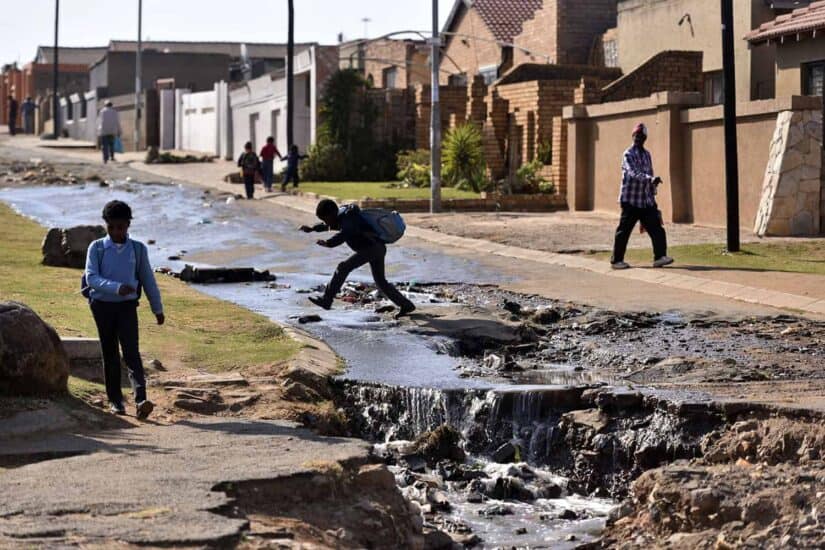
Growing dysfunction in municipalities is increasingly holding back the country’s economic growth. Picture: Nigel Sibanda


Business Leadership South Africa (BLSA) CEO Busisiwe Mavuso believes this year’s local government elections could prove to be one of the country’s most consequential, arguing that the leaders elected on 4 November will have the daunting task of restoring South Africa’s failing municipalities.
Her comments come as the financial health of local governments has come under intense scrutiny following Finance Minister Enoch Godongwana’s decision to withhold portions of the Local Government Equitable Share from municipalities that failed to meet prescribed conditions.
While intended to enforce greater accountability and improve governance, the intervention did more harm than good by putting already cash-strapped municipalities in an even weaker position, further exposing the deepening crisis in local government finances and service delivery.

LIVE interactive map, latest news, multimedia and more!
View MapFailing municipalities could hurt the country
Mavuso, speaking at the latest PSG Think Big webinar, said municipalities are the engines of local economies; they provide the infrastructure, services, and governance that businesses rely on to invest, to create jobs, and to grow. Yet, across much of the country, deteriorating service delivery, weak finances, and governance failures are undermining confidence and holding back that economic potential. This could hurt the country’s economy.
This sentiment has also been shared by the Governor of the South African Reserve Bank (Sarb) Lesetja Kganyago. He warned that growing dysfunction in municipalities is increasingly holding back the country’s economic growth.
“This year’s municipal elections are rather important,” said Mavuso. “They are important because when you look at the state of our municipalities, a lot of them are seriously eroding, deteriorating, and failing to provide the basic services for which they were designed to provide.”
Business confidence down due to failing municipalities
Mavuso said failing municipalities have direct implications for business confidence and investment. As municipalities struggle to deliver reliable services, companies are increasingly being forced to absorb the cost of state failure.
While the full cost of municipal dysfunction is difficult to quantify, Mavuso warned that businesses often respond by redirecting investment elsewhere. “A lot of businesses quietly choose to disinvest, without making too much noise.”
Kganyago also cautioned against the same thing. “What we do know is that it [municipal dysfunction] is constraining business and economic activity. What the source is, it’s for the government to identify. Suffice for us to say… there’s dysfunction and that dysfunction is constraining,” he said.
“You have heard of companies that relocate out of dysfunctional municipalities to try and find greener pastures elsewhere. We are just grateful that they are still [in the country], they can still find greener pastures in South Africa, and they didn’t decide to seek those greener pastures elsewhere.”
Joburg becomes a central concern
The BLSA CEO highlighted that Johannesburg has become a central concern, as the city’s decline is no longer a local issue alone because it is the country’s commercial capital.
“Remember, Joburg is key to the South African economy. This is where 16% of the country’s GDP is generated. So, its performance is critical to national growth. Joburg’s decline has reached a point where silence would be irresponsible from a business perspective. The situation has become urgent.
“We (BLSA) refuse to accept that Joburg’s decline is inevitable. We refuse to accept that the failure of the city of Joburg should be normalised.”
The scale of the challenge has placed local government reform firmly on the national agenda, with Operation Vulindlela’s second phase focusing on municipalities. Operation Vulindlela is a joint initiative between the Presidency and National Treasury aimed at accelerating structural reforms.
“At a national level, we’ve seen improved operational performance of Eskom and Transnet. We would now like to take that to the city of Joburg, but we need a counterparty in the city of Joburg that is serious about turning the city around. Otherwise, it’s really going to be an absolute waste of our time.”
Use of revenue
Mavuso referenced the City of Johannesburg’s water revenue as an example of the disconnect between what residents and businesses pay, and what is reinvested into infrastructure. “The City of Joburg collected R11.9 billion in water revenue, and yet only R1.3 billion was actually utilised for anything water-related.”
Municipalities’ debt to Eskom is also not something to be taken lightly. Current local government owe the bulk power utility at least R119 billion, with the City of Johannesburg being one of the municipalities contributing significantly to the debt, joined by Matjhabeng Local Municipality in the Free State, Emfuleni Local Municipality in Gauteng, and Emalahleni Local Municipality in Mpumalanga.
Despite the scale of Johannesburg’s infrastructure backlog, Mavuso believes the problems are not impossible to fix, provided there is political will and the right partnership with the private sector.
“The challenges that we are facing, in Joburg and from a broader municipal perspective, are not unfixable.”
On water, for example, she argued that practical interventions could deliver visible improvements within a relatively short period. “This is something that we can actually deal with within six months to a year, but you have to have political will on the other side.”