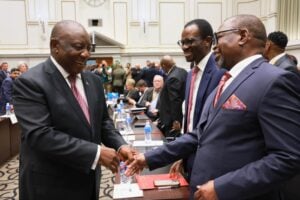
Changes will give the National Treasury more power over municipal finances.

Finance minister Enoch Godongwana. Picture: Gallo Images/Brenton Geach


National Treasury is taking steps to gain more control over municipal finances, including having a say in the appointment of chief financial officers (CFOs).
Finance Minister Enoch Godongwana announced during his medium-term budget policy statement (MTBPS) on Wednesday that the Municipal Finance Management Act (MFMA) and the Public Finance Management Act (PFMA) will be amended to address weak financial and operational management in many municipalities.
“We are undertaking the first comprehensive modernisation of the PFMA since its enactment, centred on five objectives: modernisation; clearer accountability; stronger enforcement; capable government; and fiscal sustainability,” said Godongwana.
Taking control of municipalities
The proposed changes to municipal law come two weeks before the local elections on 4 November 2026.
Godongwana said Treasury is intervening to turn around financially distressed municipalities and improve their ability to deliver basic services.
“We are enforcing compliance with public finance regulations, but we are also providing support to municipalities so that they can collect revenues more effectively and invest in urgently needed infrastructure,” he added.
First-ever amendments
Treasury said the draft Public Finance Management and Related Laws Amendment Bill (2026) is the first significant update of the PFMA since it was enacted in 1999.
The bill aims to strengthen governance, accountability, and transparency while addressing persistent financial management weaknesses, including unauthorised, irregular, fruitless and wasteful expenditure, weak consequence management and governance failures.
It clarifies chief executive officers’ responsibilities as accounting officers and the board’s responsibilities, strengthens mechanisms to address financial misconduct and non-compliance, and improves support for institutions in financial distress.
Changes coming to PFMA
According to the draft document, Treasury is amending the PFMA to require the Accountant-General to prepare consolidated financial statements for institutions and to submit them to the Auditor-General, among other changes.
If the amendments come into law, National Treasury will have to publish financial statistics and aggregations for all spheres of government on the National Treasury website.
Other changes include revoking the National Treasury’s power to withdraw exclusions; empowering the Minister of Finance to impose conditions when authorising the use of funds in emergencies; and empowering the minister of Finance to table a multi-year budget projection that contains key macro-economic projections.
Changes to MFMA
According to the draft document, Treasury is amending the MFMA to expand National Treasury’s investigative, oversight, and enforcement powers; require municipalities to submit bank account details to National Treasury; and provide for control of municipal accounts and withdrawals from municipal accounts during a national or provincial intervention.
“The proposed changes allow for robust early interventions under section 139 of the constitution, strengthen oversight of financial management by the National Treasury, and provide for officials, political office bearers and board directors to be made personally liable for unauthorised, irregular, fruitless and wasteful expenditure,” said Treasury.
Among other things, the changes will deter councils from adopting unfunded budgets and establish provisions for more credible budget estimates.
Once the amendments take effect, National Treasury will have more power over financial systems and controls, including appointing CFOs.
“These measures are part of a suite of reforms to strengthen the integrity of public finance management across all spheres of government,” said Treasury.