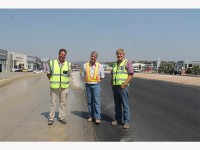
Riverside road work explained
More than 100 local people are benefiting directly from the construction work on the R40.

NELSPRUIT – Road users travelling through Riverside have had to contend with work on the R40 for the past five months. The Mbombela Local Municipality appointed a contractor to upgrade the R40 Road from the R37 intersection up to the Nels River Bridge.
The roadworks
The work, which commenced in March this year and is expected to be completed in November, includes the widening of the road on both sides of the median and outer edge to accommodate an additional third lane on both carriageways. As a result, the entire roadway would require resurfacing, and storm-water structures and intersections reconstructed to be more motorist friendly. All of this need to be done while allowing traffic on the road.
Endecon Ubuntu, civil engineers for the project, this week answered some pertinent questions about the work, raised by Lowvelder.
• Why is the asphalt placed in long strips and not in blocks across the road?
According to Mr Flippie Schoeman, site agent for Lonerock Construction, this method will eventually ensure a seamless longitudinal joint on the road as can already be seen on some parts of it. “The new road alignment has to follow the existing alignment and where the existing surface is rough and uneven , as we experienced on this road, a correction asphalt layer was placed to provide an even surface for the final seal,” Schoeman said.
This is the cause for the difference in pavement thickness that is present but it will be smoothed out with the final layer.
• How is the road constructed?
Mr Lammie Oosthuizen, resident engineer, explained that there are six layers to a road like this and that layer work is still in progress. Once all the work has been completed, the road surface will be even across the carriageway.
Each layer from the bottom up is constructed with selected gravel and compacted to a specified density to support the layer above. The final seal, in this instance, asphalt, is necessary to render a smooth riding surface and also to protect the layers below from the intrusion of water.
Schoeman added that the thickness of the asphalt layers are determined using advanced equipment that ensures the smoothest possible surface.
New asphalt is supplied in trucks from a mixing plant at a temperature of 150 degrees Celsius. Following the placement of this on the road by the paver machine, the surface is rolled with a pneumatic roller to compact the asphalt and a smooth steel drum roller to further compact and smooth out surface irregularities.
• Why are strips across the road removed at intersections?
Strips across are removed with a milling machine.This is being done to smooth the joint between the new asphalt and the existing pavement.
• Why is traffic disrupted during the day?
If the ambient temperature is to low, the temperature differential between old and new causes the binding layer to “ freeze “ and proper bonding will not take place. Unfortunately thus for motorists, layers of asphalt can only be placed when the temperature of the existing pavement is high enough to allow proper bonding between new and old.
• How does the contractor cope with traffic flow?
Boundary markers, speed signs and flagmen are placed throughout the whole project. However, Schoeman and Oosthuizen agree that too high a percentage of drivers ignore these. Motorist should adhere to the speed limit of 40 km per hour and heed all warning signs and barriers and flag men
• Benefit to local communities
More than 100 local people benefit directly from this project. Three local subcontractors are employed to construct kerbs, storm-water side drains and sidewalks. Labour is sourced from communities surrounding Mbombela.