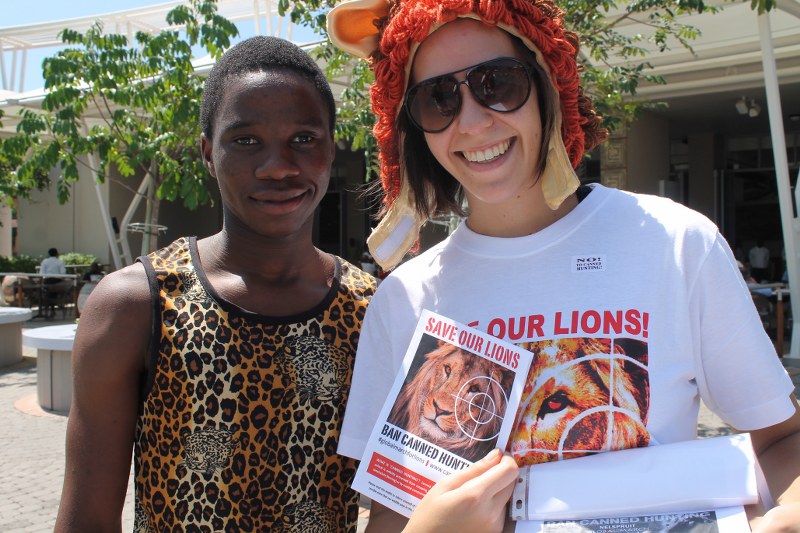
NELSPRUIT – The King of the Jungle should roam free, not be petted as a cub and destined to die as part of a canned hunting episode. This message was made clear by millions of people worldwide on March 15 by means of the Global March Against Canned Lion Hunting, which was also held in the city.
While marches took place in 64 other locations including Johannesburg, London and Hong Kong, local organisers Ms Yolande Scott and Ms Ingrid Raikes ran awareness campaigns at two local shopping malls.
“Today’s efforts will be worth it, even if we dissuade only one tourist today from supporting an establishment that promotes the petting of lion cubs,” was the opinion of Mr Vaughn Jessnitz, a game ranger of Manyeleti reserve.
Game farms that allow canned hunting are not listed, but the local game-ranging fraternity believes it is taking place in the Hoedspruit area.
Several youngsters joined the campaigners to spread the word about canned hunting, the lion bone market and the rapidly declining number of lion on the wild. Scott was delighted with the efforts and more than 1 200 signatures that were added to the global petition addressed to the president Mr Jacob Zuma, requesting a total ban on canned hunting.
The petition has 1,4 million signatures.
What is canned hunting?
This refers to cases in which an animal is unfairly prevented from escaping a hunter either by means of physical enclosures or because it has been tamed by humans.
It is estimated that there are 8 000 lion currently in captivity, most of which will die at the hands of a hunter. Search for any African hunting experience on the Internet, and you will see how lucrative this industry can be for the owners of these animals. A male can reach up to US$22 000, a lioness US$9 000 and a white lion up to US$30 000.
According to Lion Aid (www.lionaid.org) any “canned” lion hunter is guaranteed success, as every lion available for sale, is assigned to a specific client. There is no hunting season. The operators generally “demand” a 7-to-10-day safari, and the “hunter” might not be provided with the lion to shoot until some days have passed. The first few days are spent “searching” for the prey by the gullible client on the larger game ranches, but when the lion is put in the right area, the client is taken straight there.
Lion might have been transported only the evening before, and are generally provided with bait to confine them to a particular spot. As these are lion are very used to humans, clients can generally walk right up to their target to take an easy shot.
What will happen to the captive animals if canned hunting is banned?
Mr Chris Mercer, the founder of the NGO Campaign Against Canned Hunting, explained that the South African government will only ban further breeding, and when the industry is starved of new cubs it will gradually decline.
Extra money is also generated through the cubs of captive mothers, which are used as a tourist attraction.
Will a decrease in canned hunts lead to more wild lion being hunted?
Lion farming actually causes an increase in the poaching of wild lion to allow a healthy mix in the genetic pool, in the opinion of activists like Mercer and organisations like the International Union for Conservation of Nature (IUCN). CITES (Convention on International Trade in Endangered Species of Wild Fauna and Flora,) also places restrictions on the numbers, sexes and ages that can be hunted in the wild.
What is of concern to wildlife enthusiasts and conservationists, however, is the fact that canned hunting currently supplies the Asian market with lion bone. “The demand for it will grow. Prepare for a poaching frenzy of wild lions every bit as shocking as the existing slaughter of rhino,” is Mercer’s gloomy prediction.
Also see photos of the Nelspruit events and access the petition online.
Campaign Against Canned Hunting is a South African NGO that aims to cut off the funding of this practice from the overseas source. Read more about this organisation at www.cannedlion.org