NELSPRUIT – There is less than two weeks to go before the general elections on May 7. On Tuesday the president Mr Jacob Zuma announced that it would be a public holiday.
Citizens aged 18 or older who have registered can vote or not vote for a national and provincial government. According to the independent electoral commission (IEC) which oversees the elections, there are 1 680 voting stations in Mpumalanga this year. But before you visit your station (the same one where you registered) be sure of every step of the process and your rights.
How to vote
On election day, take your green bar-coded ID, Smart ID Card or temporary identification document to a voting station near you.
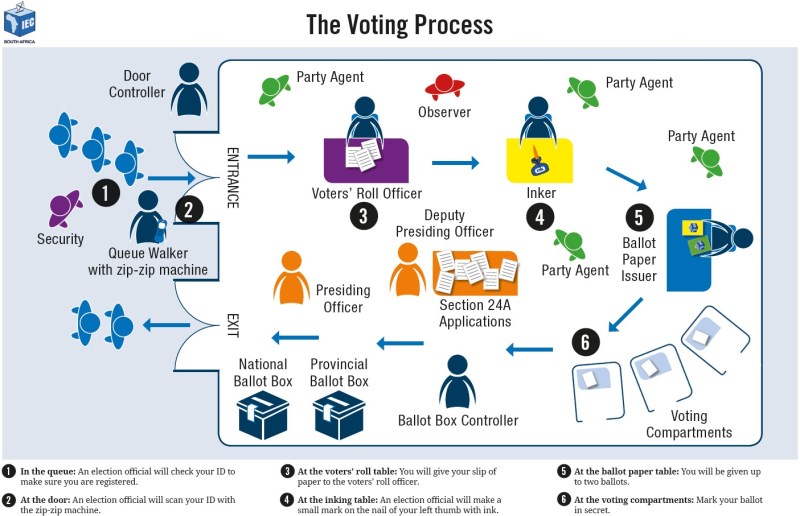
While you are in the queue, an election official will check your ID to make sure you are registered. Another one will scan it with the zip-zip machine and give you a slip of paper indicating your sequence number.
Hand the paper slip to the voters’ roll officer who then stamps your ID to show you have voted.
An official makes a small ink mark on your left thumb to indicate that you have voted. Trying to do so more than once counts as an election crime along with forcing someone to vote or not to vote, destroying voting materials and publicly disclosing how a person voted.
The ballot-paper issuers give voters two ballots (if you are in the correct province). One is to vote for the national and one for provincial government.
Inside a voting compartment, secretly mark your ballot in the block next to the party of your choice. Fold the paper over. Drop your provincial ballot in the provincial ballot box and drop your national ballot in the national one.
Section 24A applications
Registered voters who are unable to vote in the voting district where they are registered on election day can vote for the national assembly at any station in the country. They will also be able to vote for their provincial legislature at a station in the province where they are registered. To do this, fill out a section 24A form at the voting station.
Presiding officer
Each voting station has a presiding officer who is in charge. Since everyone has the right to vote safely, people can address any complaints regarding intimidation or safety fears to the presiding officer or police. Anyone who disobeys a presiding officer or a security officer’s orders can be fined or imprisoned for up to one year.
The IEC suggested that people with physical disabilities and voters who have difficulty reading bring along someone they trust to help them, but otherwise the presiding officer can be approached for assistance. The officer will ask an accredited observer and two party agents representing different parties to watch while they help you.
If you make a mistake when you mark a ballot paper and notice this mistake before putting it into the ballot, ask the officer for a new one. Your old ballot paper will be cancelled.
Election observers
The IEC will accredit organisations wishing to appoint election observers if they promote free and fair elections, observe impartially and independently of parties and candidates, observe competently and professionally, and follow the IEC’s code of conduct.
Accredited observers can observe voting, counting and the calculation of election results. They must wear identification tags approved by the IEC. It can cancel their accreditation if they do not follow conditions set by the IEC. Anyone can inspect the register of accredited observers and copies of certificates of people registered as observers at the IEC head office.
Party agents
Party agents are accredited by the IEC to be inside the voting station to observe voting, counting and the calculation of election results. Each registered political party is allowed two representatives at each station and four party agents for each counting venue as well as four agents for venues used to work out the overall election results.
They observe and represent the interests of their parties in ensuring free and fair elections. They can also make any complaints to the presiding officer or a counting officer.
They must wear identification tags and follow orders given by the IEC and in no way interfere with a voter by forcing, influencing or persuading a person to vote or not to vote for a party.
They may also not display or distribute billboards, placards, posters or pamphlets nor wear, carry or display any clothing with any writing, pictures or signs linked to a party or candidate except for their identification tag.
Party enthusiasts
On election day political parties are allowed to set up facilities outside the demarcated voting stations. While there is no rule about how far they must be away from the station, the presiding officer at each one had the power to remove them.
The presiding officer can also instruct a party to move its facilities and get help from a security officer to achieve this and must resolve disputes between parties about where to place their facilities.