Spiders are not out to get you!
In South Africa, there are about 2 500 species of spiders, only a handful of which have venom that can really affect humans.
MBOMBELA – There have been numerous reports of people suspecting that they have been bitten by spiders in the Lowveld. Even though it is very difficult to prove that this is the case, it is important to know which spiders to look out for, and leave them in peace.
In South Africa, there are about 2 500 species of spiders, only a handful of which have venom that can really affect humans. This is according to one of the authors of Spiders of Southern Africa, Astri Leroy.
Most spiders produce venom which is a mixture of saliva, venom and digestive fluids, used to subdue, kill and digest their prey but in general, has little or no effect on mammals including humans.
However, there are four potentially dangerous ones to watch out for in the Lowveld and most parts of the country. They are the black button spider, to a lesser extent brown button spiders, sac and violin spiders.
In Africa black button spiders do not have the red double-isosceles-triangle marking under the abdomen but can have a variety of red and gold markings. These little creatures are regarded as the most dangerously venomous spiders in southern Africa. Although they are reluctant to bite and prefer to play dead if disturbed, proven bites must be taken seriously and medical attention sought. The potent venom affects the nervous system (neurotoxic), causing severe systemic symptoms and localised pain, but in South Africa there have been no recorded human deaths as a direct result of its bite in more than six decades.
Brown button spiders, despite their name, can be creamy white to very dark blackish brown. Their venom is very similar to that of a black button spider but is less potent. They are also reluctant to bite and also prefer to play dead when disturbed. When symptoms of its bite occur, they should be treated although there is only one known case of lactrodectism from its bite, and no human deaths have been recorded. Antivenin for both button spiders is available in South Africa.
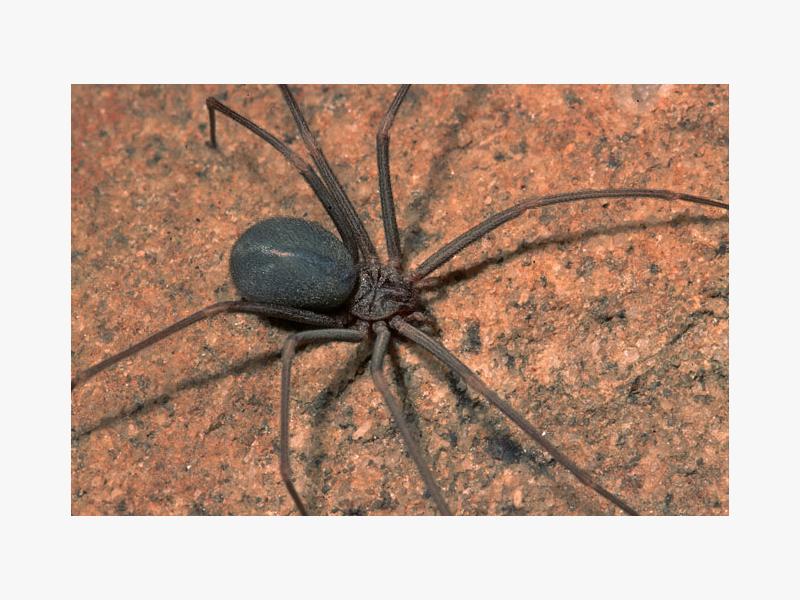
Over the past few years emails have been circulating claiming that violin spiders have become a serious problem in South Africa and that their numbers are increasing at an alarming rate. Surveys over the past 40 years proved they are regarded as rare with very few specimens recorded in homes. This is according to Dr Ansie Dippenaar-Schoeman, a world-renowned scientist who has worked with spiders all her life.
Free-living nocturnal hunters such as violin spiders are very reluctant to bite and will do so only if inadvertently squashed against the skin.
Their venom is cytotoxic to humans and can, but will not always, cause long-lasting necrotic wounds. Bites are not life threatening and the danger has been much exaggerated. Supportive and symptomatic treatment is important, but no antivenin is available or necessary.
The long-legged sac spider also has cell-destroying venom and accounts for about 75 per cent of known spider bites. They cause small necrotic wounds which can take several weeks to heal completely. No medical attention is necessary if the bite is that of a sac spider.
There are however a number of misconceptions when it comes to spiders. They are not out to get us. In general, spiders will not bite unless they are squashed against our skin – they don’t even bite in self-defence as some larger creatures do. They do not make a living by sucking our blood and are not vectors of any diseases. They are not able to lay eggs under our skin and will most certainly not make their nests in our hair. In fact, spiders see us as big and dangerous creatures and will avoid contact at all costs. Most supposed spider bites turn out to be lesions from bacterial infections or less often to be tick, flea, mosquito or other arthropod bite. Fungal infections or lesions resulting from some underlying medical conditions are also sometimes blamed on spiders. People with impaired immune systems are more susceptible to infections which cannot be diagnosed so medical practitioners take the cautious route of prescribing broad-spectrum antibiotics.
According to a well-known medical entomologist, Rick Vetter, one of the very real problems with arthropod bites is that they cause itching, the victim scratches, introduces a secondary bacterial infection from grungy fingernails and such, a horrific wound appears and is then solely blamed on the arthropod when the real culprit is the victim him/herself.
According to Leroy, there is no way to keep spiders out of your home unless you keep everything closed. “They will come in. You can just chase them out. Otherwise you can move to Antarctica – there are no spiders there.”