Taking care of the survivors
Often, the poachers will also kill any calves, either for their small horns or for no particular reason whatsoever.
SKUKUZA – The number of rhino killed by poachers this year has already soared to nearly 300, in the Kruger National Park (KNP) alone. While these criminals are only after the horns, the animals rarely survive the brutal attacks. In fact, according to head of the SANParks Veterinary Wildlife Services, Dr Markus Hofmeyr, help for a rhino that survived has been called only four or five times the past year. Furthermore, only two calves have been rescued after such ordeals.
SANParks veterinary surgeon, Mr Peter Buss explains that if they find a rhino that fell victim to poachers and survived, they will treat it in the veld if there is a chance of survival. “If they are too badly injured, we euthanise them,” he says. The organisation follows a strict ecosystem-centred philosophy, says Dr Freek Venter, KNP general manager of conservation management. It tries to balance this with respect to all living creatures.
“Our focus is not so much on the individual animal as on the species and its survival,” Venter adds. “We are not in the rehabilitation industry as we do not have the facilities or resources to help individual animals, and therefore rather leave this to qualified people.”
Injuries are multifaceted. Poachers shoot the animal first, and if this is not fatal, the shock will stun it enough to allow for the horn to be chopped or sawed off, or even hacked out, leaving it with enormous facial trauma. Other common injuries include deep cuts where they were hacked with pangas.
Often, the poachers will also kill any calves, either for their small horns or for no particular reason whatsoever.
“We’ve found them with panga cuts and their horns still intact,” says Venter. Even if the calves survive, they become prey to hyena or lion that are drawn to the mother’s carcass. If they survive this, they become severely dehydrated and eventually die in die veld. He explains that if the calf is too severely injured, to the extent that it will never be able to be released and feed for itself again, it will be euthanised.
Sometimes, though very rarely, the calves survive and are found by rangers, although Venter stresses that this happens more rarely than people think. In such cases, since the mother died of unnatural causes, and if the little one is in a relatively good condition, they will try to save it, particularly if it is a black rhino, listed as critically endangered. Yet, it’s life will never be the same again
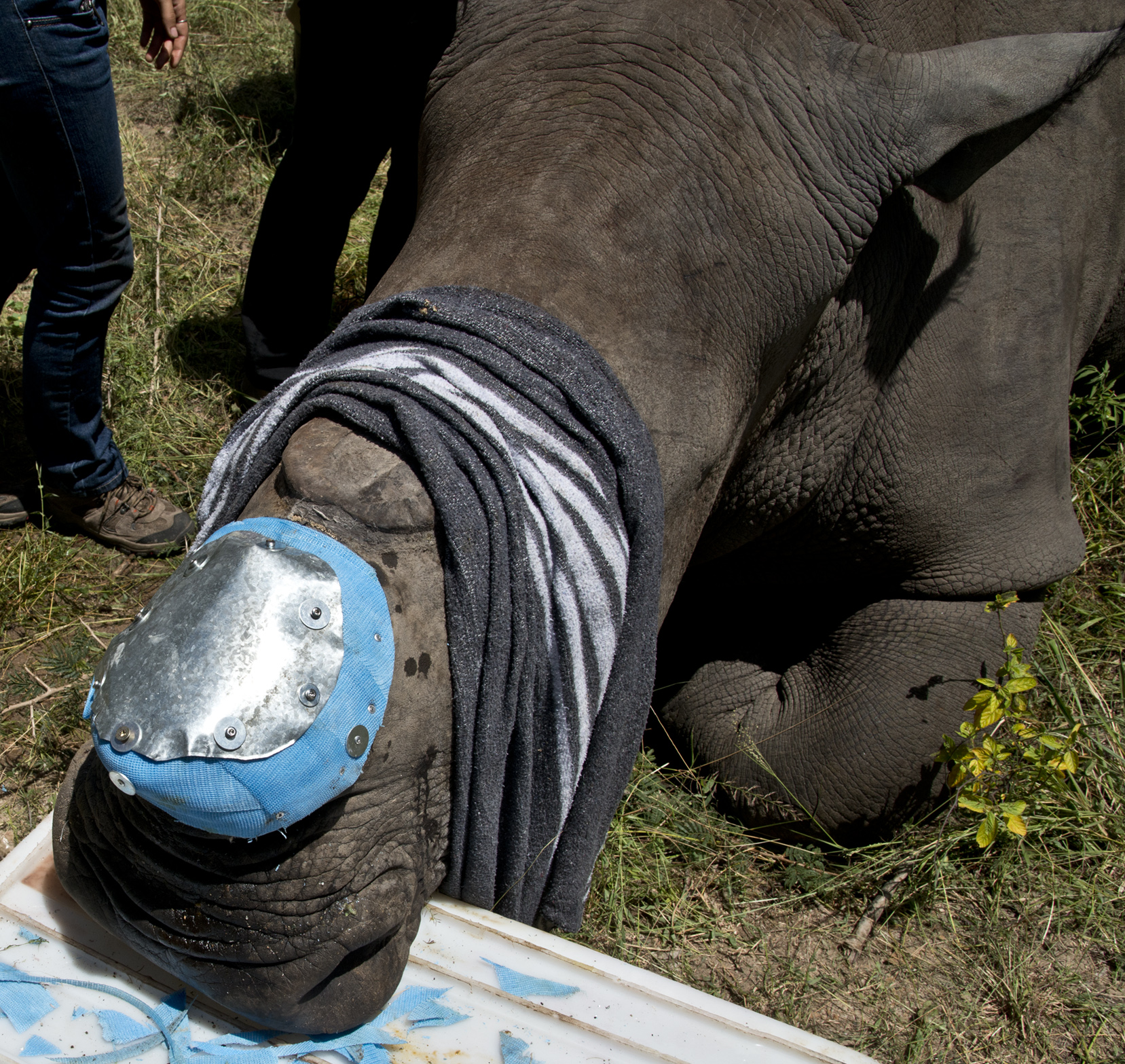
It is then taken to a reputable rehabilitation centre like Care for Wild Africa. Owner, Ms Petronel Nieuwoudt says that in preparation, the calf’s ears will be plugged, it will be blindfolded and tranquillised, and a drip inserted in each ear to start rehydration. It is then crated and taken to the centre’s facilities outside Mbombela.
“We treat the animals for trauma, stress, dehydration and stomach ulcers when they arrive,” says Nieuwoudt. They ensure that they are kept warm and comfortable. If they are still very small, she will sleep next to the crate to monitor their condition and provide company.
After about two days, they will take the blindfold off so they can see who has been feeding them. Staff keep a close eye on excrement and urine to ensure the calves are healthy and hydrated. When they are drinking well enough, they are introduced to the other little ones at the centre.
“It can get a bit rough and tumbly,” she says, as they are initially a bit unsure of their new family.
At this stage, they are housed in a small enclosure, and fed through an opening, minimising contact with humans.
The calves will now become a herd, and will be kept together wherever they are to roam in future.
They will never be released in places like Kruger again, but they will be able to breed, and will contribute to the genetic integrity of other rhino populations, helping the species as a whole to survive well into the future.
Read about another initiative, Saving the Survivors, started by two veterinarians, here.