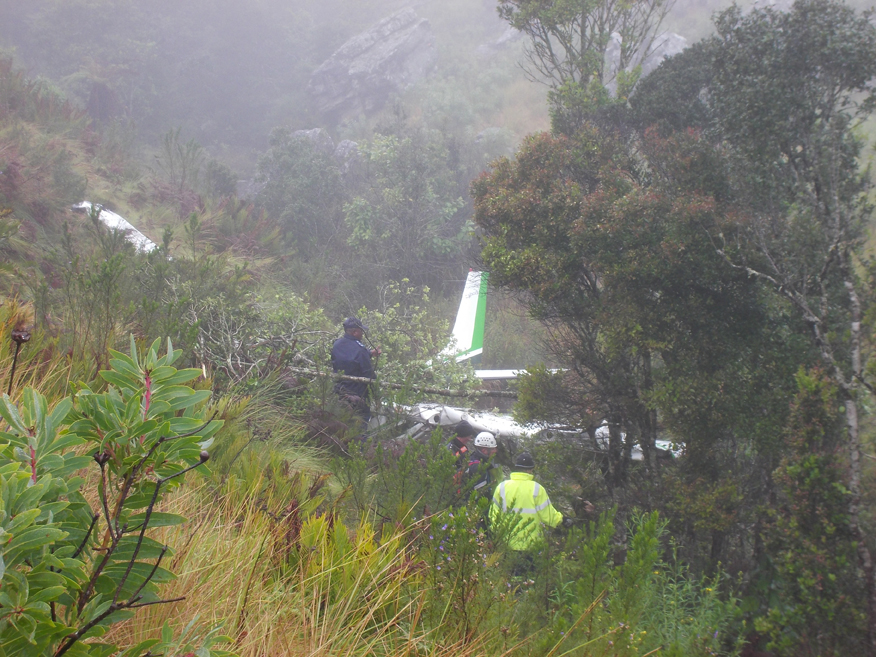
MBOMBELA – The cause of the aircraft crash in which New Zealand citizens Mr Richard Primrose (63) and Mr John Walton (49) were killed near Graskop last year, has been attributed to human error.
The Civil Aviation Authority (CAA) found that Primrose, who was the pilot-in-command that day, didn’t have enough training and experience flying in mountainous terrain and that it led to the accident. The Cessna 182P which he flew crashed in the Opdenburg farm area of Dientjie on August 22.
Lowvelder reported on the accident and the several hours it took police officials and other rescue volunteers to reach the wreckage and retrieve the bodies of Primrose and Walton. They had been on a so-called flight safari and were part of a formation of three planes when they crashed. The accident report was released by the CAA recently.
Departure
According to the report, three Cessna 182 aircrafts departed from Polokwane aerodrome in loose formation on a last leg African self-safari bush adventure scenic flight to Kitty Hawk Aerodrome in Gauteng.
The occupants were going to have lunch there and then proceed to Wonderboom aerodrome as their final destination. No flight plan was filed. Primrose had been seated in the left of the cockpit and Walton was seated on the right- acting as his co-pilot. According to a witness, who piloted one of the other Cessnas, Primrose had diverted at 6 500 feet from the planned route Southbound and entered a valley at low level in an easterly direction.
The Cessna was seen executing a 180 degree turn to the left with the intention to route away from the rising terrain, after which it collided with the high ground. Hoedspruit military airbase air traffic controller was informed accordingly and the South African Air Force’s Oryx helicopter was immediately dispatched to the crash site.
Information on Primrose and Walton
Primrose was not in possession of a South African Civil Aviation Authority (SA CAA) pilot licence validation. His profile revealed no accidents or incident history, enforcement actions or rating failure. The last pilot log book entry was dated August 2013, with a total of 1 978,4 flying hours. Walton had a SA CAA foreign pilot licence. His profile didn’t reflect any accident or incident history either.
Weather on the day
Information and eyewitness reports defined clear visibility throughout the area during the time of the accident.
Examination of the Cessna
Post-accident examinaton of the wreckage revealed no pre-impact engine or airframe abnormalities that might have affected the aircraft’s performance. No reported defects were recorded since the last mandatory periodic inspection was certified and no distress call was made by either Primrose or Walton prior to the incident. The Cessna was within its weight limitation and had flown 43,7 hours since the last maintenance inspection was certified.
Wreckage information
The wreckage was found 5 200 feet above sea level.
Pathological information
Both Walton and Primrose had died due to blunt force trauma to the chest due to deceleration.
Survival aspects
The accident was considered to be non-survivable due to the magnitude of high deceleration forces, “outside the tolerance of human ability”.
In summary, the CAA’s investigation revealed that Primrose had intended to execute a 180 degree turn to the left after noticing that the aircraft was too low and couldn’t gain altitude. Because of severe mountain wave turbulence and down-flowing air, the Cessna couldn’t complete the turn, lost altitude and airspeed, rendering ground impact inevitable.
“The minimal mountain flight training that the pilot received during the pilot competency check, would not have provided him with adequate preparation for the challenging situations presented in this environment,” the report read.