MBOMBELA – So you have broken environmental regulations and started preparing some land for construction without permission, removing indigenous vegetation in the process. You stopped construction, but now what about the environment?
Lowvelder reported last week on how Mr Simon Mkhatshwa, owner of Cefups Academy, has stopped all activity on his farm on the Uitkyk Road after being served with a pre-compliance notice by the department of environmental affairs at the beginning of November last year.
Mr Bheki Nyathikazi, spokesman for the department, indicated that the reason for the notice was that indigenous vegetation had been cleared from the area without permission.
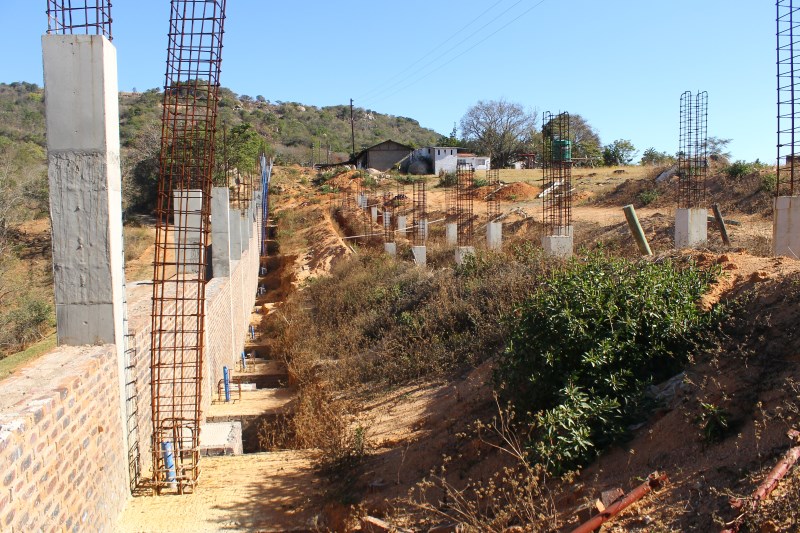
A monstrous wall now fences in a large section of the farm. Lowvelder spoke to Prof Kevin Balkwill at the School of Animal, Plant and Environmental Sciences at the University of the Witwatersrand about the implications for the environment. Balkwill served on the Crocodile Gorge Conservation committee in the area and says the environmental changes will cause long-term trouble if left untreated.
“If it is left as it is, the area will be vulnerable to infestations by weeds. It would be difficult to replant the plants that had been removed, but it may start to recover in 30 years’ time. Grass can be replanted to stabilise the soil for now. If the soil is not stabilised it will wash away and erode and silt up the dam. I don’t know if they poisoned the trees when they cut them down. If not hopefully they will sprout again. They can also plant trees. I would recommend a red currant (searsia chirindensis) as it is pretty common in the area and functions as nurse trees. Where seeds can be found of plants that used to grow there from surrounding areas, these can help too.
“It is a long process, the sooner it happens the better.”
Balkwill added that the wall is unsightly and the foundation disrupted the water drainage line from the mountain. He agreed that it would do more damage to try and remove the deep and wide concrete foundations.
“Where the foundations are still open it is a health and safety risk to people and animals who can fall into the holes. The foundation should be filled in with soil.”
He explained that the foundation’s presence was not ideal but could act like a big boulder in the way of the water drainage line. However, the top part of the wall ought to be removed, otherwise it would create a dyke preventing the water from flowing down. However, with just the foundation remaining, the water would flow down.
“The bricks of the wall should be removed completely. The pillars should be cut down half a metre below the ground, otherwise it will be too wet at the top and too dry at the bottom where the water must flow.
“This will put the vegetation downhill under water stress. It should be done as soon as possible,” Balkwill concluded.
Mkhatshwa could not be reached for comment, despite persistent attempts by the newspaper.