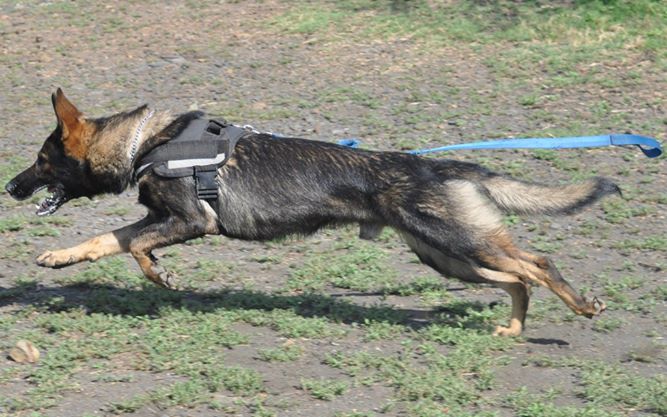
MBOMBELA – A court battle that may make South African legal history continued in the Nelspruit Regional Court on Friday. Mr Jeremano Thive and Mr Andelius Mukwebe were arrested after a tracking dog sniffed out their location in the Nwanetsi area of the Kruger National Park (KNP) on January 19, 2013.
They allegedly had rhino horn in their possession and face charges of contravening the Immigration Act, three charges relevant to illegally entering the park and poaching. On Friday the admissibility of the evidence concerning the tracking dogs was debated by defence attorney Mr Daniel Mabunda for more than two and a half hours.
Senior state advocate Ms Isabet Erwee motivated the admissibility thereof for an equal amount of time on June 9 this year.
Mabunda’s argument was based on legal precedents formed over the past 95 years. In 1920, the South African Appellate Division rejected this evidence, reasoning that sufficient scientific knowledge was not available to prove that certain breeds were able to follow the scent of specific humans without error. Due to room for uncertainty, he said this evidence could not be legally relied on.
In 1986 in the Supreme Court of Appeal, the judge ruled that the final say in the matter had not been pronounced. He said that evidence produced by tracking dogs would be considered inadmissible unless a proper foundation for this evidence had been laid. If the court considered this evidence admissible, it would be considered with caution.
Erwee had called seven witnesses to testify for the state. She referred to the testimony led in order to lay such a foundation. According to dog trainer Mr Henry Holsthyzen, Killer was introduced to the park at an early age to desensitise him to wild animals. He had to get used to the scents of animals so that he could focus on tracking humans. Killer underwent a two-year training process and Holsthyzen was confident that even the blood of a rhino would not distract the canine from tracking a human. The KNP chose to use Killer’s breed as it has proved to be the most effective one for the purpose of tracking in the park.
Whether the state has laid a proper foundation for the evidence of Killer’s tracking to be admissible, remains to be decided by the court. Magistrate Mr Eddie Hall postponed the case to August 18 after having heard summaries of the merits in both the state and defence arguments.
Read more on how the accused’s briefcase intrigued our court reporter:
It was a briefcase and a Bible