Marchers unite against horn trade
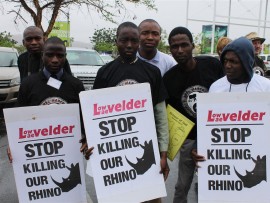
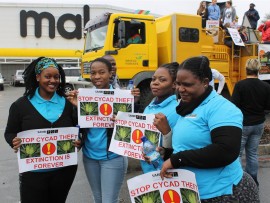
Protesters marched on legislature to hand over a memorandum of demands regarding poaching legislation as part of the Global March for Elephants and Rhinos on Saturday. Representatives of Wessa and Global March feel that government is still not doing enough to curb the rhino poaching crisis.
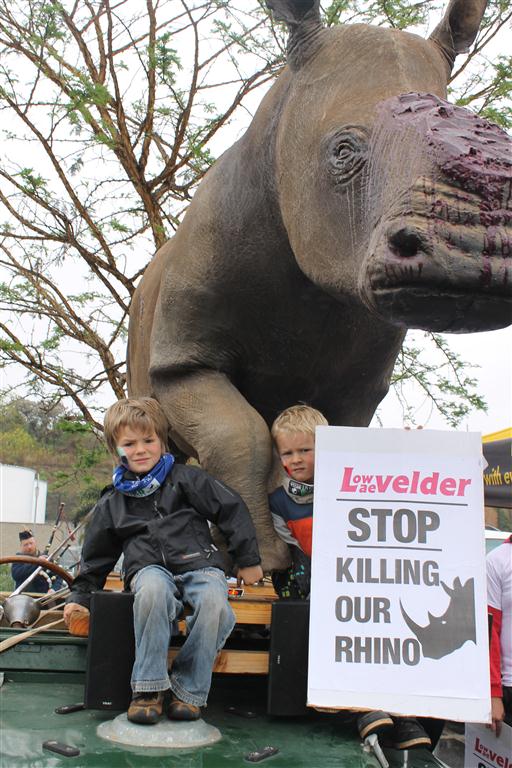
MBOMBELA – Mpumalanga’s capital was the first out of 135 cities globally to raise awareness of the decimation of rhinos and elephants during the Global March for Elephants and Rhinos on Saturday.
The march was an initiative aimed at creating awareness around the prospect of extinction of these animals. March4elephantsandrhinos.org proclaims that more than 35 000 elephants are being killed each year for their ivory, while one rhino is slaughtered every eight minutes for its horns.
The organisation stands for stopping the legal and illegal ivory and rhino-horn trade. The cause culminates in annual, worldwide, protest marches to support the ideal. This year Mbombela preceded the global set dates of October 3 and 4 and handed a memorandum over to Mr Sam Maluleke, chief director of environmental services on Saturday.
The march was led by Mr Dex Kotze, Global March for Elephants and Rhinos coordinator, and Mr Ricky Pott, Lowveld chairman of the Wildlife and Environmental Society of South Africa (Wessa).
Upon the handover, Kotze urged Maluleke to give the memorandum of concerns to the department of justice, president, Mr Jacob Zuma and vice-president, Mr Cyril Ramaphosa. Kotze explained the demands in the memorandum and stated that the same requests were made in 2014 and that none of them had been met as yet. “South Africa’s legislation does not exist to keep rhino poachers behind bars. We asked last year and we’ve had no reply. We are urging the South African government to make the sentencing of poachers more stringent.

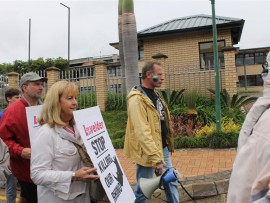
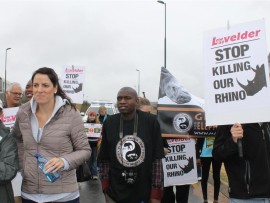
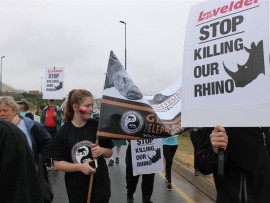





“We are asking for 15 years, making rhino poaching and elephant poaching a criminal five offence in the Criminal Procedures Act as it is known, and to give no bail.” Kotze further explained the public concern is that poachers walk away from their crimes with extremely light punishments. “Everybody here knows, and we hear the news, that poachers are sometimes given as little as R1 500 bail and that is our big problem. We want no bail. And if they are guilty, give them 15 years and make them refund the legitimate owner, whether it’s the government, the community or a private person, with the value of the rhino.”
Pott stated that, to his knowledge, the only demand in the 2014 memorandum that was attended to by government to some extent, was the adaptation of legislation to allow SANParks to subcontract selected field operations to the private sector. “The slaughter of rhino in South Africa continues unabated. Despite patrolling and efforts, we’ve probably reached the point where mortality rate exceeds the birth rate, with the inevitable consequence of rhinos heading towards the black void of extinction,” he said.
He further expressed concern about the regular poaching activity linked to neighbouring Mozambique. “We are aware that the majority of the poachers come from (this) neighbouring country where unemployment is rife, and the rewards of rhino poaching are so great, that there is never a shortage of recruits, in spite of the danger of being arrested or killed. While we sympathise with their unemployment and their poverty, we cannot condone the poaching and we call upon this neighbouring country to create employment opportunities in the areas where the poachers come from.”
Pott also categorically stated that Wessa will undertake to continue the allocation of funds to projects that may curb the poaching crisis, and extended an invitation to private conservation organisations, custodians of rhinos, to SANParks and the MTPA, to approach Wessa with their needs. He invited all South Africans to help raise money to meet these needs. Prior to the march, Kotze told Lowvelder that although there is a focus on rhino poaching, elephant slaughter in Africa is a grave concern.
“Ninety six elephants are poached every day all over Africa, and most of this takes place in Tanzania. It’s all pushed by the demand for ivory in China, and it’s only a matter of time until this crisis spills over the borders into our country,” he said. Kotze was highly critical of what he describes as the South African government’s, and specifically Zuma’s, lack of leadership in the matter.
“It’s been eight years since this crisis started and still the government has not taken any action with tangible results. President Zuma is a weak leader when it comes to environmental matters, and he needs to come to a rhino-poaching scene and see for himself what’s going on, if that’s what it takes to make government protect a dwindling species,” he stated.
Watch an excerpt of the march here: