National Key Point Act often abused to deny media access
Even Lowvelder fell victim to this "ridiculous" act.
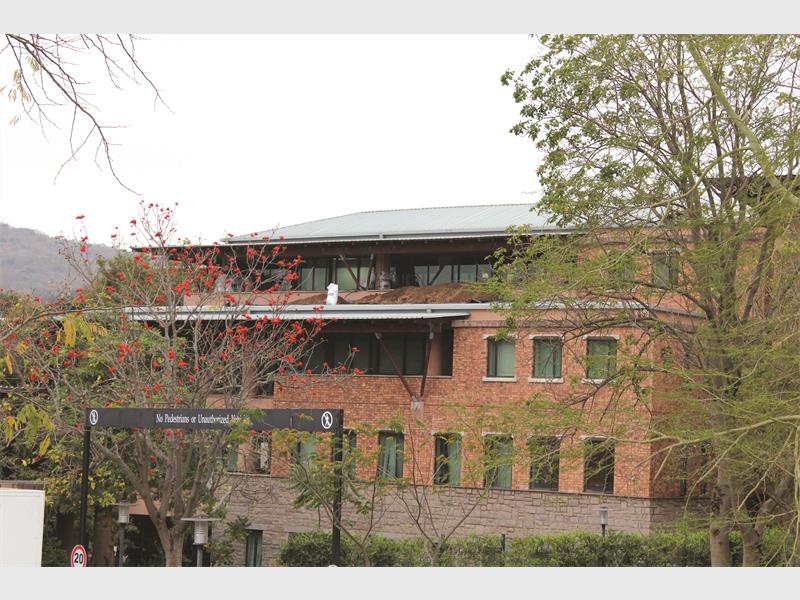
MBOMBELA – In July Lowvelder reported on the collapse of the roof of one of the government complex buildings – ironically, the Department of Public Works, Roads and Transport (DPWRT). However, the security guards denied this journalist access to the building because, they said, it had been registered as a national key point (NKP).
Later that day the department sent out a press release claiming that the roof had collapsed due to a large amount of potting soil which had been removed from pots and placed on the roof, causing the corrugated-iron structure to give way.
This ordeal sparked questions about what we can report on in this democratic country, if we can’t even report on the roof of a government building. Does the government use the National Key Points Act (NKPA) as an excuse to avoid answering embarrassing questions?
But what is a national key point? In 1980 the government instated a law which prohibited the press from reporting on certain issues which could threaten national security. It was called the National Key Points Act (NKPA) of 1980.
See the National Key Point Act here: National Key Points Act
An area or building can be classified as a NKP “if it appears to the minister at any time that any place or area is so important that its loss, damage, disruption or immobilisation may prejudice the republic, or whenever he considers it necessary or expedient for the safety of the republic or in the public interest, he may declare that place or area a national key point”.
In other words, a person or place can be registered as a NKP only when their loss or damage poses a direct threat to the security of the state. This reporter, for example, could not report on the safety measures taken at a NKP – the government complex, in this case – like security cameras or safety checks.
An “incident” taking place at a national key point is defined as “a means or occurrence arising out of or relating to terrorist activities, sabotage, espionage or subversion”.
In both clauses mentioned, the collapse of a government building’s roof due to an excess amount of potting soil, could not be seen as a threat to state security and thus the denial of access was, in fact, unlawful.
Mr Murray Hunter, spokesman for Right2Know (R2K) told Lowvelder that government officials are quick to hide behind the NKPA, mostly because many reporters and members of the public are not familiar with the Act and do not know when they have the right to demand comment.
“It is imperative that everyone know where the Act comes from and which information can be classified in the act,” Hunter said. “Government officials will use this ridiculous Act to avoid answering just any old question.”
Hunter labelled the DWPRT’s response to this journalist as “nonsense”. “If they knew anything about the NKP Act they would know that they can’t deny the press access to an accident scene if the reporting will not compromise state security.”
The department was slow to respond to Lowvelder’s enquiry. According to DPWRT spokesman Mr Mxolisi Dhlamini, the building was evacuated for safety reasons. “During the incident in question, necessary safety measures were activated which, among others, included the immediate evacuation of the building. As a result, no one was allowed to access it since it was cordoned off as an accident scene.”
However, with the correct authorisation, the media are allowed on an accident scene. The only reason given for the denial of access was the NKP Act.
“Do not let officials fool you,” warned Hunter. “They will reword and rephrase facts to protect themselves.”