What to do when your property gets land-grabbed
The recent public debate on land expropriation has been an ongoing battle. Lowvelder summarises what you need to know in order to protect your property rights.
In order to define land expropriation within the context of Section 25 of the Constitution, one must distinguish between deprivation and expropriation.
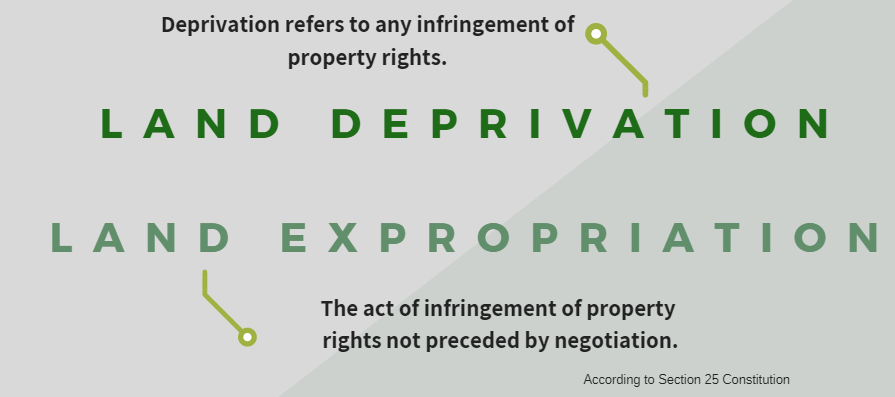
Expropriation can be seen as a subcategory of deprivation: Arbitrary deprivation of the owner’s property. In this sense arbitrary means that the deprivation was not preceded by negotiations that accommodated the deprived party.ⁱ
https://soundcloud.com/roneque-jvr/explanation-of-the-constitutions-section-25
Many experts claim that the contra-Constitutional dialogue was nothing more than pre-election speech. On the other hand, certain residents have questioned whether it is indeed time to question the Constitution.
The public debate has been highly publicised. Inaccurate media reportage left some South Africans with the impression that the law has been altered. This is not the case.
Lowvelder answers some FAQ’s
What to do if land grabbers threaten to take possession or expropriate your land
You need to apply for an urgent interdict at your nearest competent court. This may order those who threaten you to not set foot on your property or expropriate it. Contact your attorney for legal advice in this respect. Anyone who contravenes will be in contempt of court and may be arrested.
What to do if people trespass on your property
Regardless of their intention, whether to invade or expropriate, trespassers are trespassers and their presence by definition is illegal. The Trespassing Act, which states that no person may access land or property without the lawful owner or occupier’s permission, will be implemented.
If a person trespasses it is a criminal offence and you should contact the police and report the trespasser.

What is the difference between a trespasser and an unlawful occupant?
If an unwelcome visitor erects a structure on your property with the intention to live there, they become an unlawful occupant. The Prevention of Illegal Eviction and the Unlawful Occupation of Land (PIE) Act will apply. This means that the unlawful occupant may only be evicted from the land in terms of a court order.
A court order can be obtained from the court on an urgent basis if the landowner or legal occupier can prove that there is a real and imminent danger that they may suffer serious loss if unlawful occupants are not evicted. Evicting unlawful occupants without a court order is illegal.
The landowner or legal occupier must also prove that their potential losses are greater than that of the hypothetically evicted unlawful occupant, should the latter be evicted.
Will the PIE Act protect expropriators?
Recently expropriators have made themselves guilty of criminal conduct while trying to expropriate land. Regardless of whether someone is a legally protected occupant of land, if they commit a crime such as trespassing, arson or malicious damage to property, they will be arrested.

In the past police have arrested land occupiers in terms of the Gatherings Act. This stipulates that where 16 or more people partake in a protest, contest or criticism expressed in a public space, local authorities must be notified. Police previously argued that planned land evasion protests have amounted to illegal gatherings.
Many recent debates over the possible amendments or removal over Section 25 of The Constitution have emerged.
In order for Section 25 to be amended the following requirements must be met:
• Two-thirds of Parliament must vote in favour of the amendment.
• Six out of the nine provinces in the National Council of Province must vote in favour of it.
“The legal position will become more certain after consequential amendments to laws have been made,” a legal adviser stated.
https://soundcloud.com/roneque-jvr/land-expropriation-debate-in-two-minutes
ⁱ Reference: FNB versus South African Revenue Services (2002 7 BCLR 702 CC)
Sources: Interview with admitted attorney Helene Eloff, Trespassing Act, the Regulation of Gatherings Act, the Prevention of Illegal Eviction from and Unlawful Occupation of Land Act, Lowveld Media Archives, The Constitution of the Republic of South Africa, Jurisprudence.
This should not be construed as legal advice to be applied to any specific case. Readers are advised to discuss individual scenarios with their attorneys.