Beacon College wants to plant hundreds of trees to fight global warming
Instead of just learning about global warming, Beacon College learners are planning to plant hundreds of trees throughout Nkomazi to combat it.
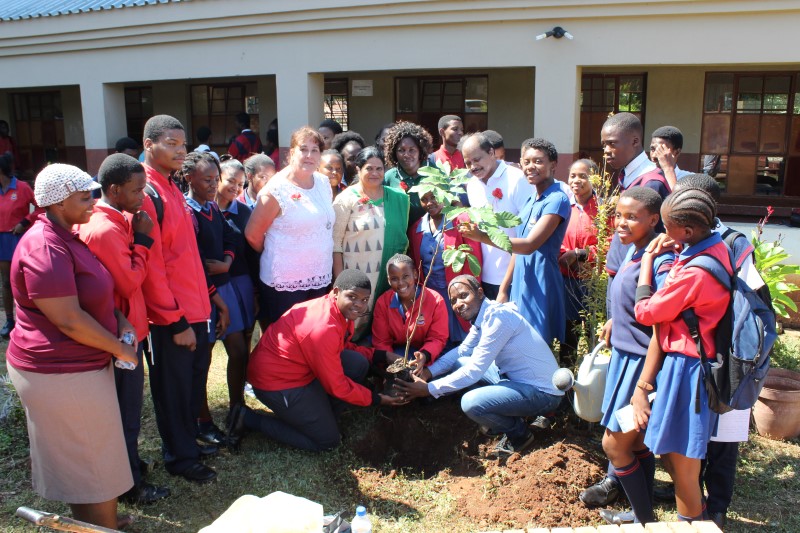
MALALANE – Beacon College launched the first phase of their Greening Project last Tuesday with an information session for learners and by planting the first of hundreds of trees on the premises.
The seed for the project was planted in July last year, when Beacon’s director, Surendran Nair, decided that they needed to do something practical to aid the environment.
A team of seven grade 11 geography learners, led by teacher Munyaradzi Munikwa, was established to come up with solutions.

The group visited the Kruger National Park (KNP) and the Lowveld National Botanical Garden to chat to experts about environmental conservation. The organisations also lent their support to the project.
READ: Enviro Monday: How trees talk to each other via the wood wide web
It was decided that planting trees at the school and in the community would be the project’s focus and the KNP and SA National Biodiversity Institute (Sanbi) each donated indigenous trees for the first phase.
The Greening Project group grew to 40 members and, with their slogan of “just go green”, they hope to encourage communities to join their cause.
At the launch, Nair told learners and guests that trees are an integral part of the community as they provide shade and oxygen but are often taken for granted. “As long as you use oxygen, it is your responsibility to ensure that more is produced,” he said.

Learners entertained friends and guests with speeches, poems and even songs on why trees and plants are important, the effect of global warming and humanity’s destructive ways and the aim of the Greening Project.
Elaine Nkosi, an environmental officer at the KNP, also elaborated on the benefits of planting trees, such as helping to avoid soil erosion, soil enrichment and providing shelter and food for people and animals. She mentioned the negative impact people have on the environment and encouraged learners to only take what they need from trees instead of just chopping them down.
READ: Municipality celebrates schools greening projects
The KNP donated five pepper-bark and Natal mahogany trees, while Sanbi donated a baobab, wild plum, two Natal mahogany trees and a pepper tree.
Sephatle Molekoa of the Lowveld National Botanical Garden explained the uses of the various trees and urged learners to learn as much about the environment and related issues as they can.
The event concluded with learners and staff planting some of the trees that were donated.
As part of the first phase, several more trees, shrubs and flowers will be planted on school grounds to revive their garden. The hope is that this will improve air quality and biodiversity, inspire pupils and teachers and increase awareness about sustainability.
READ: Enviro Monday: 7 of the world’s oldest and weirdest trees
During the second phase, each learner will receive a tree to plant at their homes. They will be required to take care of it, monitor it and report back to the school.
The third phase will be ongoing, as learners will be urged to plant trees in their various communities and encourage others to do the same.
Besides fighting global warming, the project hopes to create environmentally friendly communities and encourage “environmental sustainability with the main aim of extracting the maximum benefit from the resources available in an ecologically acceptable way”.