
To power up or not?
Load-shedding, expected or unexpected, is a schlepp that reaches into all our wallets. In combination with Covid-19 challenges, it is tiring the collective - it destroys business and disrupts our daily lives.
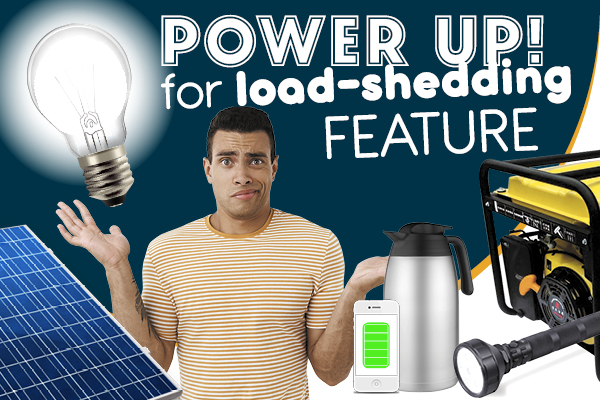
What is worse, ordinary citizens have little or no control over this situation. At best, you can prepare to lighten the burden on your own household or business for when load-shedding does occur. Perhaps the following information will help you to understand and be better prepared in future.
If you are an Eskom customer and cannot find your schedule:
• Log onto CS Online on the Eskom website, www.eskom.co.za, or,
• Call the Eskom Contact Centre on 08600 37566/08600 ESKOM to verify your schedule. You can use your Eskom account or meter number to find your schedule.
• Download the MyEskom app, which now provides the ability to search for an Eskom schedule using an Eskom account number, meter number, address or geolocation, plus a number of other value-added functions.
If you are not an Eskom customer and cannot find your schedule, please contact your municipality or metro.
• The municipality/metro schedules are different to the Eskom schedules in design and detail.
• Eskom has established principles for the design of its schedules in order to ensure as much equity and consistency as possible.
• In many cases, metros/municipalities have agreed to work according to the same principles, but ultimately Eskom has no control over how they determine their own schedules.
Stages explained
There are several stages of load-shedding. These are implemented according to how much power Eskom needs to keep the nation power supply grid limping along.
• Stage 1 load-shedding means that up to 1 000MW of capacity needs to be shed. Consumers can expect to be shed up to three times over a four-day period for two hours at a time, or three times over an eight-day period for four hours at a time.
• Stage 2 load-shedding means that up to 2 000MW of capacity needs to be shed. Consumers can expect to be shed up to six times over a four-day period for two hours at a time, or six times over an eight-day period for four hours at a time.
• Stage 3 load-shedding means that up to 3 000MW of capacity needs to be shed. Consumers can expect to be shed up to nine times over a four-day period for two hours at a time, or nine times over an eight-day period for four hours at a time.
• Stage 4 load-shedding means that up to 4 000MW of capacity needs to be shed. Consumers can expect to be shed up to 12 times over a four-day period for two hours at a time, or 12 times over an eight-day period for four hours at a time.

• Stage 5 load-shedding means that up to 5 000MW of capacity needs to be shed. Consumers can expect to be shed up to 12 times over a four-day period: nine times for two hours and three times for four hours.
• Stage 6 load-shedding means that up to 6 000MW of capacity needs to be shed. Consumers can expect to be shed up to 12 times over a four-day period: six times for two hours and six times for four hours.
• Stage 7 load-shedding means that up to 7 000MW of capacity needs to be shed. Consumers can expect to be shed up to 12 times over a four-day period: three times for two hours or nine times for four hours.
• Stage 8 load-shedding means that up to 8 000MW of capacity needs to be shed. Consumers can expect to be shed up to 12 times over a four-day period for four hours at a time.

This information is according to the Eskom webpage.
Load-shedding will be used under emergency conditions for limited periods.
How does one prepare?
You have a few options. Buy an invertor, install a solar system or install a petrol or diesel generator. All of these are expensive and dependent on what your actual electricity (load) requirements are. Though solar has become a little less expensive over the years, petrol and diesels generators have not.
Go solar
Many suggest solar to be the way forward. Be that as it may, if you are a pensioner or individual, some of the other options may be more productive and less costly. To design and install a solar or invertor system requires meticulous planning. In-depth homework and research is imperative and you need a contractor with the required technical skills, otherwise your money will be wasted. Geysers are probably the biggest user of electricity in any household. Solar geysers are definitely worth the investment over the long term, according to many.
Gas stoves/freezers
Unless you like braaiing every day, invest in gas to keep a kettle on the boil and a stove on the go. Or invest in a gas braai as well, so that you do not have to get a normal braai started just to boil a kettle or fry some eggs!
Generators
Once again, if you are going the generator route, get expert advice before you buy. Generators may be noisy, but there are methods to dampen the noise. When connected to your existing distribution board, installation needs to be done by a qualified electrician, and you will need a certificate of competency (COC) to certify the installation for insurance purposes. Diesel generators require less maintenance and depending on the design, can be quieter than a petrol generator. It uses less fuel per hour than a petrol generator.
Load-shedding checklist
• Keep your cellphone fully charged
• Install solar-powered outdoor lights
• Switch off your oven
• Keep boiled water in thermo flasks
• Install surge protection devices
• Keep a frozen bottle of water in the freezer
• Keep torches where they are easily found
• Keep the fridge and freezer doors closed
• Never keep a lit candle unattended.




