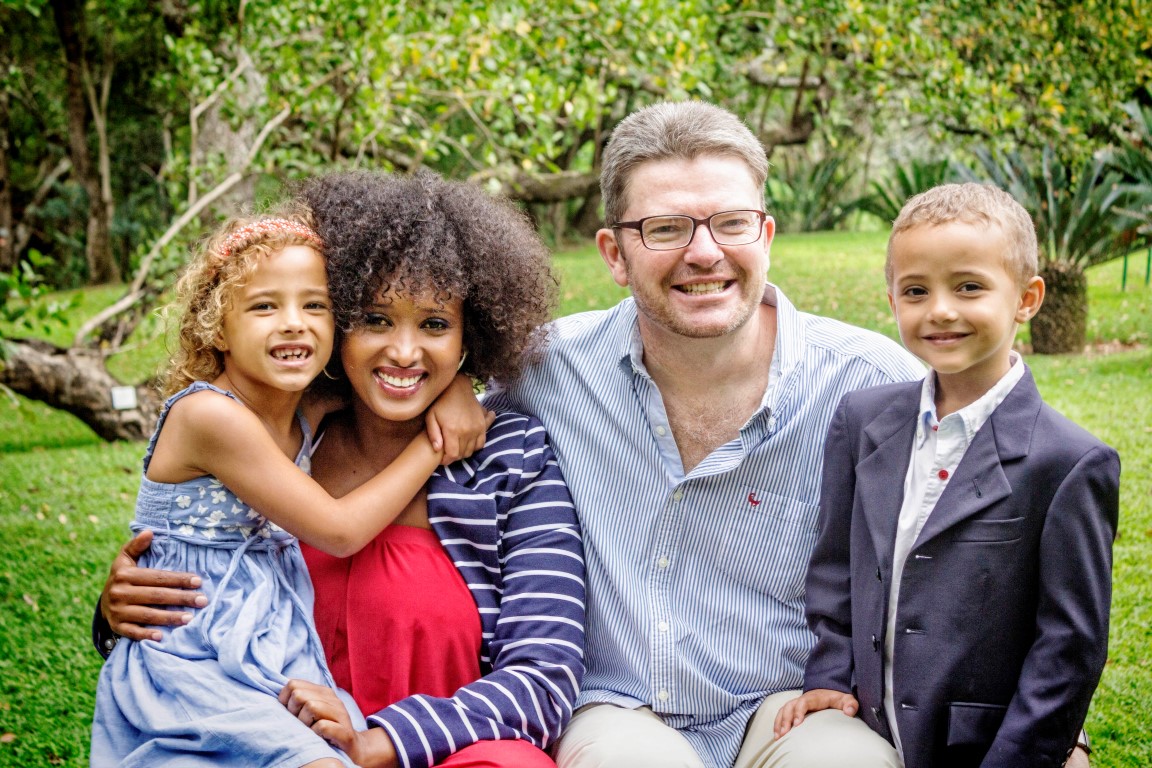
MBOMBELA – “It’s all about your attitude. Don’t look for negativity and racism in every situation.”
This is the opinion of Ifrah Bulter, a black woman married a white South African man, Andrew Bulter. Although Ifrah is originally from Kenya, the couple has been living in the city for more than 10 years.
Lowvelder spoke to them about the spate of racist incidents which have dominated national headlines since the beginning of 2016. It started with a post by Penny Sparrow on Twitter. She tweeted a photo of black people on Durban’s beach on New Year’s Day and referred to them as monkeys. Several public figures reacted to this, landing themselves in hot water too.
Also read: Penny Sparrow calls black people ‘monkeys’
The newspaper wanted to know from Ifrah and Andrew if they have experienced racism in Mbombela. The couple said from the onset of the interview, that they have experienced minimal racism on local soil. “We are the wrong people to interview,” they laughed.
The couple has two beautiful children, Leylah and Ricky. Ifrah’s skin tone is fairly dark and the children’s complexion is almost caramel.
“People stare at me and the kids. But maybe it’s because I’m attractive, or they stare at my hair, handbag, accessories or my shoes. I don’t perceive it as coming from an evil place with a racist intention,” she said.
Andrew agrees. “People admire the kids. We’ve never experienced it as hateful.”
He added that interracial couples are quite a common sight in Mbombela because so many Mozambicans visits the region. Interestingly, in Andrew’s opinion, although Mozambique may be 20 years behind South Africa on an economical level, socially they are light years ahead of us.
Ifrah recalled that when Leylah was born, a woman asked her whether she was in fact the mother.
“She asked why the child was so white. I saw genuine concern in her eyes and I didn’t experience it as racist. I replied that Leylah’s father was white on which she smiled, complimented me on my beautiful child and walked away.”
She has several white girlfriends. They once went out for a night on the town and Ifrah was cautioned to be wary of clubs frequented by Afrikaans-speaking white people and that the group should steer clear of clubs in the CBD as these weren’t safe.
“Nothing happened. We had a great time all over. There are goodwill in the Lowveld,” Ifrah laughs.
However, she celebrated her birthday last month and entertained a group of friends at a local watering hole. Someone wanted to know if they were colleagues having a Christmas party. It seems difficult for some to perceive that friendships can be formed across the racial line. “Get out. Make friends and embrace each other’s cultures,” Ifrah said.
Andrew often travels abroad on business and noted that it is amazing to witness the camaraderie between black and white colleagues on these trips. “They are united overseas, especially in countries with very different cultures like China. There they realise that we actually have more in common than we think. We all like braai, we all like pap.”
Ifrah continues, “I don’t understand Siswati. When people speak Siswati and I indicate that I don’t understand the language, they do not hesitate to switch over to English. However, I’ve encountered that when white people speak Afrikaans, their black colleagues simply get up and leave.”
Open you heart and your mind, she urges. “The fact that your parents might have indoctrinated you into a certain belief is not an excuse.”
The couple got back to the Sparrow debacle, but only briefly. “You get stupid people all over,” Ifrah snorts and waves her hands in the air again. “Don’t be a victim! When you hate, you stop living. Set yourself free and see the positive in everything.”