
Moeletsi Mbeki on winners and losers
Mbeki writes in the preface to his newly published book, A Manifesto for Social Change, "Under the apartheid system we knew who the winners were and who the losers were. Under the new democratic system, who are the new winners and who are the new losers?"
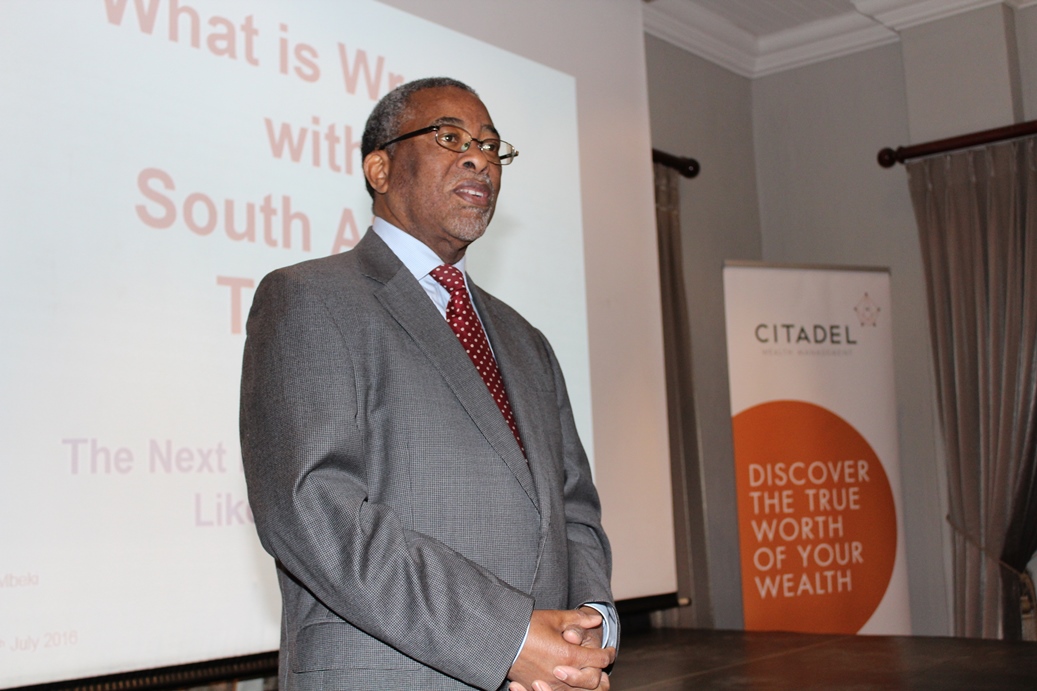
MBOMBELA – South Africa is ruled by the political elite, who are largely a different group from the economic elite. On Thursday Moeletsi Mbeki explained to clients and guests of Citadel, specialist wealth managers, at La Villa Vita Boutique Hotel that the rich do not own government, but are dependent on it.
Mbeki, younger brother of former president Thabo Mbeki, does not need any introduction. As a well-known political analyst and author, he frequents the news with his sometimes unpopular and bold comments on politics and economics. He is also expressive in his critique of the current ANC leadership and the lies and half-truths used to gain support.
Last week he also shared thoughts on his new book, A Manifesto for Social Change. It is the third and conclusive book in a trilogy that started seven years ago with Architects of Poverty. Mbeki wrote the book with his niece, Dr Nobantu Mbeki. Nobantu teaches economics at the University of the Witwatersrand and has worked as an economist for BoE and Deutsche Bank.
Mbeki writes in the preface to the book, “Under the apartheid system we knew who the winners were and who the losers were. Under the new democratic system, who are the new winners and who are the new losers?”
The book proposes the existence of a class system based not on skin colour, but on economics. The relationship between political parties and voters, the impeding rebellion of the lower and underclasses and the ANC’s sense of entitlement is discussed. In the final chapter four potential scenarios are sketched.
In May he participated in a panel discussion with Brigalia Bam, former IEC head, and Ferial Haffajee, City Press editor, at the Franschhoek Literary Festival. The discussion focused on the protection of democracy in South Africa. Afterwards he was severely criticised for saying white people do not control the South African economy – a “fact” that the ANC frequently uses to gain support.
Just a few months before Mbeki’s remarks on the economic elite, News24 and other news houses reported on deputy president Cyril Ramaphosa’s promise that the government will spend around R24 billion on Broad-Based Black Economic Empowerment. “For far too long this economy has been owned and controlled by white people. That must come to an end,” he said.
This last statement is contradicted by statistics used in A Manifesto for Social Change and provided by the statistician general for Statistics South Africa. According to Mbeki, only 105 036 individuals belonged to the group of economic elite in 2014 – the economic elite being individuals earning more than R60 000 per month. This group is racially fully integrated and there is no statistics to show that these numbers have suddenly changed.
On the contrary, statistics on the number of individuals belonging to the economic middle class – those earning between R11 565 and R60 000 per month – sketched a whole different picture in 2014: This group was disproportionately dominated by black Africans.
It is worrying that the largest group in South Africa by far is still the underclass workers and the unemployed, he said. Mbeki says South Africa is ruled by the political elite, who are largely a different group from the economic elite.
The rich do not own the government, but are dependent on the government and people who own politics – mainly for infrastructure. This causes lack of confidence in the government and is consequently the reason for low investments in the country.
A Manifesto for Social Change is published by Picador Africa, an imprint of Pan Macmillan. Considering the contents thereof, it should not come as a surprise that it was the very same Harold Macmillan who delivered the “Wind of Change” speech in 1960.
“The wind of change is blowing through this continent. Whether we like it or not, this growth of national consciousness is a political fact. We must all accept it as a fact, and our national policies must take account of it.”
Could it be that history is on the verge of repeating itself – albeit under much different circumstances?