Hundreds benefit from health train’s visit to Komatipoort
Phelophepa, a train with several 'clinics' on board travels around the country to bring quality medical care to people who can't access the services or afford it. It recently rolled into the Komatipoort station for a two-week stay.
KOMATIPOORT – For thousands of people across the country the Phelophepa I Health Train is a lifeline, their only chance once a year to seek medical assistance.
This amazing Transnet corporate social investment (CSI) project rolled into the local station last Wednesday and has since helped hundreds of people with dental, eye and general health problems.
The Transnet CSI project started in 1994, with a second train joining Phelophepa I in 2012, acting train manager Mr Bheki Mandlula explained.
Each of the two Phelophepa locomotives visit four provinces and a variety of towns between January and the end of September every year.
The trains are manned by a team of medical and catering students from universities across the country and foreign countries, such as Scotland and Australia. Their two-week rotation on the train is crafted into their programme and gives them practical experience in dealing with a broad variety of cases.
READ: Help raise awareness in the fight against child abuse
Local youth are employed as helpers, interpreters, cleaners and kitchen staff and retired nurses for basic nursing duties. “The pay they get from these two weeks’ work can make a major difference,” Mandlula said.
Phelophepa’s 19 coaches feature accommodation (where staff and students stay while the train is in operation), offices, the healthcare, psychiatry, pharmacy, nursing, dental and eye clinics.

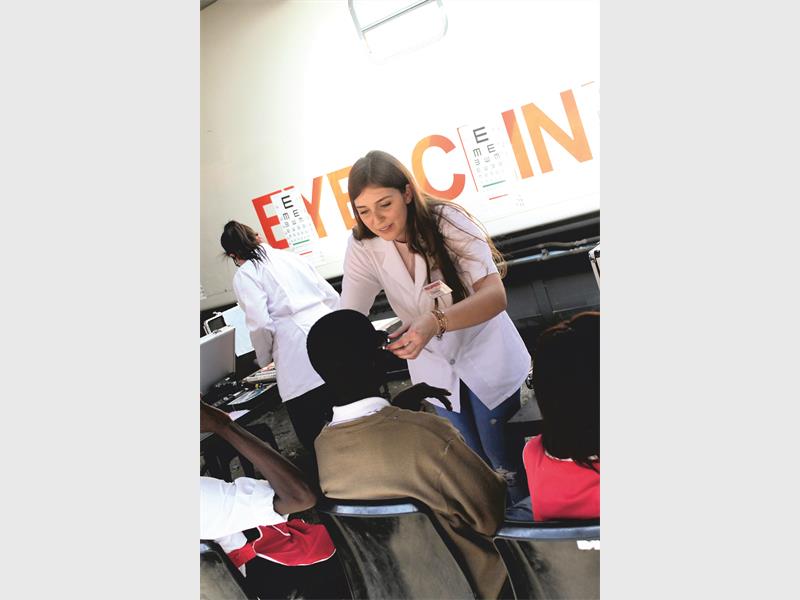
The psychiatric coach provides free counselling and visits schools, prisons, old age homes and care centres. In the healthcare compartment, patients can go for free check-ups and treatment of minor ailments. At dental, tooth extractions, sealing and polishing and restoring is done. The eye clinic, which is the most popular service, offers free eye tests and custom-made glasses.
The services are all offered for fees ranging from R5 to R30. Children under 15 are treated free of charge.
Mandlula explained that the different divisions can accommodate a number of patients per day, depending on the proficiency of the students assigned.
On average between 1 800 and 2 000 people are assisted in a two-week rotation.
Phelophepa has dual responsibilities. The first is to help develop the skills of students under the guidance of a team of qualified professionals and second, to reach out to communities.
The trains partner with several state departments such as social development and education in order to reach the right people. “We complement the area’s health services and help to relieve pressure from clinics,” Mandlula explained.
READ: Healthy Friday: Fasting for 2 to 4 days can reboot your immune system
He also stated that they get all sorts of people visiting the train. “Outside of the poorest of poor, we get teachers, cashiers and petrol attendants. If someone really can’t afford the fee and we can see that they really need something, we’ll sponsor them,” he said.

They draw people that don’t ordinarily go to clinics and health services, because they don’t want people that know them or can recognise them to know what their issues are. “What makes the train is that people can see the impact of the services. Patients are our main marketers,” Mandlula said.
Phelophepa I can be seen on the rails behind the new Shoprite Centre until tomorrow (Friday), before it departs for Mbombela.
Find more information on the Phelophepa Health Trains here.