More research needed on freshwater crayfish
There is little doubt that eating crayfish is a treat. People also like to joke that the Lowveld offers everything except a beach. The surprise then, to discover crayfish in the Lowveld's waterways.
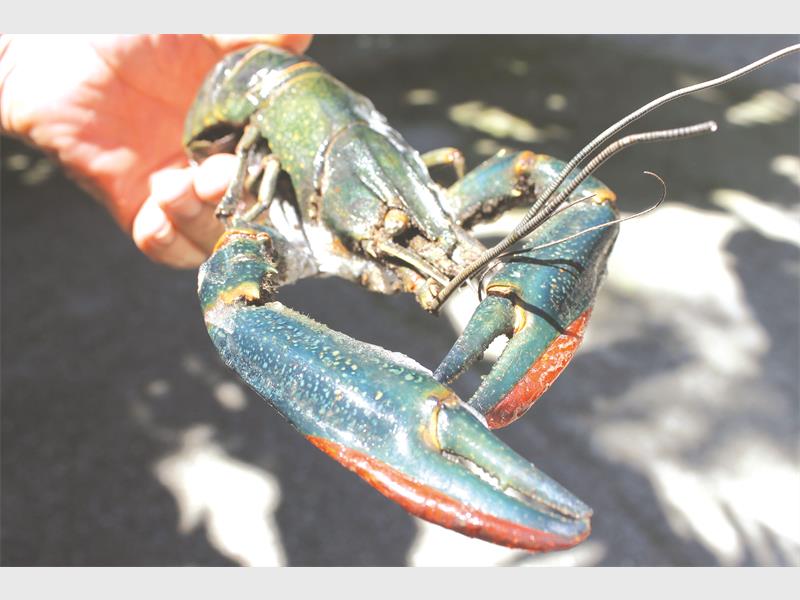
MBOMBELA – This freshwater crayfish variety, the Australian red claw, is classified as a 1B invader by the national Department of Environmental Affairs. It calls for their eradication and being found in possession of a live one in the country is illegal.
Also see

It is believed that they have spread through large parts of the country over the past 20 years, and their presence in the Lowveld’s waterways are confirmed. The Australian red claw is believed to have spread naturally across the Lowveld’s water systems, as is now prevalent from the Komati to the Crocodile rivers.
Agriculturalists and conservationists are in two minds about their use. Dr Ana Luisa Nunes, a postdoctoral fellow at the Centre for Invasion Biology (CIB) and South African Institute for Aquatic Biodiversity (SAIAB) based at Stellenbosch University, visited the area earlier this year to perform experiments on the crayfish in the Lowveld’s water.
Nunes’ project aims to study the presence, distribution, abundance and impacts of different freshwater crayfish species in the country. Little research has been done on them.
Invaders
“The main goal was to generate the urgently needed detailed information on the status and impacts of invasive crayfish species in South Africa, using a combined approach of fieldwork and mesocosm experiments,” Nunes told Lowvelder.
She noted that little research has been done on the Australian red claw, both in southern Africa and abroad in terms of their effect on ecosystems.
“Although it has invaded more than 10 countries in the world, no research has been done on its impact so far.
“Researchers that report it from different countries all show extreme concern about its invasion, based on some characteristics of the species, such as an exceptional growth rate, being very hardy and tolerating low-water quality, and that crayfish invasions around the world usually have proved devastating.”
Invasive crayfish can act as novel predators, competitors, habitat changers and vectors of pathogens. They are considered keystone species in freshwater habitats, which often cause strong alterations in invaded ecosystems.
Some crayfish species live on insects, crustaceans, snails and eggs and larvae of fish and amphibians. The red claw seems to be mostly detritivorous (feeding on decomposing plant and animal parts as adults), but are omnivores as juveniles.
“We are mostly worried about potential competition with native crustaceans, such as freshwater crabs and prawns. We also think that crayfish activity, which basically takes place at the bottom of the rivers, might disturb reproductive activity and nesting success of substrate-spawning fish.”
Research
Her own research was to understand if crayfish are competitively superior to crabs. She used an experiment where crayfish and crabs were introduced to large pools at different densities, to look at potential interspecific competition relationships.
“Competition between the two species was measured by looking at alterations in crab behaviour and life-history traits. Preliminarily, I can say the two species did not seem to have a lot of agonistic interactions. If they did, crayfish seemed to be dominant over crabs, being more aggressive, although not so much by fighting, but mainly by chasing crabs.”
The red claw also carries a parasitic flatworm, which is found on them and also exotic to South Africa. The temnocephalans don’t pose a risk to the crayfish, but have the potential to be transmitted to other crustaceans, such as freshwater crabs and prawns.
“We do not know what harm it might cause to these species.”
No research has been done on it that she knew of. A paper published in 1993 using another Australian crayfish species showed that temnocephalans could be transmitted to freshwater crabs in the lab, but the temnocephalans died out once the crabs left the water and their carapace dried. “Once again, more research is needed on this topic.”
Challenges
Due to their classification, Nunes has faced extensive challenges merely attempting to research them.
“For a start, it was a challenge knowing where to start, since not much information existed on freshwater crayfish invasions in South Africa. Doing fieldwork in the Komatipoort area was not that easy because of restricted access to the Komati River.
“A big problem is that South Africa is an incredibly large country,” she added. “It is impossible to know where they are actually present, especially since there are anecdotal reports of it existing in many more places than I sampledand we are aware of people moving them around illegally, which is impossible to control.”
Farming
She adds that red claw crayfish are good candidates for farming, which has extensively been done in Australia where they are native, but also in several countries around the world.
“However, given that they are not native to South Africa, that they are a species with high invasive potential, and that most of the invasive crayfish introductions around the world have been caused by escapes from aquaculture facilities, I personally do not believe that farming this species in South Africa is a good idea.
“There is no project or programme from the DEA to investigate the impacts of crayfish. As such, it all depends on how much scientific research is done.”
Going forward
Her research into the topic ended last month, and she did not intend to continue.
“My personal opinion is that not much research on this will be performed any time soon, unless maybe by researchers in other countries where this species has also invaded and from which conclusions might be paralleled into South Africa.”
Nunes noted that the fact that no adverse impacts of the red claw crayfish’s presence in South Africa have yet been detected, does not mean that they have not been occurring.
“No one is looking into it or studying it, so of course it is hard to know if something is happening. Although no immediate devastating impacts that we can see with the naked eye seem to be happening (as has happened with other crayfish invasions), it certainly does not mean that smaller or maybe even large but simply long-term impacts are not occurring.
“I feel like my project was a drop of water in the ocean, since there is still so much to be done on crayfish invasions in South Africa and mainly on its impacts. Still, you have to start somewhere, so I am happy that my work will hopefully contribute to future studies on this topic,” she concluded.
Also see