
UV-C tech zaps disease before it gets in your car
The car of the future could help win the battle against superbugs.
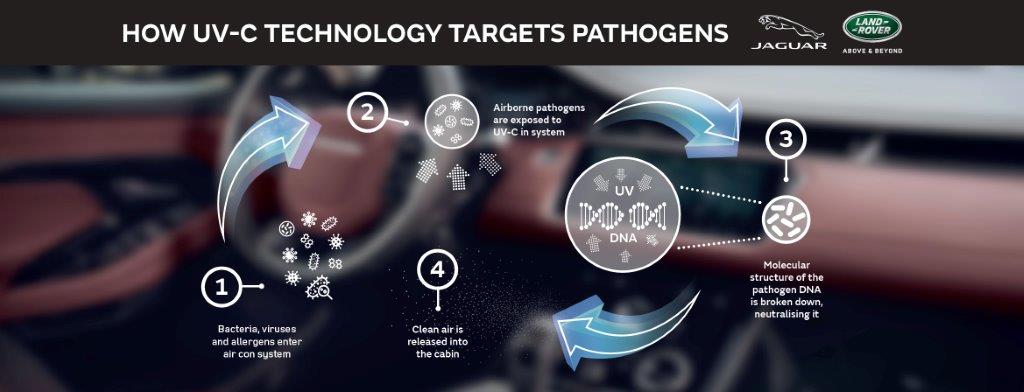
This according to Jaguar Land Rover. Future models could help stop the spread of colds and flu thanks to innovative ultraviolet light technology (UV-C) borrowed from the medical industry, where it has been used for more than
70 years.
By integrating UV-C, Jaguar Land Rover believes it could help to stop bacteria and harmful viruses, known as pathogens, from surviving in the cabin.
UV-C is currently widely used for disinfecting water, filtering air and sterilising surfaces by utilising wavelengths of light between 200 to 280 nanometres.
Exposing pathogens to UV-C within the air-conditioning system breaks down the molecular structure of the DNA, neutralising them. Clean air is then released into the cabin.
The technology could even help in the fight against drug-resistant superbugs. Jaguar Land Rover is exploring UV-C technology as part of its vision to create a tranquil sanctuary inside each of its luxury vehicles.
The manufacturer is piloting a wide range of driver and passenger well-being features as it looks towards a self-driving future. Dr Steve Iley, Jaguar Land Rover’s chief medical officer, said, “The average motorist spends as much as 300 hours per year behind the wheel.
ALSO READ: Take the risk out of buying a second-hand car
There is a clear opportunity to better utilise cars for administering preventative health care. “The implementation of individual well-being measures as part of our ‘tranquil sanctuary’ research promises to not only improve quality of life for our customers, but in this case, offers clear advantages in reducing pathogen spread – protecting the overall population from the threat of disease, particularly as we move towards shared mobility solutions.”
Jaguar Land Rover is already actively seeking to neutralise pathogens in its latest generation heating, ventilation and air conditioning (HVAC) systems, available across the range including the all-electric Jaguar I-PACE and Range Rover Sport.
The current four-zone climate control and cabin air ionisation system works by using high voltage to create trillions of nano-sized negatively charged particles (ions) coated in water molecules. These ions deactivate pathogens, forming larger particles which are removed from the air as they are brought back into the filter.
As well as combatting pathogens, the ions also act upon odour molecules and allergens in a similar way. Iley said, “In the colder months, infections are spread more easily.
It’s reassuring to know that in your car at least, you can be confident that harmful pathogens are being neutralised.”Recent medical trials suggest the use of UV-C could be even more effective, as it has been shown to cut the transmission of four major superbugs by up to 30 per cent.
Researchers focused on four drug-resistant organisms: MRSA, vancomycin-resistant enterococci (VRE), C difficile and acinetobacter.
Immunology expert, Dr Hellmut Münch, CEO at Medical Enzyme Research Association, said, “The rise of superbugs and allergens is one of the largest threats we face as a species today.
“Investment in immunology is vital in ensuring that our immune systems stay ahead of the race against micro-organisms, which are evolving far quicker than traditional pharmaceuticals can keep pace.
It is important that we continue to take an innovative look at how we can adapt our environment to help prevent the spread of the most harmful pathogens – which is why this research is paramount.”
ALSO READ: All the King’s cars