

It was a slap in the face of the democracy cherished in a post-1994 South Africa.
On March 22, two community journalists were chased out of a Mbombela courtroom.
Those who did the chasing were an EFF supporter and his cronies.
Here’s another disturbing thing – his demand was echoed by a Fidelity guard seemingly contracted by the court and two policemen.
Words like “absurd,” “ridiculous” and “gross violations of open justice” came to mind.
And then the big question: Apart from writing a story and a headline, what is this publication going to do about it?
After careful consideration, Lowvelder has elected to publish excerpts from its – yet unanswered – correspondence directed to the SAPS, the EFF, the Department of Justice, the Nelspruit Magistrate’s Court and the security company involved. Both journalists are considering pressing charges against those who have grossly violated their rights.
- BACKGROUND
Click on the image link below for a video and report of the events, which are also summarised below.
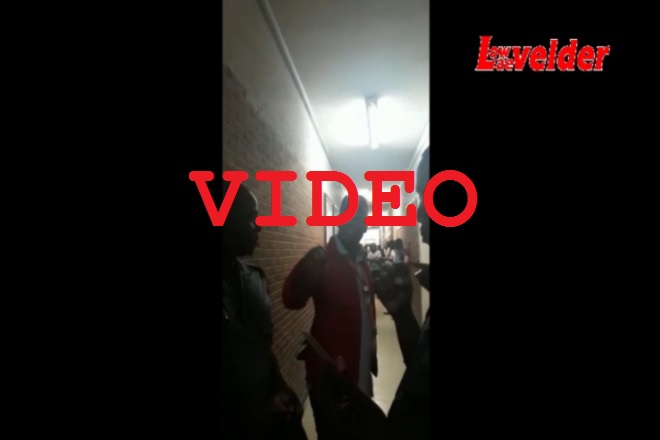
Journalists Hancu Louw and Arisa Janse van Rensburg sought to attend a the criminal court appearance of accused Kenneth Mkhonto, Vusi Mamba, Mfundo Mlimi, Sipho Ngutshane and Lucky Sithole. Mkhonto is an ANC ward councillor. The five allegedly burnt down Mama Esther’s Haven in Msholozi.
Shortly after they entered the courtroom, a Fidelity guard instructed them to leave, claiming that the courtroom was too full. An EFF supporter accosted them in the court’s corridor, demanding that they leave. When Louw informed him that only a magistrate could make that decision, the man in red retorted by stating that he had no regard for the law nor a magistrate’s order.
Two policemen arrived. (Yes, they are the guys in blue tasked with executing our laws in a reasonable way.) Yet the two concluded that the journalists were causing an uproar and had to leave.
In a scenario that bled tragic irony, the journalists were repeatedly asked to identify themselves by the EFF supporter, the policemen and the guard, yet none of these people were willing to do the same.
It is a series of events one involuntarily associates with the old South Africa where censorship and intimidation were at the order of the day.
- APPLICABLE LAW:
Lowvelder compiled a media query asking relevant authorities to explain how it viewed the behaviour of its representatives.
It was put to representatives that the following legal norms were violated:
- Section 152 of the Criminal Procedure Act states that criminal proceedings are to be conducted in open court. The act further dictates that a magistrate may order otherwise. No such order was made.
- Sections 34 and 35 of the Constitution of the Republic of South Africa confirm the public nature of court proceedings – it is a crucial component of what a fair trial entails.
- The principal of open justice as entrenched in our law. This principle was expounded on by Deputy Chief Justice Dikgang Moseneke recently. According to Moseneke, the transparency of the judicial process is fundamental to developing public trust in the judiciary.
- Section 16 of the Constitution provides the right to freedom of expression. It gives the media the right to disseminate information and the responsibility to keep the public informed regarding newsworthy events. The media is a Constitutionally protected extension through which the public exercises its right to open justice. The rights of both the media and the public had thus been affected.
The Nelspruit Magistrate’s Court, the Department of Justice, the EFF, Fidelity and the SAPS were asked to clarify:
- In terms of what law, regulation or agreement does a policeman, a security guard or a member of the public have the authority to order a journalist – or any other member of the public – to leave a courtroom? What authorises the security guard to demand that journalists identify themselves? How do the various spokespersons react to the guard’s argument that they had to leave because ‘the courtroom was full?’ It is the publication’s position that no such rule exists.
- Blatant rights violations and intimidation had occurred in front of two local policemen. They elected to shift blame onto journalists who were being intimidated and, in so doing, robbed the public of its right to open justice. What is the police’s comment?
- An EFF representative had intimidated the press, robbing them of their Constitutional right to attend and report on court proceedings. The same representative expressed his blatant disregard of the law and a magistrate’s authority. Is this an opinion the EFF agrees with? How does the EFF intent to deal with the member, taken into consideration his blatant disregard for the legal system and the Constitution?
Lowvelder will keep readers updated as the above sources respond to queries.



