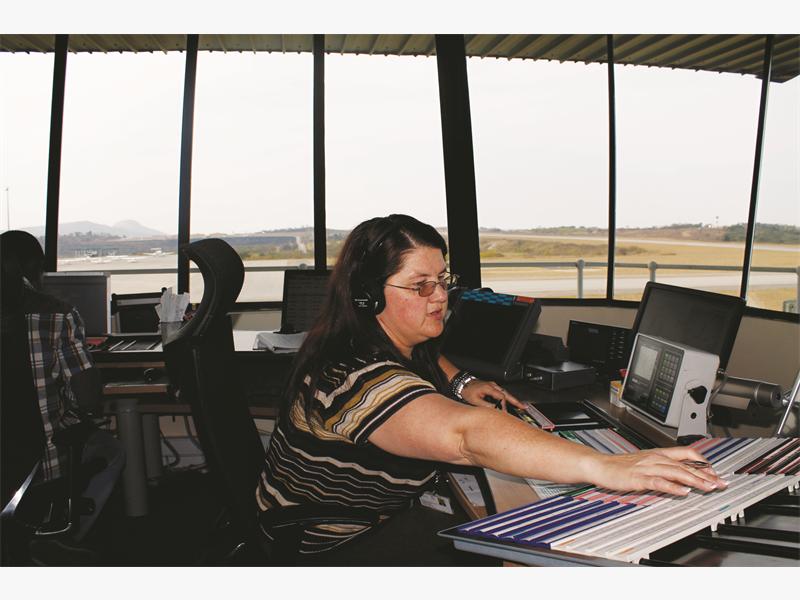
MBOMBELA – When you hear that someone does air traffic controlling (ATC) as an occupation, the first thing you think of is the visual signalling between ground personnel and pilots at an airport, aircraft carrier or helipad, when in fact that is called a marshaller.
Lowvelder spoke to ATC Dayle Russel at Kruger Mpumalanga International Airport (KMIA) to find out what the job entails.
“The first thing you need, to become an ATC, is a passion for aviation,” says Russel. Becoming an ATC is a fairly lengthy, training-filled process. Air Traffic and Navigation Services (ATNS)controls about 10 per cent of the world’s airspace and uses well-trained ATCs to do the job.
Applications are considered for candidates who are South African citizens, over
18 years of age, hold a grade 12 certificate (that includes maths and English) and are medically fit. Once you have been selected into the recruitment process, you attend aptitude (psychometric) testing – to make sure your brain works the right way to be an ATC. You have to pass a medical examination.
This is a stressful occupation and health is important,” Russel says. If you are successful in both the testing and medical exam, you are short-listed for interviews.
Upon acceptance into ATNS, you attend basic training.
This gives you a foundation in aviation and includes topics like aviation law, avionics (electronic system on the aircraft), instrument approaches, navigation and maps, search and rescue, ATC procedures, aviation English, human factors, meteorology and principles of flight. You will then work at one of ATNS’s 22 units as an air-traffic service officer, assisting the controllers with paperwork, and – at some units – coordination. To become an air traffic controller, you attend further training. Each additional discipline requires additional training. All this theoretical training happens at the training academy at OR Tambo International Airport. Once you have completed this training and are deployed to a unit, you undergo on-the-job training. This is practical training to equip you to work solo at the unit.
What exactly does an ATC do? Air traffic controllers work a specified airspace to prevent collisions between aircraft, between aircraft on manoeuvring areas and between aircraft and obstructions on manoeuvring areas and to expedite and maintain a safe and orderly flow of traffic. They also provide advice and information useful for the safe and efficient conduct of flights and notify appropriate organisations regarding aircraft in need of search and rescue and to assist such organisations as required.
In short, they use specified procedures to ensure that aircraft in their airspace are safe. This is done by issuing various clearances (instructions for departure, landing, climb, descent, direction of flight or taxi or published routes or holding patterns to comply with).
These clearances are based on a set of laid-down procedures, which are set against an International standard published by the International Civil Aviation Organisation, and regulated (in SA) by the South African Civil Aviation Authority. Clearances are given with reference to navigational aids or landmarks. Navigational aids include beacons (that the aircraft can home towards or away from), instrument approaches (these procedures guide aircraft to runways), and radars (these give the air traffic controller a screen view of the airspace).
There are various disciplines within the air traffic controller domain. Airspace is divided up into various areas and each airspace is controlled by a different ATC discipline. Picture cake tins of all sizes, pile them up – smallest at the bottom – and you have a picture of how airspace is allocated.
• The smallest (bottom) airspace is centred on an airfield. This is the aerodrome control tower. The tower controller relies on visual sighting of traffic. Basically – “see them, control them”.
• The next airspace is the terminal control area (approach). This predominantly caters to aircraft descending into, or departing out of the airport serviced and any surrounding (close) airstrips.
• The highest airspace is the control area. This airspace encompasses the high-flyers – long haul flights as well as short haul jets.
• All the leftover space between the airspaces is covered by flight information service, which provide information to traffic in these areas, promoting and assisting safe flight.
• For each flight, the ATC has a flight progress strip (a strip of paper preprinted with a specific table) on which all clearances are entered, as well as relevant information including point of departure, destination, flight level, routing and elapse time.
The Kruger Air Traffic Control Unit provides a combined tower and approach procedural service. Procedural means that they do not use radar to see the traffic, rather they use procedural separations to ensure that the traffic is always safely distanced from each other.
Simply, use a mental picture of the traffic, in conjunction with the flight progress strips to provide the service.
This is how Russel sees a normal day as an ATC: “Our day starts with pre-briefing. This includes logging on duty, checking the status of all navigational equipment, and reading any instructions or memos that may affect the airspace.
Then we open the unit (if we are the first shift for the day) or proceed with the takeover/handover procedure, where the ATC on position gives a complete and in-depth handover of everything that is happening, (including all the traffic and anything we can expect during the shift) to the takeover controller. This all takes about 15 minutes. We then control the airspace until another ATC comes to relieve us, or until the unit closes. At the Kruger Unit (based at KMIA), we work anywhere from one to five hours between breaks.”
The Kruger airspace includes the area from Ngodwana to Malalane, and from Hazyview to Barberton. They provide a service to all the aircraft arriving at, and departing from KMIA, as well as traffic flying through the airspace to or from Malalane, Mbombela, White River, Lake Longmere or any of the other 20 odd airstrips/helistops that fall within the lateral limits of our airspace. They also provide a service to traffic transiting our airspace (mostly to or from destinations within the Kruger National Park).
The Kruger Air Traffic Service Unit controls the airstrips and helistops that fall within their control zone – which measures between six nautical miles (just over
11 kilometres) and 10 nautical miles
(18,5 kilometres) from the airfield depending on which direction.
These are KMIA, Likweti Helistop, Rob Ferreira Hospital Helistop, Themba Hospital Helistop, Njala airstrip, Spioenkop airstrip and Bell helistop. Traffic will call on the frequency – before departing from the airstrip/helistop – to get a clearance.
“Air traffic control, as a profession, is typically stressful. We deal with the safety of hundreds of people every time we work. This stress is increased in situations where an aircraft experiences an emergency or where the exchange of instructions between ATCs and pilots is misunderstood. But, controllers undergo training to deal with emergencies as and when they occur,” Russel explains.
“It is an adrenalin-filled job that carries a heavy responsibility with it and each air traffic control unit comes with its own challenges, but they all carry the same responsibility for safety. I love my job. It gives me huge satisfaction to take a difficult sequence of traffic and resolve it safely and efficiently. Controlling air traffic provides an adrenaline rush. For me, it is definitely a way of life and not just a job or a profession.”