Bluebird back to life with a roar
On January 29, Sir Malcolm Campbell’s record-breaking 350hp Sunbeam was fired up - the first time in over 50 years.
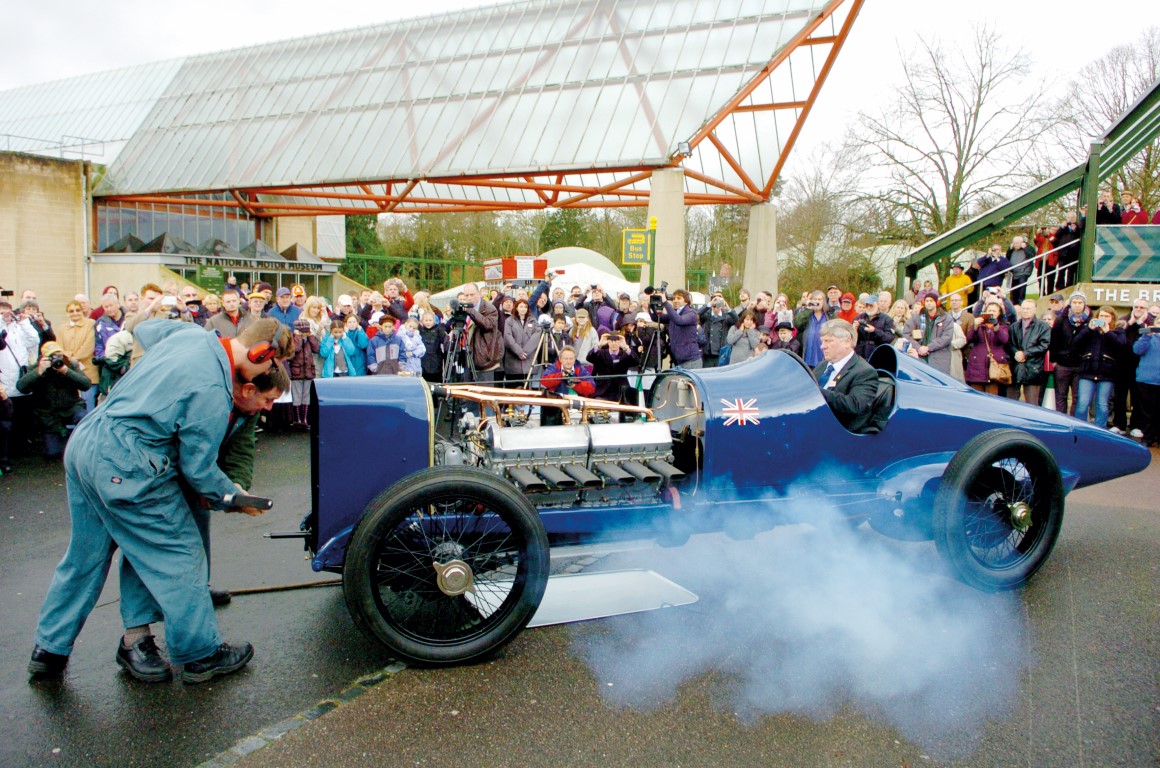
Following a complete mechanical rebuild by the National Motor Museum’s workshop team, the handle was swung to bring the engine back to life – a sound which has been described as being akin to the roar of a Rolls-Royce Merlin engine.
The car was the brainchild of Sunbeam’s chief engineer and racing team manager, Louis Coatalen, and was constructed at the company’s workshop in Wolverhampton during 1919 and early 1920.
For a period following WWl, the world of motor racing was enthralled by a breed of racing cars powered by huge aircraft engines – the 350hp Sunbeam being one of the most famous of this group of aero-engined giants.
Power came from an 18,322-litre V12 modified Manitou Arab aero engine, a type used on naval seaplanes. The Sunbeam, renamed Blue Bird by Campbell, holds three world land-speed records, the first achieved by Kenelm Lee Guinness at Brooklands in 1922 with a speed of 133,75mp/h. Campbell then purchased the car, had it painted in his distinctive colour scheme and in September 1924 achieved a new record speed of 146,16mp/h at Pendine in South Wales, raising it the following year to 150,76mp/h.
Campbell sold the car shortly after. It then passed through a number of owners and is recorded as being driven by band leader, Billy Cotton, at the Southport Speed Trials in 1936. For a time the car’s location was unknown, then in 1942 it was unearthed in Lancashire by Harold Pratley who bought it in 1944. He loaned it to Rootes Ltd (successors to the Sunbeam Company), who undertook a cosmetic restoration for promotional purposes.
In 1957 the Sunbeam was purchased by Lord Montagu, restored to working order and put on display in the Montagu Motor Museum.
In 1972 it moved into the newly created National Motor Museum where it has been on permanent display ever since. During a test fire-up in 1993 to assess the car’s condition, disaster struck when a blocked oil way in the engine caused it to seize and ‘throw a rod’. For several years after that, the car was on display in the museum with a very visible hole in its engine where the piston and con-rod had exited.
In 1987 the car was repainted and the wheels rebuilt. Around 2007, the workshop team started looking at the car with a view to repairing the engine and an initial strip-out allowed them to assess the damage sustained in the 1993 start-up.
Examination showed that the con rod had come through the side of the crank case, scoring the crank shaft and damaging three pistons and valves. A restoration of this size is a very time consuming process, approximately 2 000 hours on this project, so the museum workshop relied heavily on the use of volunteers to do the work, directed by the workshop’s senior engineer, Ian Stanfield, and also on generous donations by specialist suppliers.
Doug Hill, the National Motor Museum’s chief engineer said: “This project has been a long-running labour of love for the whole team and such has been their passion that many have dedicated hours of their own time to get the job done.
“However, there is more that we still want to do and our next objective is to research the design of the original gearbox – all original drawings and records were lost when the Sunbeam factory was bombed during WWll – so that we can restore the car to the full 1920s specification, as driven to two world land-speed records by Sir Malcolm Campbell at Pendine Sands in 1924 and 1925.”
Source: Newspress