The Ocean Photographer of the Year 2026 finalists have captured everything from dramatic predator encounters to microscopic marine life.
The Ocean Photographer of the Year 2026 finalists showcase breathtaking images that celebrate the beauty, diversity and fragility of the world’s oceans while highlighting the urgent need for marine conservation.
The competition features striking photographs across categories including Wildlife, Conservation Impact, Adventure and Human Connection, among others.
Presented by Oceanographic and Blancpain, the Ocean Photographer of the Year will announce its category winners and overall winner in September, but this collection offers a compelling preview of some of the year’s most remarkable ocean photography.
(For best view, click on image for fullscreen)

A New Zealand fur seal tears apart a rough skate in the waters of New Zealand, while seabirds gather for the scraps. Unable to swallow such large prey whole, the seal throws the skate repeatedly to break it into smaller pieces. Photographed from a kayak, this scene reveals the feeding strategy of a powerful predator and the chain of life that follows every meal. Picture: Allan Cronin
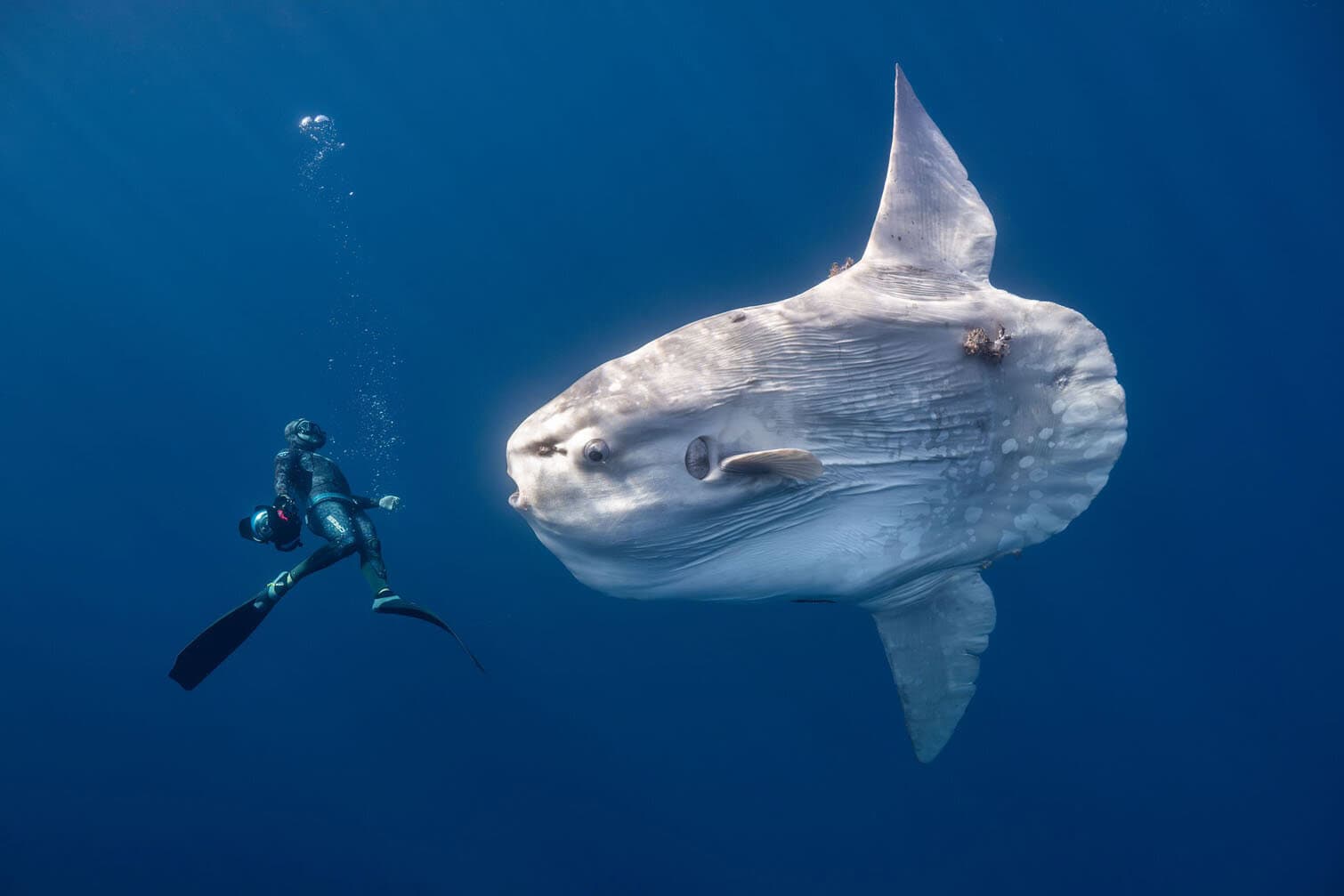
A giant oceanic sunfish (Mola mola) glides through the clear waters of Mexico’s Baja Peninsula. Encountered during the final hour of a 2025 sardine run expedition, the unusually pale fish approaches the freedivers on its own. Picture: Anita Verde

A freediver is surrounded by a vast school of sardines, which part to form a striking halo as they move around her. Captured during an unplanned morning dive. Picture: Benjamin Yavar/Ocean Photographer of the Year

Freediver Arnaud Jerald descends into Dean’s Blue Hole in the Bahamas during a successful world record attempt at the Vertical Blue competition. Photographed from more than 30 metres below, the image captures the scale of one of the world’s deepest marine sinkholes. Picture: Daan Verhoeven

Grooved brain corals (Diploria labyrinthiformis) sit in a land-based coral nursery moments before their annual spawning. The still water, created to help researchers collect eggs and sperm for coral breeding, reflects each colony’s unique patterns. Assisted spawning is an important conservation technique, helping restore threatened coral reefs by increasing the genetic diversity of future generations. Picture: Dan Mele

Thirty days after the 2023 Lahaina wildfire claimed 102 lives, thousands gathered off West Maui for a traditional Hawaiian paddle-out ceremony. Surfers and families formed a circle on the ocean, linking hands and releasing leis in memory of those lost. Picture: Daniel Edmond Sullivan Jr

The photographer shot this image of a surfer, windsurfer and kitesurfer sharing the same towering wave at Peʻahi, known as Jaws, on Maui’s north shore, from a doorless helicopter. At the time there was an unusual combination of huge swell and strong wind that allowed three different forms of wave riding to happen in harmony. Picture: Daniel Edmond Sullivan Jr

A ribbonfish rises vertically through the dark waters of Osezaki, Japan. Its long, silver body and delicate fins are adapted for life in the open ocean. This image was captured during a winter blackwater dive. Around the ribbonfish, a swarm of salps – small, jelly-like animals that feed on tiny particles in the ocean – creates a glimpse of life moving through the deep sea. Picture: Mitsuna Kawai

Sunlight pours through cracks in an iceberg in East Greenland, illuminating the seabed like a natural theatre. Created by a storm just days earlier, these openings allow light to reach an underwater world usually hidden in darkness. Despite its warm glow, the scene was photographed in extreme conditions, with water at -2.5°C and air temperatures of -15°C, pushing both divers and equipment to their limits. Picture: Lars von Ritter Zahony

A Hawaiian monk seal rests with her week-old pup on Kaimana Beach in Waikīkī. Mothers nurse their pups for around six weeks without feeding, losing up to a third of their body weight while the pup grows rapidly before becoming independent. Despite choosing one of Hawaiʻi’s busiest beaches to raise her pup, Kaiwi has successfully raised several pups here. Picture: Leighton Lum

From above, moored fishing and tourist boats bloom across the sapphire-blue sea like the petals of a flower. Fringed by golden coastal vegetation, the shoreline becomes an abstract pattern that is difficult to recognise from ground level. Picture: Chen Lin

Three surfers converge on the same wave at Teahupoʻo, French Polynesia, after a paddler is thrown from his board. The tow-in surfer immediately changes course, grabbing the cameraman to avoid a collision. Picture: Marc Lenfant

A pair of twospot cardinalfish shelter above a vibrant field of Christmas tree worms in Japan. These colourful worms are actually the feeding crowns of tiny marine worms that live embedded within coral, extending their spirals to capture plankton from the water. Extremely sensitive to movement and light, they retract instantly when disturbed. Picture: Shigeno Yuta

A male Banggai cardinalfish shelters newly hatched juveniles inside his mouth, continuing the parental care that follows a three-week incubation period. After hatching, the male may brood the young for another 10 days without feeding, protecting them from predators until they become more independent. This image captures two juveniles peering from their father’s mouth, revealing the specialised mouthbrooding strategy that helps this species increase the survival of its young. Picture: Suliman Alatiqi
MORE: Strength, stamina and grit on display at Red Bull Agri-Grit [Video & Pics]