


The department said the use of each ambulance depended on its purpose and the needs of the service.
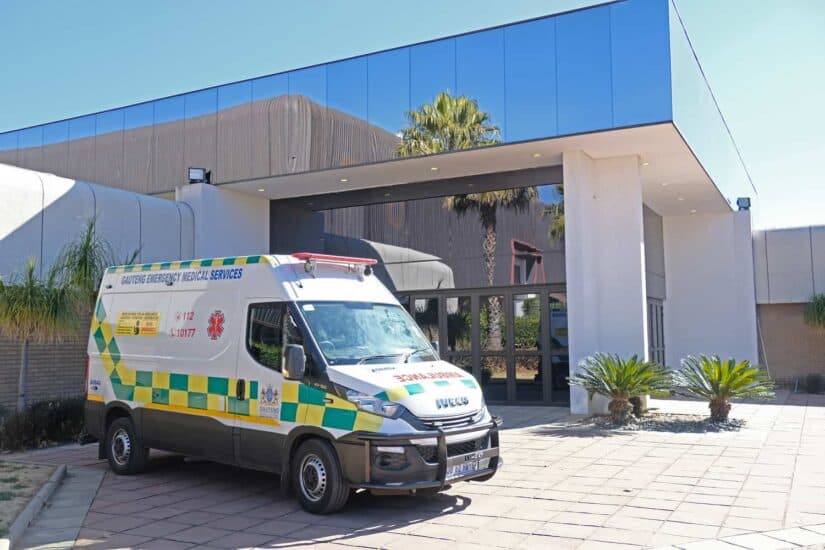
A provincial service ambulance outside the Nasrec quarantine and isolation site on 3 July 2020 in Johannesburg, South Africa. Picture: Gallo Images/Dino Lloyd


The Gauteng Department of Health (GDoH) said on Monday that ambulances parked at Emergency Medical Services (EMS) bases were not necessarily idle or out of service.
According to department spokesperson Steve Mabona, a parked vehicle did not necessarily mean it was not being used.
Why ambulances may be parked at EMS bases
The department said how each ambulance was used depended on service needs.
“The deployment and utilisation of ambulances depend on their specific purpose and operational requirements,” Mabona said.
He said the fleet was also rotated to keep services running, especially when some vehicles were undergoing maintenance.
According to Mabona, some ambulances served clinics, while others responded to emergencies and supported patients at various health facilities.
“Accordingly, the number of ambulances seen parked at an EMS base at any given time does not, on its own, indicate that these vehicles are idle or not being utilised,” Mabona said.
Different types of ambulances in the EMS fleet
Mabona said EMS used several vehicle categories.
These included emergency ambulances, intensive care unit (ICU) and high-care ambulances, and Gauteng Scheduled Emergency Transport (GSET) vehicles, which handled scheduled patient transport.
“Each category serves a specific purpose, and the deployment of these vehicles depends on the nature of the service required,” Mabona said.
To illustrate, the department pointed to one EMS base with 33 vehicles.
According to Mabona, these included 22 emergency ambulances, five ICU and high-care ambulances, and six GSET vehicles.
“This demonstrates the different categories of vehicles and operational requirements that must be considered when assessing ambulance deployment and utilisation,” Mabona said.
EMS recruitment of 541 posts to boost capacity
The department said it was working to strengthen EMS staffing by recruiting and selecting candidates for 541 advertised posts.
Applications closed in September 2026.
“The filling of these posts will support operational capacity and contribute to the effective delivery of emergency medical services,” Mabona said.
Mabona added that the department remained committed to managing its ambulance fleet responsibly.
“The department will continue working to improve operational capacity and ensure that communities across the province receive emergency medical assistance when they need it,” Mabona said.



