Public testimony could expose the identities of Saps informants embedded in syndicates.
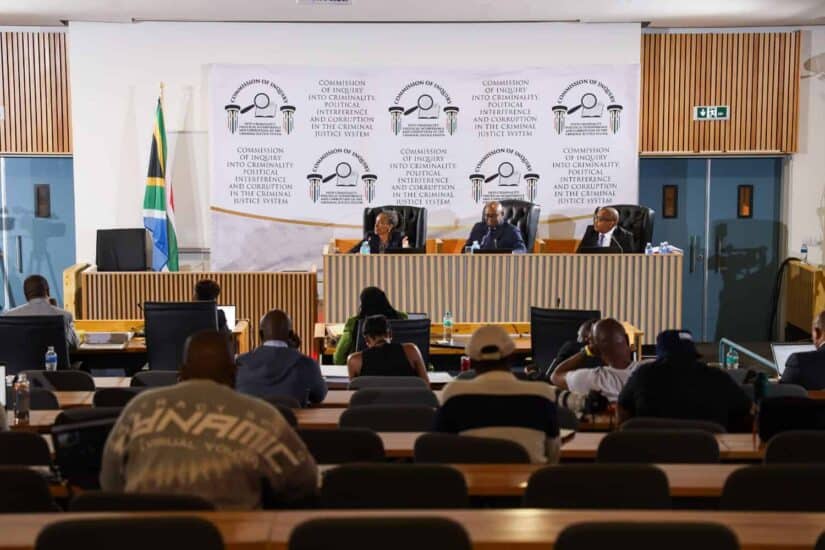
General overview at the Madlanga Commission of Inquiry at Brigitte Mabandla Judicial College in Pretoria on 22 September 2025. Picture: Gallo Images/Luba Lesolle


The Madlanga Commission of Inquiry into Criminality, Political Interference and Corruption in the Criminal Justice System’s evidence leaders have applied to have a key witness’ evidence heard in camera, citing risks to national security and informant safety.
In papers filed on 1 October 2026, the Commission’s evidence leaders requested that the testimony of Witness S, a former Crime Intelligence officer, be kept out of public view.
Affidavit
The application, supported by a founding affidavit from attorney Geraldine Burger of Diale Mogashoa Inc., argues that the witness’ evidence involves sensitive undercover operations targeting organised crime syndicates that infiltrated the South African Police Service (Saps).
“Witness S will testify in relation to undercover Crime Intelligence operations with which he was involved as a Crime Intelligence officer, and which involved an attempt to gather information on an organised crime syndicate which had infiltrated the Saps,” Burger stated in her affidavit.
Classified records
The Commission confirmed that the bulk of the evidence will rely on declassified records of undercover operations.
It said that while the Commission cleared these records for use, they are not authorised for public dissemination.
“Unless he is to testify in camera, it will not be possible for him to give most of the evidence that the evidence leaders want him to give,” Burger explained.
Warning
She warned that public testimony could expose the identities of SAPS informants embedded in syndicates.
“Should the identity of the informants be disclosed, their physical safety and possibly their lives will be put at risk,” the affidavit reads.
Legal framework
The application relies on Rules 4.2 and 4.3 of the Commission’s governing rules, which empower Chairperson Mbuyiseli Madlanga to order hearings in camera and prohibit disclosure of a witness’s identity.
The evidence leaders asked that transcripts, recordings and documentation from the hearing be treated as confidential, with attendance restricted to those specified by the Chairperson.
In line with procedure, the Commission’s attorneys notified media houses of the application and gave them 72 hours to oppose. The Chairperson will consider any opposition before issuing a ruling.
Witness S
Witness S is scheduled to appear before the Commission on 7 October 2026. If the application succeeds, the Commission will hear his testimony behind closed doors, with only Commissioners, evidence leaders, and authorised attorneys present.
The Commission, established after Lieutenant General Nhlanhla Mkhwanazi made allegations public in July 2025, is probing deep‑seated criminality, political interference, and corruption within South Africa’s criminal justice system.