


SADC officials are due to meet in Durban in August to discuss industrial advancement, as well as political, defence, safety cooperation.
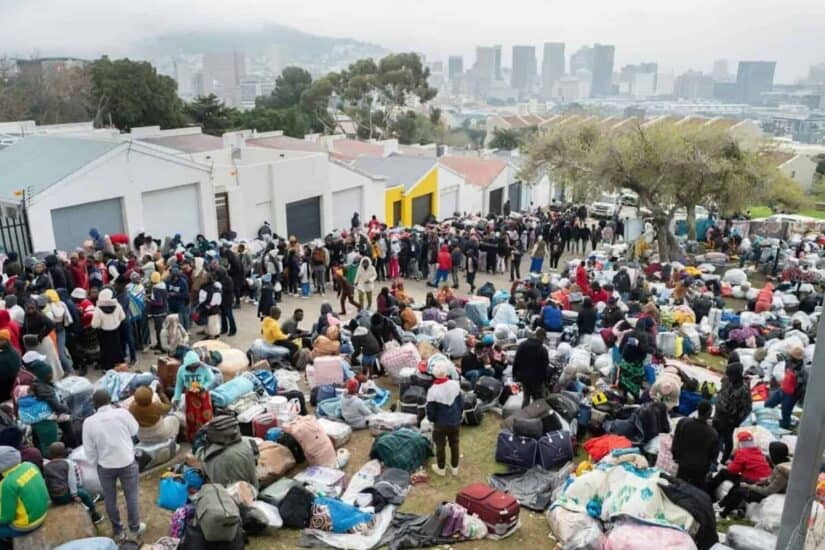
Hundreds of Zimbabwean migrants gather at the Zimbabwean Consulate in Cape Town, 27 June. Picture: Rodger Bosch / AFP


The most pressing issue currently facing the Southern African Development Community (SADC) has not yet been added to the agenda of its August summit.
Tensions over illegal immigration have yet to dissipate as migrants continue to pour out of South Africa in response to widespread protests in the country.
Member states are due to meet in Durban next month for the 46th SADC Summit, with the Department of International Relations and Cooperation (Dirco) stating on Monday that the issue was not tabled for discussion.
‘Solution orientated discussion’ needed
Tebogo Seokolo, deputy director general (DDG) of Dirco’s Africa branch, on Monday gave a preliminary briefing on the summit to be hosted in Durban for several weeks in August.
When asked if the issue of migration could cast a shadow over the summit, Seokolo said the annual conference was focused on the broader issues that fuelled migration.
He explained that the economic factors would be central to the work of diplomats, but reiterated that addressing the issue of migration had not been allocated dedicated time or resources.
“South Africa has indicated its readiness to engage with its partners. There has been a greater understanding in the region about that.
“We are quite confident that at a point when there is a discussion on migration, it will be a solution orientated discussion and a discussion that will ensure that in the final analysis, unity in the region is solidified,” said Seokolo.
SADC heads of state will meet on 17 August, with associated meetings and side events beginning from 27 July.
Industrialisation key
The theme at the 46th SADC summit will be centred around resilient, sustainable and inclusive industrialisation.
Seokolo noted that the varying levels of industrialisation of SADC member states was central to the migration issue.
He expressed South Africa’s desire to see all SADC members show growth and development, highlighting the areas identified as having the greatest potential for advancement.
SADC’s development policies had stipulated the focusing of investment into the automotive, agriculture, mining and pharmaceuticals sectors.
Seokolo added that international partners had pledged $160 million for industrialisation, and that South Africa’s Industrial Development Corporation (IDC) and the Development Bank of South Africa (DBSA) were engaging with other development finance institutions in the region to boost efforts.
“It is about increasing, enhancing and accelerating the implementation of the identified national value chains.
“The value chains are not only about projects in one country. We are looking at those projects that are cross-border,” the DDG said.
‘Political commitment’
South Africa prematurely took over as SADC chair last November after Madagascar relinquished the position due to political instability.
South Africa was already the deputy chair, and was also appointed to take over from Madagascar following the conclusion of August’s summit.
Other key features of the summit include the assessment of the 2030 regional development plan, a finance committee meeting, a public lecture at the University of KwaZulu-Natal, as well as politics, defence and security cooperation meetings.
“Our ministers instructed us that we should identify high-impact projects that will advance our regional integration.
“What is important is that SADC is a community and its success will depend on the highest level of political commitment,” Seokolo stated.



