


The institution faced what she called a 'skills catastrophe'.
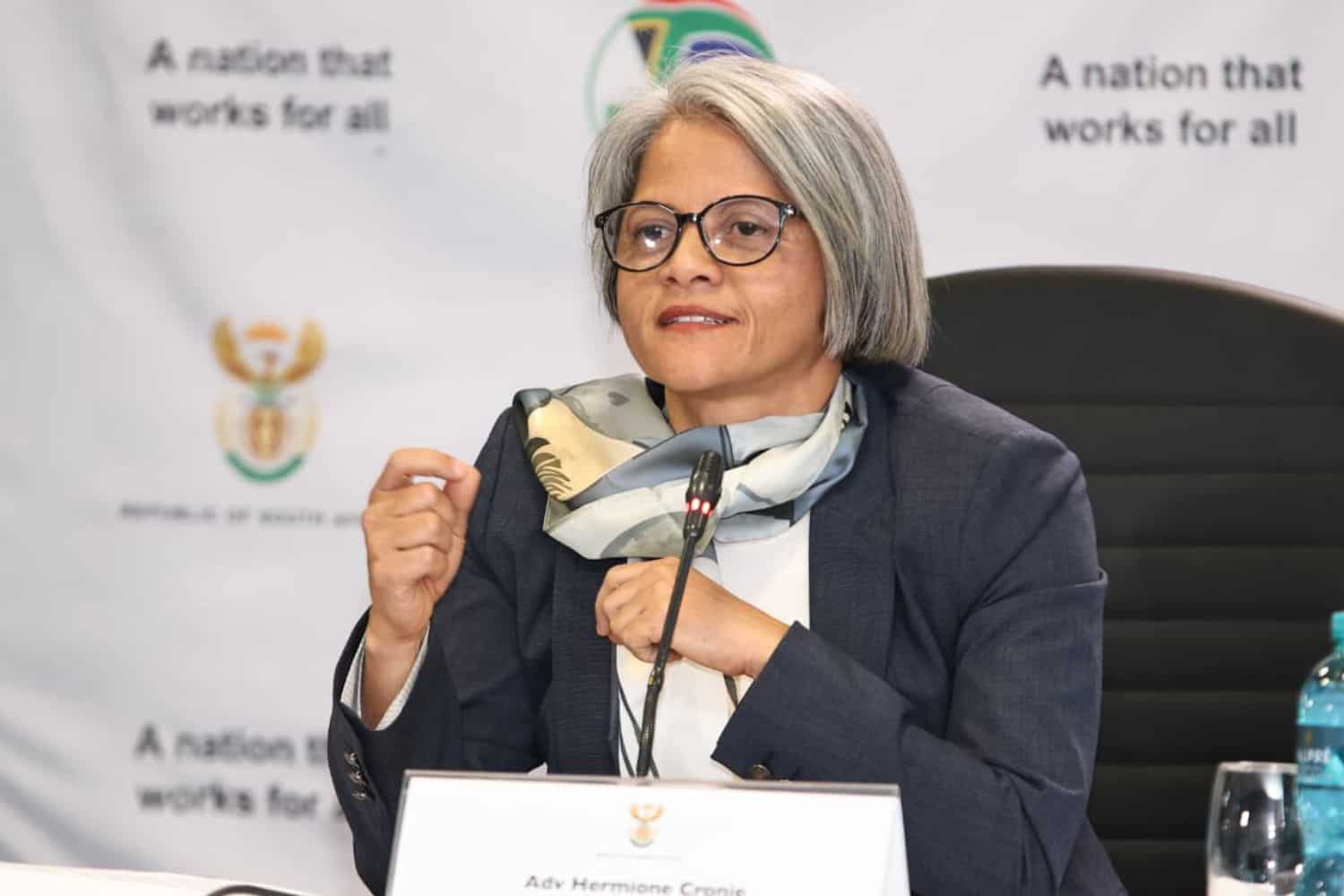
Former Investigating Directorate (ID) head Hermione Cronje during her National Director of Public Prosecutions (NDPP) interview on 11 December 2025. Picture: GCIS


Former Investigating Directorate (ID) head Hermione Cronje on Thursday revealed that she had long aspired to lead the National Prosecuting Authority (NPA) as National Director of Public Prosecutions (NDPP).
But she described severe internal dysfunction at the institution — problems that she says ultimately pushed her out of the NPA twice.
Cronje appeared as the fifth candidate on day two of the interview process in Pretoria to select a successor for current NDPP Shamila Batohi, who will retire in January 2026.
ALSO READ: NDPP interviews: Kubayi says DA’s interdict ‘misguided’ amid concerns over Menzi Simelane
She officially left the ID — now known as the Investigating Directorate Against Corruption (Idac), a permanent NPA unit — in March 2022.
Her initial appointment took place in May 2019, but she resigned in December 2021.
Cronje’s history with the NPA goes back decades, with her working under former NDPP Bulelani Ngcuka, helping establish the Asset Forfeiture Unit (AFU), and eventually serving as the AFU’s Western Cape head.
Hermione Cronje interviewed for NDPP post
During her interview, Cronje recalled being involved in the NPA’s creation in 1998 after Ngcuka recruited her while they were both working in Parliament.
“What it gave me was an incredible vantage point,” she said.
Even then, she envisioned a future as NDPP.
“I enjoyed very much working with Bulelani, but I also thought if I am going to national director one day, I’m going to have to get some legal experience.”
According to Cronje, the NPA entered a turbulent period around 2010, worsened by the dissolution of the Scorpions.
She claimed that state capture within the NPA began that same year, driven by questionable appointments.
READ MORE: NPA struggles with high-profile corruption cases
She said it was “unusual” that then-NDPP Menzi Simelane and his deputy, Nomgcobo Jiba, sat on interview panels for junior prosecutors.
“I couldn’t understand the purpose of this, but as the interviews unfolded it was very clear to me that the purpose was to appoint people loyal to what they considered their faction.”
Cronje told the advisory panel she resigned from the NPA in March 2011 for professional reasons.
“When I left the NPA, it was very hard.”
Watch the NDPP interviews below:
She explained that she had wanted to step down earlier after Simelane instructed her to withdraw an AFU preservation order — even though a court had provisionally found the unit had a strong case.
She eventually served out an outstanding sabbatical period before leaving in 2012.
Although she sensed the “writing on the wall” regarding the NPA’s capture, Cronje remarked that she did not anticipate the depth of decline she would witness when she returned in 2019.
Cronje’s return to lead ID
Cronje revealed that she was in Tanzania when Batohi phoned and asked her to consider leading the newly established ID.
“I was certainly not convinced,” she said, though she admitted she found the opportunity appealing.
She had been working internationally in advisory roles, and the ID position offered her a chance to implement reforms she had long advocated elsewhere.
She told Batohi she could only commit for a limited period.
“It was agreed with the national director that I could do it for a few years.”
READ MORE: NDPP interviews: Idac boss Andrea Johnson questioned over ethics complaint
At the time, her children were young, and she did not want to uproot them to Pretoria.
“I would disrupt them from their routine, but then not be available to support them in settling here.”
This meant constant travel between Cape Town and Pretoria — an arrangement that was difficult personally but not, she stressed, the reason she resigned again in 2022.
“I left for professional reasons. I left because I found that the space wasn’t there for me to implement things that I thought should be implemented.”
NPA dysfunction
She said she tried to confront the dysfunction within the NPA, but was instead accused of being negative.
“So I was in an organisation where there was a narrative that everything is fine now in the NPA since the capturers left.”
This, Cronje emphasised, did not reflect her own experience.
She said the institution faced what she called a “skills catastrophe”.
“I still believe that, but that doesn’t mean there aren’t very good people in the NPA with very good experience.”
According to Cronje, the results of an NPA skills audit were never published because they were “depressing”.
“We thought it would just demoralise the staff if we released them.”
READ MORE: Who’s vying for NPA top job alongside Simelane? What you need to know about the candidates
She then requested a second skills audit, highlighting ongoing concerns about the organisation’s capacity.
“We’ll have to speculate if we have to talk about how many people in the NPA have the ability to cross-examine effectively,” she said.
She remarked that “everything in the NPA was a fight”.
Cronje added that she was branded “problematic” and faced constant obstacles.
“It was very exhausting and frustrating because on the one hand you are trying to build case and on the other hand you have nothing.
“You have no staff, no infrastructure, no budget, just generally no support.”
She admitted she did not have direct prosecutorial experience in her career, but argued that mentorship at the bar council and private practice gave her trial exposure in the high court.
Leadership style and complaints
When questioned about her management approach, Cronje said she is typically seen as someone who delivers results.
“There may be some bodies in the wake. I am a kind of person when the chips are down, I’m over focused on the outcome and there may be some casualties in the process.”
She described herself as a manager determined to identify and resolve core problems.
Cronje confirmed that she has never been suspended or formally charged.
However, after leaving the NPA in 2022 and joining Open Secrets, she faced two complaints.
Both private investigator Paul O’Sullivan and Batohi accused her of unlawfully sharing ID-acquired state capture information with her new employer.
O’Sullivan also threatened criminal charges.
“There was very little about state capture that wasn’t already in the public domain. I think that people didn’t like the accountability work that was coming out of Open Secrets and it was just an intimidation tactic.
“It didn’t go any further. I did get called by journalists saying are you breaking the law or something?
“And I explained, but the board I think wrote back to both parties [O’Sullivan and Batohi] and said they didn’t see that there was any merit.
“But if they felt there was a crime being committed, they should certainly report it to the authorities. I don’t know that a case was ever opened.”
Cronje’s concerns about NPA’s independence
Cronje said she didn’t “run away” from the NPA when she left.
She emphasised that legislation needed to be amended to allow the NDPP to discipline DPPs, with the president’s involvement, and warned that if this change did not occur, she would not remain in the role because she wouldn’t be able to achieve her objectives.
“I have no intention of sticking around if there is no space for me to implement what I think needs to be implemented.”
She added that her departure from the NPA came with the understanding that she and Batohi did not align.
Cronje also raised her concerns about the NPA’s independence and the institution not having control over the budget with the justice minister and the president prior to her resignation.
“I have a vision and I would to have that vision implemented. If I find that government has no interest in implementing that, I’m not going to be here for 10 years battling the door down. But I’ll certainly give it my best effort.”
NOW READ: Shamila Batohi’s been in the job for 6 years. Here’s how many high-profile convictions she’s secured
Support Local Journalism
Add The Citizen as a Preferred Source on Google and follow us on Google News to see more of our trusted reporting in Google News and Top Stories.

