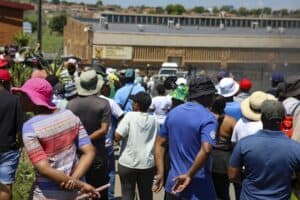
Citizens march for enforcement of rule of law, not hatred.

Herman Mashaba, ActionSA Leader. Picture: Gallo Images/Luba Lesolle


There is a reality that deeply troubles me: 32 years into democracy, many South Africans are being labelled xenophobic, intolerant and even criminal, simply because they are demanding that the laws of this country be enforced.
How did we get here? How did we arrive at a point where poor and unemployed South Africans are treated as perpetrators for raising concerns about illegal immigration, while the government that has failed them for decades escapes accountability? South Africa has a proud history of protest.
Historical protests
In 1956, courageous women marched against the pass laws that sought to control and dehumanise black people.
On 21 March 1960, our people were massacred for demanding the abolition of the pass laws.
In 1976, young people took to the streets to reject an unjust education system and the imposition of Afrikaans as a medium of instruction.
Throughout our democratic journey, citizens have organised, marched, and spoken out whenever the government has failed to listen.
Today, a new generation is marching. They are not marching because they have jobs and opportunities waiting for them.
New generation following suit
They are not marching because the government has delivered on the promise of a better life for all. They are marching because millions remain unemployed.
They are marching because many communities have been abandoned. They are marching because drugs continue to destroy young lives while the government appears incapable of confronting the criminal networks responsible.
They are marching because they feel unheard. And yet, instead of engaging them, many political leaders have chosen to insult them.
The message from these South Africans is simple: the law must apply to everyone.
Action against illegal immigrants
If someone is legally in South Africa, their rights must be protected. If someone is in South Africa illegally, the law must also be applied. This should not be a controversial position.
No sovereign nation can function without secure borders and a credible immigration system. No country can ignore the distinction between legal and illegal entry.
The demand for the enforcement of immigration laws is not extremism. It is not hatred. It is not xenophobia. It is a legitimate public policy concern in every functioning democracy.
What concerns me most is the government’s growing tendency to dismiss citizens rather than listen to them.
Peaceful marches
The people participating in these marches are overwhelmingly peaceful. They are exercising constitutional rights that generations before them fought and died to secure.
Rather than threatening citizens, the government should be asking: Why are so many people marching? Why are the numbers growing? Why are thousands of South Africans sacrificing their time? When millions of young people cannot find work, when communities are overwhelmed by crime and when citizens feel that the state is absent, the government cannot simply lecture them about social cohesion while refusing to address the underlying problems.
President Cyril Ramaphosa has repeatedly spoken about the rule of law. I agree with him on one point: South Africa must be governed by the rule of law.
‘Rule of law cannot be selective’
But the rule of law cannot be selective. Ramaphosa cannot invoke the rule of law when citizens demand action, while failing to provide clear answers on controversies that have raised serious public concern, including the Phala Phala matter.
South Africans have not forgotten the dollars hidden inside furniture on a private farm, nor have they forgotten the allegations surrounding undocumented foreign workers on that property.
The rule of law cannot be something that applies only to ordinary citizens while political elites expect a different standard for themselves.
South Africans deserve a plan
More importantly, the rule of law requires the state to enforce immigration legislation consistently and transparently.
What South Africans deserve is not another lecture. What South Africans deserve is a plan.
The government must present a credible, practical, lawful strategy for identifying undocumented migrants, processing cases efficiently, strengthening border management and ensuring that those who do not have the legal right to remain in South Africa are dealt with according to the law.
For too long, the government has treated the symptoms while ignoring the disease. The real crisis is not that South Africans are speaking out. The real crisis is that millions of South Africans feel they have no choice but to do so.