Didiza won't oppose Ramaphosa's interdict, with opposition parties slamming her decision.
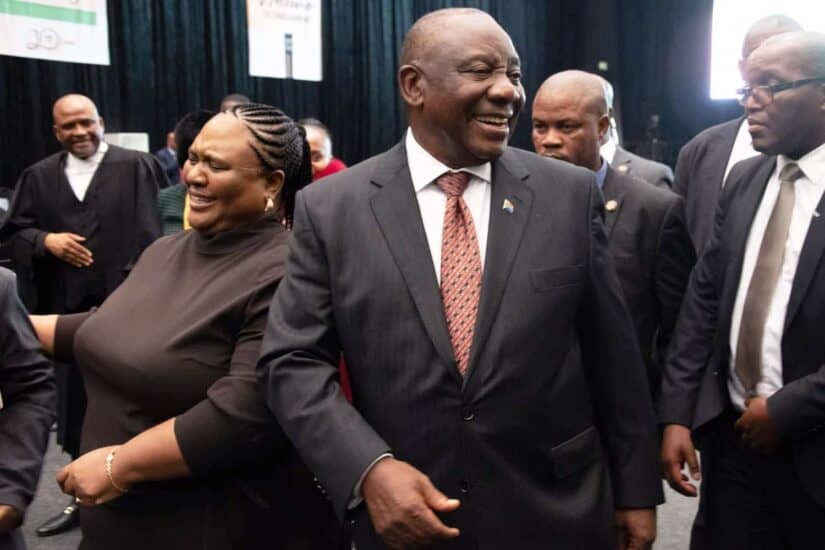
National Assembly Speaker Thoko Didiza and President Cyril Ramaphosa at the Cape Town International Convention Centre (CTICC) on 14 June 2024. Picture: Gallo Images/Jeffrey Abrahams


President Cyril Ramaphosa has defended Speaker of Parliament Thoko Didiza’s stance, insisting she is acting independently and in strict accordance with the constitution by choosing not to oppose his urgent application to interdict the impeachment committee.
Didiza said on Friday that she won’t oppose Ramaphosa’s attempt to interdict the impeachment committee from proceedings, with opposition parties slamming her decision.
Opposing Ramaphosa
Her decision follows the impeachment committee’s decision to oppose Ramaphosa’s application.
The 31-member committee resolved to take action on Thursday, after MPs were advised by an independent legal expert.
Defending Didiza
Ramaphosa, speaking to the media on the sidelines of an ANC voter registration campaign in Kwa-Thema, Ekurhuleni, over the weekend, said Didiza has “to do her work.”
“The speaker of Parliament has to do the work that she has to do. She’s independent, and we don’t bring any influence to bear on her, and that is where the separation of powers comes into play.
“The State, as you well know, is composed of the executive, which is led by the president, by Parliament, the National Assembly, which is led by the speaker and the Judiciary, which is led by the Chief Justice.
“So, those three must act independently. So, we subscribe to that, and we know that when the speaker takes a decision, she is taking a decision in accordance with the principle of a separation of powers,” Ramaphosa said.
Interdict
Ramaphosa approached the Western Cape High Court, seeking an urgent interdict while he challenges the Section 89 Independent Panel’s report, seeking to prevent the start of an impeachment inquiry until his separate review application against the report has been finalised.
The president decided to revive a judicial review of the Section 89 Independent Panel Report after the Constitutional Court (ConCourt) sent the report on the Phala Phala scandal back to parliament earlier this month, paving the way for an impeachment process against Ramaphosa to proceed.
Didiza
Didiza opted not to oppose Ramaphosa’s bid to halt the impeachment process and instead filed a notice to abide by the court’s ruling.
The speaker said her decision is neither inconsistent nor in conflict with the impeachment committee, which is opposing Ramaphosa’s interdict attempt.
Diza will also submit an explanatory affidavit saying this route will allow her office to help the Western Cape High Court.
The affidavit will explain the considerations Parliament took into account when implementing the Constitutional Court judgment.
Opposition parties
However, opposition parties slammed Didiza’s move, calling it a partisan decision on behalf of the ANC.
Ramaphosa’s interdict application will be heard in the Western Cape High Court on the 15th and 16th of July.
ActionSA condemned the decision as untenable, arguing that Didiza is prioritising the political protection of an ANC colleague over her constitutional duty to defend Parliament.
The ATM accused Didiza of “dereliction of duty” and acting to shield Ramaphosa by ignoring legal advice that instructed her to directly oppose the application
ATM Parliamentary leader, Vuyo Zungula, said Didiza failed Parliament by refusing to oppose Ramaphosa’s bid to halt impeachment proceedings.
Zungula has labelled her decision a “dereliction of duty and wasteful expenditure.”
[ICYMI] ATM Parliamentary leader, Vuyo Zungula, says Thoko Didiza has failed Parliament by refusing to oppose Cyril Ramaphosa’s bid to halt impeachment proceedings. Zungula has labelled her decision a dereliction of duty and wasteful expenditure.
– Newzroom Afrika (@Newzroom405) June 21, 2026
Watch: https://t.co/GXpx0NhnLF… pic.twitter.com/f1y3iEXXlF
MK party
The MK party also rejected Didiza’s decision.
“The MK party believes this decision is deeply concerning because it risks weakening Parliament’s constitutional duty to hold the executive accountable. The National Assembly has a responsibility to protect its processes and ensure that accountability mechanisms are not undermined.
“The MK party warns that Speaker Didiza must be careful not to go against the course of history. History has a way of harshly judging those who, at critical moments, fail to defend constitutional principles, accountability, and the integrity of democratic institutions,” the party said.
EFF
The EFF condemned her decision as “reckless, irrational, and irresponsible”, saying Didiza’s decision represents a “shameful abdication of constitutional responsibility” and ignores established precedent intended to protect Parliament’s integrity and independence.
DA spokesperson Jan de Villiers said the party believes the Constitutional Court has stated that the committee must do its work, and “therefore, we support the legal opinion given to the committee that Parliament must oppose that application.”
Parliament legal opinion
An urgent legal opinion requested by parliament’s impeachment committee last week recommended that the panel oppose the court application.
The opinion stated that if the committee chose not to oppose Ramaphosa’s application, it should still file an explanatory affidavit to assist the court in adjudicating the matter.
According to the opinion, the impeachment committee has a constitutional and legal obligation to comply with the Constitutional Court order that referred the report to the committee for consideration and possible implementation.
Legal battle
The High Court has scheduled the review application to be heard between 2 and 4 September, with opposing parties required to file notices of motion by 7 July.
In his court papers, Ramaphosa maintained that urgent intervention is necessary.
He argued that without the interdict, the impeachment committee could begin its work before the courts had had an opportunity to rule on the validity of the panel’s findings.
The legal developments follow a ConCourt ruling in May, which found that parliament had acted unlawfully when it blocked impeachment proceedings against Ramaphosa in December 2022.
As a result, the National Assembly was compelled to establish a formal impeachment committee to investigate the allegations further.