With 95% of India trade by sea IORA members target radar networks white shipping pacts and stronger crisis response capacity.
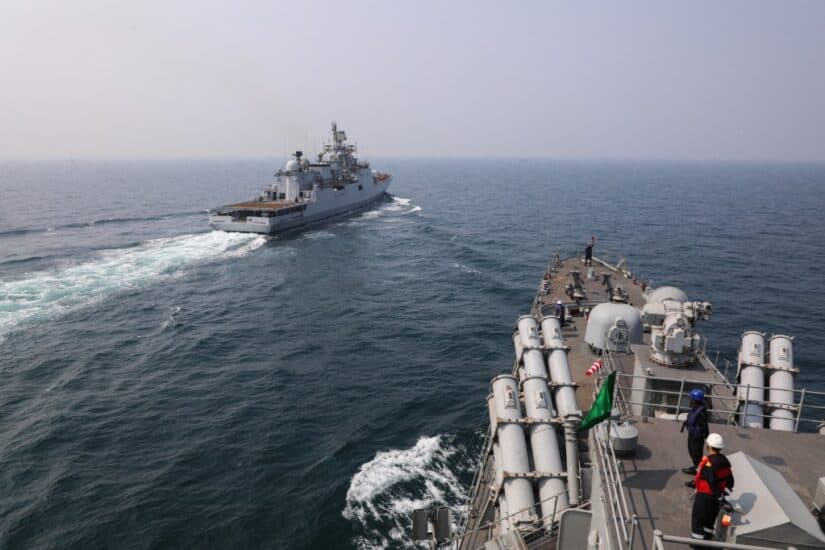
Warship INS Beas moves close to warship INS Trikand during a media day at sea event in Mumbai, India, 03 November, 2023. (Photo by Niharika Kulkarni/NurPhoto) (Photo by Niharika Kulkarni / NurPhoto via AFP)


Regional cooperation across the Indian Ocean Rim (IOR) has taken on new urgency as global economic volatility intensifies and conflict in the Middle East disrupts trade and energy markets.
This was the core message at the 10th Indian Ocean Dialogue in New Delhi on 7 and 8 May, where members of the Indian Ocean Rim Association (IORA), including India and South Africa, called for stronger regional solidarity and collective action in maritime safety, security and the blue economy.
Held under the theme, Indian Ocean region in a transforming world, the dialogue focused on security challenges and the need for closer cooperation as geopolitical tensions rise.
The Indian Ocean Rim, which links Asia, Africa and Europe, has become one of the world’s most strategically significant regions. IORA, comprising 23 littoral states and 12 dialogue partners, including China, Russia, Saudi Arabia and the United States, is shaping a new era of maritime multilateralism.
At a time of intensifying rivalry between major powers, particularly China and the US, IORA offers small and middle powers an important platform to avoid being drawn into geopolitical contests.
It provides a diplomatic and economic middle ground for countries seeking cooperation without choosing sides, resulting in the region evolving from a peripheral maritime space into a central arena of geopolitical and geo-economic competition.
The region’s challenges are diverse and growing. Several member states, including countries such as Bangladesh, face economic constraints while contending with non-traditional maritime threats such as trafficking, piracy, armed robbery at sea and drug smuggling.
Illegal, unreported and unregulated fishing is undermining food security and eroding coastal economies.
Climate change, which is intensifying floods and extreme weather events, adds another layer of vulnerability. At the same time, limited regional information sharing and inadequate maritime surveillance hamper effective responses.
India, as the current IORA chair, set the tone at the dialogue by reaffirming its commitment to a “peaceful, stable and prosperous Indian Ocean Region” under its Mutual and Holistic Advancement for Security and Growth Across Regions vision.
Discussions highlighted the far-reaching consequences of the Middle East conflict, which has transformed parts of the Indian Ocean into a volatile theatre marked by supply chain disruptions, piracy and smuggling.
Panellists called for a more multipolar regional order supported by expanded coastal radar networks, stronger white shipping agreements and enhanced capacity for countries to act as first responders during crises.
A persistent obstacle is the limited funding and operational capacity of many member states to monitor this vast oceanic expanse. For both India and South Africa, the Indian Ocean is central to national security and economic prosperity.
It carries 95% of India’s trade by volume and supplies 70% of its oil imports. It is, therefore, indispensable for India’s energy security and for protecting critical maritime chokepoints from strategic competition and terrorism, piracy and smuggling.
South Africa’s coastline, extending from the Atlantic to the Indian Ocean, serves as a crucial corridor for international trade, linking the Middle East, Africa, and East Asia.
The IOR is a key focus for South Africa’s economy and maritime security. It offers crucial fishing resources that support millions of livelihoods and IORA is a platform for both India and SA to boost initiatives to enhance their blue economies and increase security to protect trade routes and focus on sustainable use of ocean resources.
Through Operation Phakisa, Pretoria is seeking to unlock the economic potential of its oceans while reducing poverty, boosting trade and supporting efforts to integrate climate resilience into regional maritime strategies.
The conflict involving Iran has further underscored IORA’s strategic importance. Its impact on oil prices, shipping routes and investor confidence has affected all 23 member states, though to varying degrees. India, with its heavy dependence on Middle Eastern energy supplies, is particularly exposed.
SA has seen some short-term gains as shipping traffic has been redirected to ports such as Cape Town, Durban and Ngqura. But these benefits are outweighed by the economic fallout from higher fuel costs and global market instability.
In an uncertain world, the Indian Ocean is not just a transit corridor. It is a strategic lifeline. For countries such as India and SA, stronger cooperation through IORA is essential to safeguarding trade, securing energy supplies and building a more resilient and prosperous region.