That run-down slum in Trafalgar Square is just another symptom of what more than three decades of ANC governance have cost us.
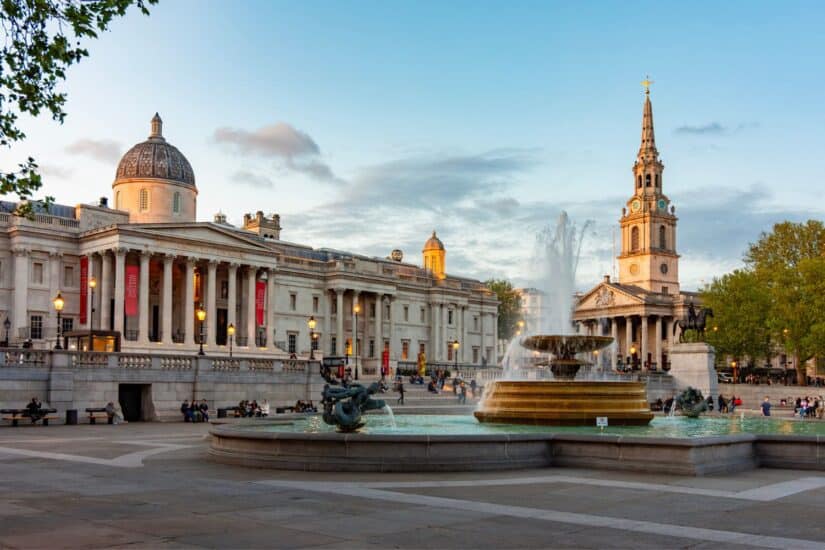
Image: iStock


We have no diplomatic mission more emblematic of this nation’s international stature and aspirations, than South Africa House on Trafalgar Square.
The arc of its existence over almost a century mirrors our global standing, from a respected player to posturing pretender.
This week, the DA revealed that South Africa House has been shuttered by the department of international relations and cooperation (Dirco) because it is no longer fit for purpose.
The roof leaks, the wiring sparks. After years of neglected maintenance, the façade is crumbling, the heating system is broken, and the water supply is intermittent.
Oh, and there is apparently a persistent smell of urine.
Landmark at the heart of London
Designed by Sir Herbert Baker and opened in 1933, this imposing edifice dominates the eastern flank of the square.
Opposite stands Canada House, while to the north it is the hulking National Gallery. The building’s fantastical, gilded, flying Springboks gaze past Nelson atop his towering column, through Admiralty Arch, and down The Mall toward Buckingham Palace.
To the south lies Whitehall, the centre of government. Despite Britain’s much diminished role in the world, this remains one of the most iconic diplomatic addresses that any country could possess.
A building that witnessed history
It also encapsulates many of the contradictions of our turbulent history. Jan Smuts, who played a leading role in the Anglo-Boer War, lived there for stretches during World War II, overseeing SA’s military support to his former foe.
From there, too, he worked on his visionary project, the creation of the United Nations. Some four decades later, South Africa House became the stage for a different struggle.
For years, it was the site of a non-stop vigil against apartheid, helping to keep pressure on the National Party government.
How fitting, then, that in 2001 Nelson Mandela should stand on its balcony and address a rapturous crowd of 20 000 people.
Mandela told them: “I’m happy to be in Trafalgar Square where the most important battles for liberating South Africa were fought.”
From pride to political revisionism
I remember in the early 2000s attending a function there hosted by Cheryl Carolus, then former High Commissioner to London, took a group of us through the impeccable reception rooms, enthusing about its priceless treasures.
The spaces held Anton van Wouw sculptures, and magnificent murals of JH Pierneef, interspersed with works by new black artists.
In 2012, diplomats at the High Commission complained the art was a jarring reminder of SA’s history. They demanded that “offensive” paintings be removed.
As a compromise, and the supposedly objectionable works were screened from view by movable panels. By now, no doubt, some of the “art of the oppressor” is likely to have vanished entirely, “liberated” by crooked cadres. Rising damp can be relied upon to do the rest.
Broader national decline
Ryan Smith, the DA’s spokesperson on international relations, says repairs to South Africa House will cost just under R70 million. But South Africa House is by no means the only one that has fallen into ruin.
The embassy in The Hague has been closed as an unsafe eyesore. In Bonn, the mission has long been abandoned.
So that run-down slum in Trafalgar Square is just another symptom of what more than three decades of ANC governance have cost us.
One feels only shame at how blithely they allow the remarkable achievements of our past to be erased through indifference.
For those of us who can remember that it was not always like this, it is heartbreaking.