A landmark settlement agreement has been reached between Southern African Agri Initiative (Saai), Free State Agriculture, Sake Liga and the department of agriculture for the distribution and administration of FMD vaccines.
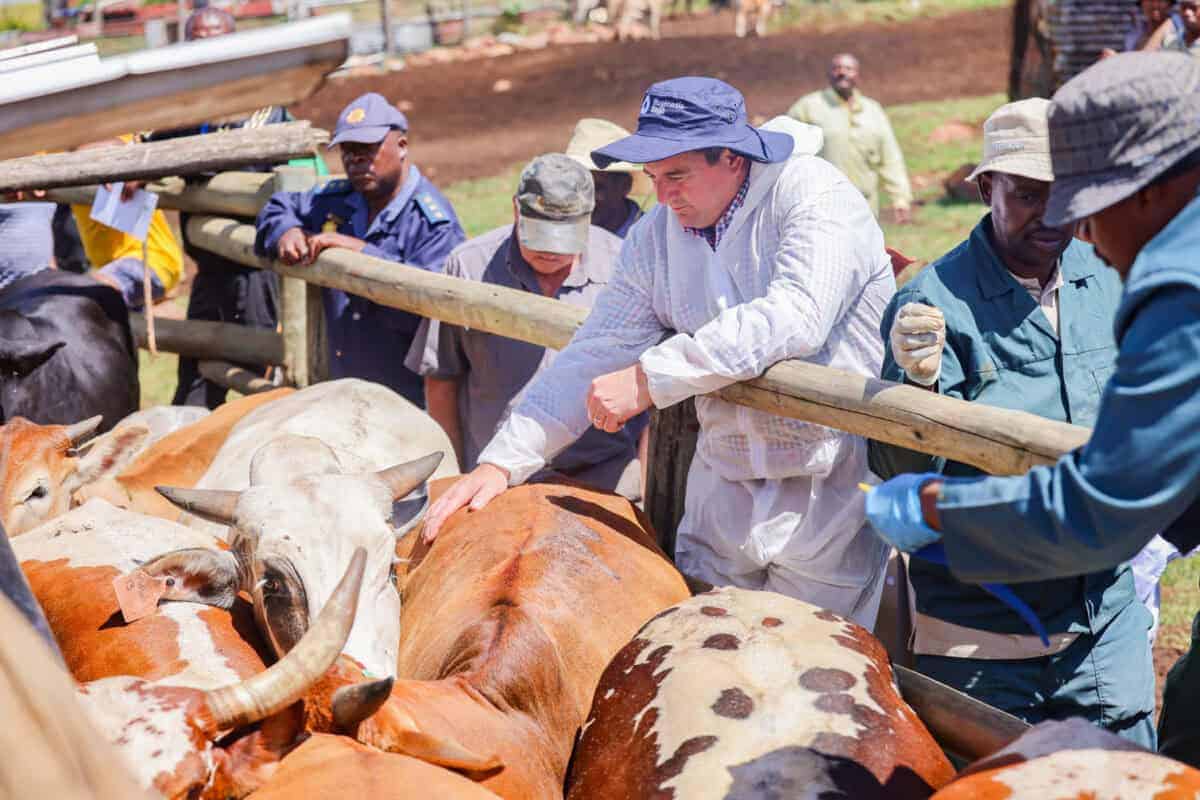
Agriculture Minister John Steenhuisen at the mass vaccination against foot-and-mouth disease (FMD) roll-out outreach at Magagula Heights in Katlehong on March 07, 2026 in Ekurhuleni, South Africa. Picture: Gallo Images/OJ Koloti


Farmers are finally able to vaccinate their own herds following a new settlement agreement for the private sector to procure foot-and-mouth disease (FMD) vaccines.
Last week, the Southern African Agri Initiative announced that a landmark settlement agreement has been reached between Southern African Agri Initiative (Saai), Free State Agriculture, Sake Liga and the department of agriculture for the distribution and administration of FMD vaccines.
Saai CEO Francois Rossouw said the deal brought about several important changes that will improve access to FMD vaccines.
“The state and Onderstepoort Biological Products will no longer hold a monopoly on the import and distribution of FMD vaccines,” he said.
Rossouw added private companies were now permitted to import and deliver vaccines directly to farmers. Livestock owners can also be registered as authorised persons to administer vaccines themselves.
“The agreement further reduces unnecessary bureaucracy by shortening the time required for Section 21 applications and import permits, to create the shortest possible route between the harbour and the cattle.
“The agreement takes effect immediately and will be made an order of court,” he said.
“While the government will continue to fulfil its role by managing outbreaks and providing vaccines to farmers who cannot afford them, producers can now purchase vaccines through private channels.”
Rossouw said the objective was to conduct two intensive national vaccination campaigns two to three months apart, during the remainder of this year.
“Thereafter, routine vaccinations every six months will continue until South Africa meets the international criteria to regain FMD-free status,” he added.
TLU chair Bennie van Zyl said farmers were grateful.
“New Minister of Agriculture Willie Aucamp’s approach is to sit around a table, sort things out and look at what is in the best interest of the sector,” he said.
Van Zyl said the sector had to get back to being able to export. This involves trading of livestock.
“We must realise one thing: the authority granted to the private sector to vaccinate places a huge responsibility on the sector and on every farmer. It is now time to take the bull by the horns,” he added.
Manager of environmental affairs at AfriForum Lambert de Klerk described it as a necessary step towards decentralising state control amid the FMD crisis.
“Aucamp, who facilitated the privatisation of vaccine procurement, played a critical role in a decision that should have been made months ago,” he said.
“The deal will now give farmers the opportunity to take personal responsibility for their herds. They will no longer watch helplessly as their farming operations collapse due to state incompetence.”
FMD Response SA spokesperson Andrew Morphew said according to the World Organisation for Animal Health at least 80% of cattle must be immune at the same time to stop the transmission of FMD.
“Vaccinating 80% of the country’s cattle by December, as previously proposed, will not achieve this simultaneous immunity and will not halt the spread of the virus,” said Morphew.
“Instead, most cattle need to be vaccinated within six to eight weeks, including the administration of booster doses for cattle vaccinated in February. This is an epidemiological necessity.”