Pressure is mounting for a credible fiscal rule to rein in spending.

It will be important for Finance Minister Enoch Godongwana ‘to be specific about what will be included in the fiscal anchor’. Picture: Betty Laura Zapata/Bloomberg


Talk around a fiscal anchor for South Africa has remained just that, and once again there is hope that Finance Minister Enoch Godongwana will put words into action when he delivers his Medium-Term Budget Policy Statement (MTBPS) in parliament on Wednesday (21 October).
A fiscal anchor is a financial rule that guides government on how much it can spend and how much debt it can take on.
There is general consensus that a fiscal anchor will be beneficial for SA to keep runaway spending and debt in check.
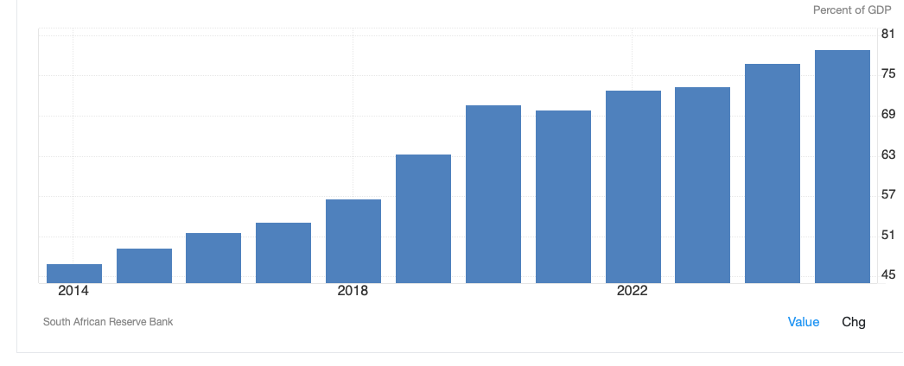
Debt-to-GDP currently stands at close to 77%
Source: South African Reserve Bank
In a January 2025 research note, the Bureau for Economic Research (BER) at Stellenbosch University set out four general types of rules:
- Debt rules, which set limits on debt-to-GDP ratios;
- Budget balance rules, which set targets for budget balances (normally expressed as a percentage of GDP);
- Expenditure rules, which set limits to public expenditure growth; and
- Revenue rules, which set targets for revenue collection, or limits tax the burden.
Most of these categories have different variations, most notably to adjust targets for economic cycles.
Empirically, fiscal rules have a mixed track record, writes researcher Robert Botha who prepared the research note for BER.
In the South African context, fiscal rules might be useful for building consensus around the need to improve fiscal credibility and sustainability going forward – especially during periods of “economic plenitude”, he adds.
Flexible vs hard anchors
Investec chief economist Annabel Bishop said in a recent podcast that credibility is improved if the anchor is flexible and not a hard anchor.
Typically, a hard anchor would be if government says the debt to GDP ratio should not exceed 80%.
Credibility is jeopardised when there is an economic crisis such as the Covid-19 pandemic or a global shock that causes an economic tsunami in SA and the target is adjusted too often.
Dawie Roodt, chief economist at the Efficient Group, says several countries have introduced some form of fiscal anchor.
The US has a nominal anchor where debt is limited to a certain amount, while some European countries have indirect fiscal anchors which provide for a combination of fiscal deficit and debt-to-GDP rules.
Roodt is in favour of a fiscal anchor for SA. He would prefer one that targets state spending-to-GDP and not only limits it to a specific level, but limits it to a lower level over time.
“Spending is eventually what drives the tax burden.”
The current preference appears to be a debt-to-GDP anchor with a specific target, and currently it looks like a debt-to-GDP ratio of 80%.
Roodt is not comfortable with this.
“What is debt really? Is it net or gross debt, and does it include debt of state-owned entities that is basically guaranteed by him [the minister of finance] and local government debt that is implicitly guaranteed by him.”
Roodt acknowledges that the same concern goes for a fiscal anchor targeting spending. It will therefore be important for Godongwana to be specific about what will be included in the fiscal anchor.
Political will
One lacuna of a fiscal anchor is that it can be adjusted.
“The Americans keep adjusting their nominal fiscal anchor and the Europeans simply ignore their fiscal anchors. In the end it all depends on political will,” says Roodt.
Bishop refers to having “crisis flexibility” built into a fiscal anchor when the country moves into difficult periods.
She is hopeful that Godongwana will spell out which way National Treasury will go when he presents the MTBPS.
Having flexibility will “strengthen our fiscal path” and she believes it will give credit rating agencies even more confidence in SA.
“It’s important to provide guidelines or guardrails, so that we know what we are trying to achieve.”
Keitumetse Sesana, a tax legislative policy expert, is also expecting feedback on efforts to curb wastage and an update on the Targeted and Responsible Savings (Tars) budget reform initiative.
“The MTBPS must show what has actually been saved and whether resources are reaching services and growth-enhancing investment.”
This article was republished from Moneyweb. Read the original here.